Patriot National Bancorp (PNBK): supplier relationships and what they mean for investors
Patriot National Bancorp operates as the holding company for Patriot Bank, N.A., a community bank that monetizes through traditional banking channels—deposit gathering, lending, and fee income—while supplementing capital needs with episodic equity and debt transactions such as registered direct offerings. Investors should treat PNBK as a small regional bank with constrained liquidity levers, elevated insider ownership, and a service model dependent on a mix of transactional advisers and operational third‑party providers. For a concise supplier-risk view and ongoing monitoring tools, visit https://nullexposure.com/.
How Patriot makes money and the supplier footprint that supports that model
Patriot is a classic community bank: interest income on a loan and securities portfolio combined with noninterest fee revenue from payment and account services. The company’s recent metrics reinforce that profile—modest revenue (approximately $15.6M trailing twelve months) and negative profitability (diluted EPS -9.35, negative ROE)—which translates to sensitivity to funding costs and occasional capital markets activity to shore up the balance sheet.
Operationally, this business model relies on two supplier classes:
- Transactional advisers and capital markets counterparties for episodic equity raises and financing (the June 2025 registered direct offering is a recent example).
- Ongoing service providers and correspondent banks that deliver critical infrastructure: check clearing, data processing, card processing, armored transport and short-term liquidity lines.
Company disclosures show the bank maintains third‑party arrangements for core operational functions and has formalized third‑party risk management (an individual has managed that program since 2021). Separately, Patriot has unsecured correspondent banking facilities that provided $5.0 million of borrowing availability as of December 31, 2024, down from $22.0 million the prior year—a clear signal of tightening contingency liquidity capacity. These are company-level signals drawn from Patriot’s own filings and public statements.
For a detailed supplier map and alerts for counterparties, see https://nullexposure.com/.
What the June 2025 offering announcement actually named
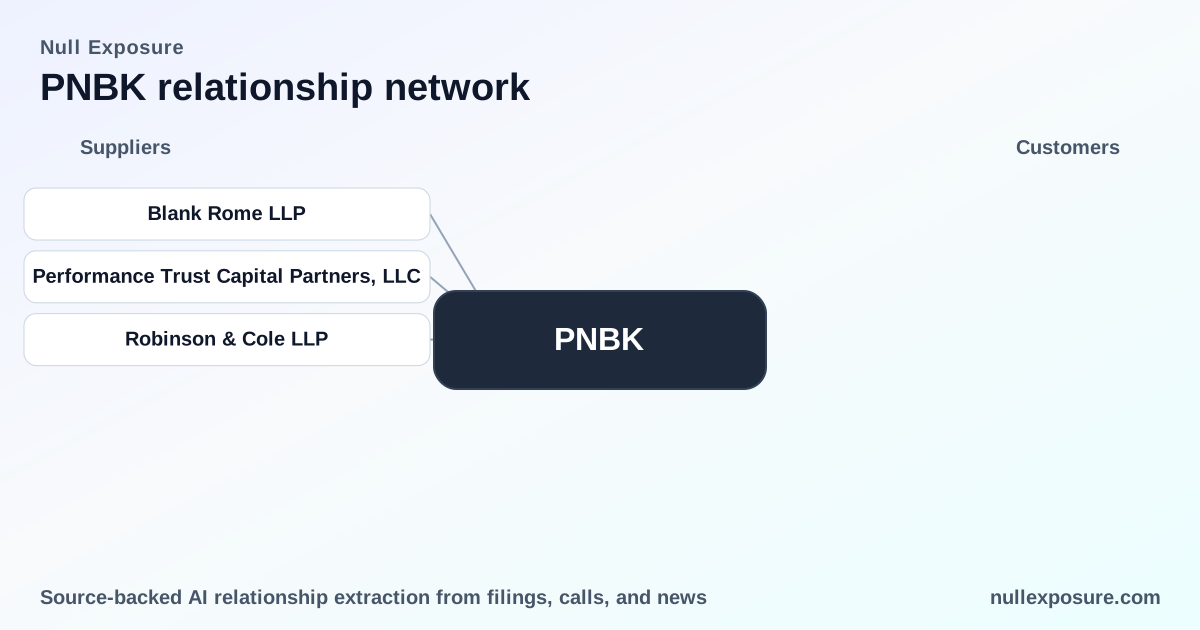
The company’s June 5, 2025 press release announcing completion of a $10 million registered direct offering identified three external firms involved in the transaction. Each relationship is transactional but relevant to assessing execution capability and advisory quality.
- Blank Rome LLP served as legal counsel to Patriot for the offering; this is the bank engaging external corporate counsel for deal documentation and compliance. (Source: GlobeNewswire press release, June 5, 2025.)
- Robinson & Cole LLP also served as legal counsel alongside Blank Rome, indicating Patriot engaged multiple law firms for the transaction’s legal work. (Source: GlobeNewswire press release, June 5, 2025.)
- Performance Trust Capital Partners, LLC acted as the capital markets adviser to the company, which is the firm responsible for structuring and placing the registered direct offering. (Source: GlobeNewswire press release, June 5, 2025.)
Each of these parties appears solely in the context of the capital raise in the public notice; they are important for execution credibility but are transactional rather than core operational vendors.
How supplier relationships and constraints shape operational risk
Patriot’s supplier posture combines transactional adviser engagements with ongoing operational dependencies. From the company-level disclosures:
- Contracting posture: The bank uses short‑term, transactional contracts for capital markets activity (legal counsel and placement agents) and maintains operational contracts for correspondent banking, check clearing, card processing, data services and armored transport. These operational contracts are the backbone of day‑to‑day banking services.
- Concentration and criticality: Legal and capital markets advisers are replaceable in the near term, but the bank’s correspondent and processing relationships are highly critical to maintaining deposit and payment flows; disruption would be impactful to customer service and liquidity management.
- Maturity and governance: The bank has formal third‑party risk management in place and reports an identified manager since 2021, signaling some institutionalization of vendor oversight. That governance reduces but does not eliminate counterparty execution risk.
- Liquidity constraints: Company disclosures indicate borrowings available under correspondent bank facilities fell to $5.0M at 12/31/2024 from $22.0M the year before, which compresses fall‑back liquidity and raises the importance of capital markets access and operational continuity.
These are company-level signals derived from Patriot’s own public disclosures and the June 2025 offering announcement.
What investors and operators should watch in supplier diligence
Focus diligence on areas that change the bank’s risk profile materially:
- Funding lines and correspondent relationships: Verify the identity, tenor, and renewal mechanics of correspondent lines; the reduction in available borrowings is a direct operational constraint. (Company disclosures as of December 31, 2024.)
- Continuity of core processing vendors: Confirm SLA terms for check clearing, data processing and card services; these are mission‑critical. The bank’s public disclosures list these categories as third‑party arrangements.
- Third‑party risk governance: Evaluate the scope and resourcing of the third‑party risk program that has been in place since 2021; strong oversight materially reduces vendor concentration risk.
- Capital markets access: Track the bank’s ability to execute equity transactions with advisers like Performance Trust; the June 2025 offering demonstrates continued reliance on market transactions to augment capital. (GlobeNewswire press release, June 5, 2025.)
- Insider and investor structure: Insider ownership is elevated (nearly 39%), which affects control dynamics and the bargaining environment around supplier contracting and cost allocation. (Company overview data.)
If you need a consolidated supplier-risk scorecard and continuous monitoring for Patriot and peers, consider exploring the tools at https://nullexposure.com/.
Bottom line: what this means for investors and counterparty managers
Patriot National Bancorp runs a lean community bank model that depends on a mix of transactional advisers for capital raises and ongoing third‑party vendors for essential banking operations. The June 2025 registered direct offering shows the bank can still access capital markets with reputable advisers, but the drop in correspondent borrowing availability and negative profitability metrics mean operations are sensitive to vendor performance and funding shocks.
- Key takeaway for investors: Capital access and correspondent-bank liquidity are the primary near-term constraints; monitor renewal of lines and the bank’s next funding steps.
- Key takeaway for counterparty managers: Legal and capital markets advisers engaged in the offering are transactional; prioritize diligence on core processing, clearing, and funding counterparties where disruption would be material.
For a structured supplier risk profile and ongoing alerts on Patriot and comparable institutions, visit https://nullexposure.com/ and sign up for coverage.