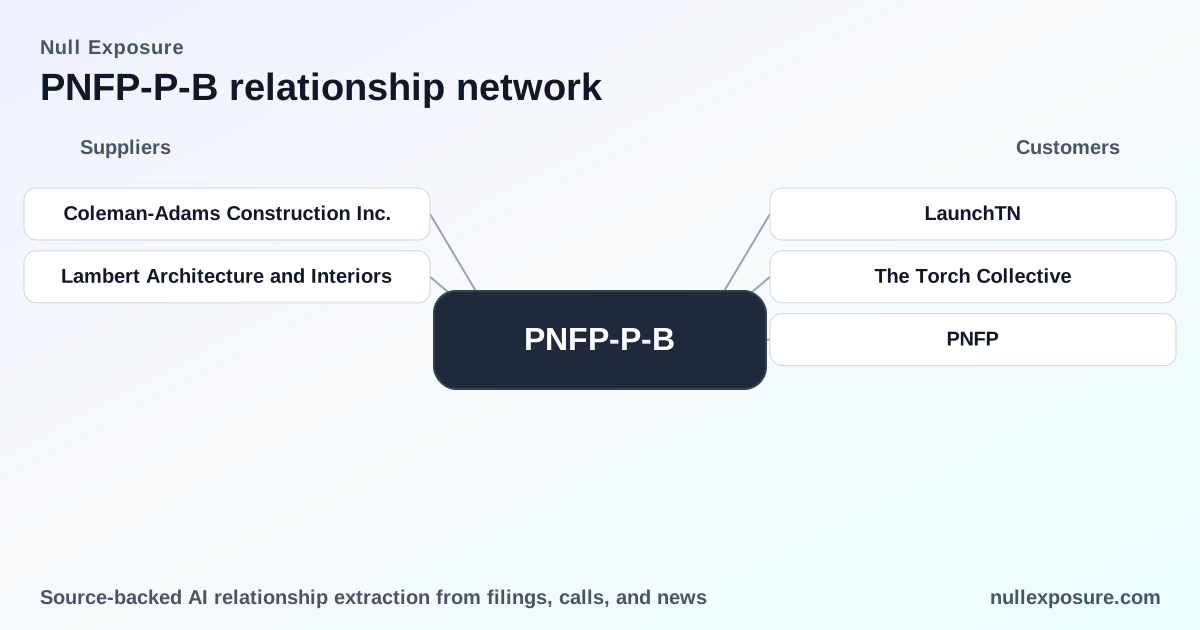
Pinnacle Financial Partners (PNFP-P-B): Local branch buildouts reveal conservative supplier posture and low vendor concentration
Pinnacle Financial Partners operates as a regional commercial bank and wealth manager headquartered in Nashville, monetizing through interest income on commercial and consumer lending, net interest margin management on deposit franchises, and fee-based wealth and treasury services. Branch expansions and full-service office openings are operational investments that support deposit gathering, loan origination, and client-facing wealth distribution channels—and the supplier footprint for these projects provides a direct window into Pinnacle’s procurement posture and execution model.
If you want structured supplier intelligence on regional financial institutions and how those relationships affect operational risk, visit the NullExposure homepage for more: https://nullexposure.com/
Why a Lynchburg office build matters to investors
Pinnacle’s decision to open a full-service office in Lynchburg is more than a real estate event: it signals continued regional penetration and the living costs of growth. Capital deployed on branch infrastructure converts to long-term deposit access and lending relationships, especially in small- and medium-sized enterprise (SME) markets where physical presence still drives pipeline formation.
Quick takeaways:
- Project type: Branch/full-service office buildout announced March 10, 2026.
- Supplier style: Local architecture and general contracting partners for execution.
- Operational implication: Low supplier concentration on a per-project basis; procurement is executed at a project level rather than through a national single-vendor model.
Suppliers identified in the Lynchburg build — direct, local partners
Pinnacle’s press release announcing the Lynchburg office names two external partners connected to the project. Each relationship is direct and project-scoped, consistent with localized commercial real estate execution.
Coleman-Adams Construction Inc.
Coleman-Adams Construction Inc., based in Forest, Virginia, is identified as the contractor on the Lynchburg office build, executing on-site construction activities and project completion. According to Pinnacle’s news release dated March 10, 2026, Coleman-Adams is the primary builder for the new full-service office in Lynchburg (Pinnacle press release, March 10, 2026: https://pnfp.com/news/news-releases/pinnacle-opens-new-full-service-office-in-lynchburg/).
Lambert Architecture and Interiors
Lambert Architecture and Interiors, headquartered in Winston-Salem, North Carolina, is named as the architect for the same project, responsible for design, interiors and likely permit-level documentation. Pinnacle’s March 10, 2026 announcement lists Lambert as the architect on the Lynchburg office (Pinnacle press release, March 10, 2026: https://pnfp.com/news/news-releases/pinnacle-opens-new-full-service-office-in-lynchburg/).
What the supplier list tells investors about Pinnacle’s operating model
The contracting choices for this branch reflect a distinct operating posture. Presenting these as company-level signals:
- Contracting posture — localized and tactical. Pinnacle contracts with regional architecture and construction firms for individual branch projects, indicating a decentralized procurement approach for branch infrastructure rather than long-term master contracting with national build firms.
- Concentration — low on a per-project basis, manageable at enterprise level. Each branch engages a small set of suppliers; single-project relationships limit supplier concentration risk but increase administrative overhead across multiple local engagements.
- Criticality — operationally important but replaceable. Branch construction is essential to deposit and lending growth, but the suppliers themselves are not single points of failure for Pinnacle’s overall franchise—Pinnacle can source alternate local contractors or architects for future projects.
- Maturity — established vendor selection pattern. Using regional, presumably experienced firms for branch construction signals a repeatable and mature approach to physical expansion.
These signals align with a community-focused bank that values regional reputation and local execution. For investors tracking operational risk and vendor exposure across branch networks, NullExposure publishes structured profiles and relationship maps that make these patterns trackable. Learn more on the homepage: https://nullexposure.com/
Investment implications and risk considerations
- Execution risk is project-specific. Construction and architectural vendors bring standard delivery risk (timelines, cost overruns), but the decentralized vendor model prevents systemic vendor dependency. Investors should monitor the cadence of branch openings and any concentration of contracts to a single vendor over time.
- Operational cost vs. strategic benefit. Branch openings are capital-intensive but support higher-quality deposit mix and SME lending originations. Evaluate how many similar rollouts Pinnacle plans and whether branch economics justify the build cost in local markets.
- Reputational and regulatory exposure. Local contractors and architects can introduce compliance and reputational vectors (e.g., permitting, local labor issues). These are manageable but warrant monitoring in quarterly operational disclosures and local press.
- Predictability of vendor relationships. The use of local suppliers suggests high predictability for who will execute future jobs within a given geography, which improves forecasting for near-term capital expenditures and allows better regional rollout planning.
How to use these relationship signals in your model
- Add a project-level expense bucket for branch capex tied to regional buildouts, with vendor-level execution risk factored into schedule and cost assumptions.
- Monitor local press and Pinnacle’s news releases for supplier names and project timelines; frequent reuse of the same suppliers in one geography could shift vendor concentration and procurement leverage.
- For covenant and credit analysis, treat branch capex as discretionary growth spend; if deposit growth underperforms, this capex becomes a potential stress factor.
Final read and next steps
Pinnacle’s supplier footprint for the Lynchburg office is intentionally regional and project-focused, trading supplier concentration for localized execution control. For investors, that means monitoring cadence and reuse of suppliers, tracking project execution risk, and understanding how branch infrastructure supports deposit and loan growth in target markets.
To explore a broader map of supplier relationships and extract operational insights across regional banks, visit NullExposure for deeper supplier intelligence and reporting: https://nullexposure.com/
If you want a tailored supplier-risk briefing or a supplier concentration scan for a specific issuer, start with our homepage and request a briefing: https://nullexposure.com/