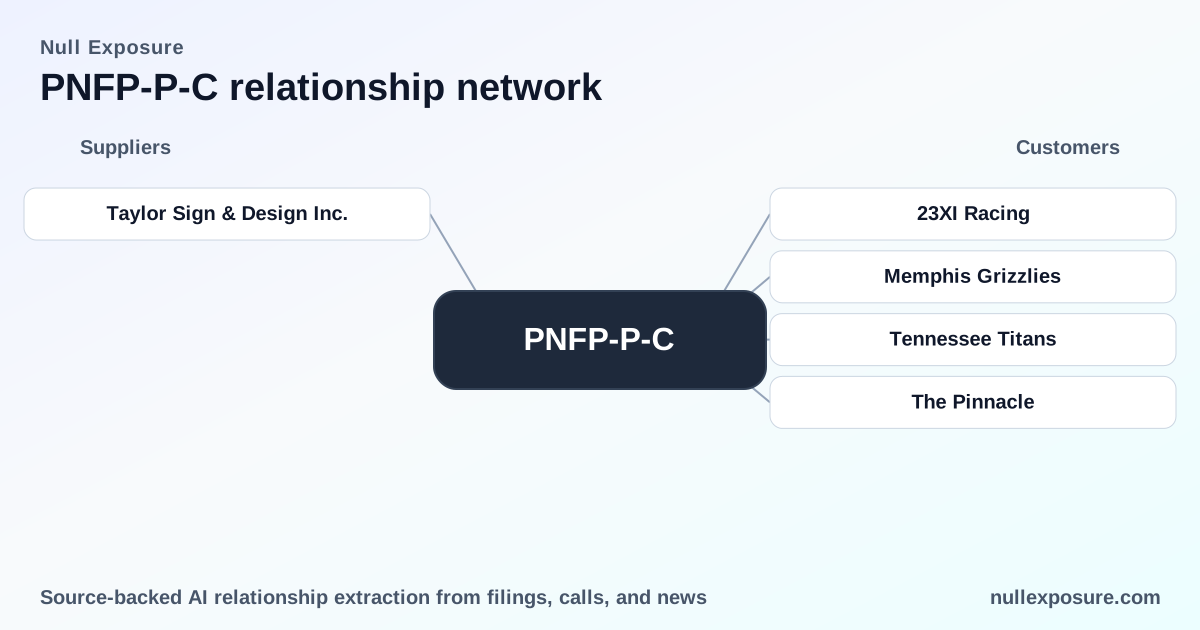
Pinnacle Financial Partners (PNFP-P-C): Supplier Landscape and operational signals investors should track
Pinnacle Financial Partners operates as a regional commercial and retail bank out of Nashville with a focus on interest income, fee-based services, mortgage lending and capital markets activities to generate shareholder value. The company runs a branch-centric, customer-facing model across the Southeast, monetizing through net interest margin, loan origination and servicing fees, and transaction-related revenue. This note examines supplier relationships tied to PNFP-P-C, explains what a small local vendor relationship signals about Pinnacle’s operating posture, and highlights the immediate monitoring steps investors and operators should take. For deeper supplier intelligence, visit https://nullexposure.com/.
Why a single local vendor matters to investors
A regional bank’s supplier roster is a window into how it runs branches, scales local operations and controls brand execution. Small, local suppliers for branch assets and facilities indicate a decentralized procurement posture, low supplier concentration at the enterprise level, and an emphasis on community-level execution rather than centralized mass contracting. Those traits influence cost flexibility, vendor risk exposure, and operational resilience in different ways than a bank that relies on a handful of national integrators.
- Contracting posture: Local vendor use signals negotiation at the business- or branch-level rather than through centralized global procurement; this supports speed and local customization but increases vendor count and oversight needs.
- Concentration: Reliance on local firms suggests low single-supplier concentration, reducing systemic vendor disruption risk but increasing management overhead.
- Criticality: Most local suppliers supporting signage, fit-outs and facilities are non-core operational vendors—important for presentation and compliance but not typically mission-critical to banking operations.
- Maturity and scale: Engaging small contractors implies a mix of mature banking processes with locally executed operational tasks, a common trait for regionally focused banks.
No formal supplier constraints are listed in the public relationship snapshot for PNFP-P-C; there are no supplier-level contractual constraints disclosed in the record reviewed. That absence is itself a company-level signal: supplier relationships in public filings or press are limited to execution-level announcements, rather than material outsourced service arrangements subject to regulatory disclosure.
Relationship snapshot: Taylor Sign & Design Inc.
Taylor Sign & Design Inc. performed an in-market signage installation for Pinnacle at 501 Riverside Ave., Jacksonville, with the installation dated Sept. 25. According to a JAX Daily Record article (Jan. 31, 2025), Taylor Sign & Design installed the Pinnacle sign referenced in the piece (https://www.jaxdailyrecord.com/news/2025/jan/31/pinnacle-financial-partners-builds-its-jacksonville-team-hiring-by-invitation-only/). This is a straightforward facilities/branding engagement that confirms Pinnacle’s use of local contractors for branch-facing physical assets.
Implication: This relationship is operationally tactical—brand and branch presentation—rather than strategic IT or core service outsourcing. It reflects a vendor-management model that emphasizes local execution and likely requires branch-level oversight, permit coordination and short-duration contracting.
What this single relationship tells you about procurement and risk posture
This signage engagement illustrates several sustained operating tendencies:
- Local-first execution: Using a Jacksonville-based sign company signals that Pinnacle engages local vendors for branch openings and renovations rather than executing exclusively through national roll‑out vendors. That provides speed and local knowledge advantages.
- Low strategic vendor concentration: A focus on local contractors spreads vendor exposure across many small providers, reducing dependency on a small set of national vendors but increasing administrative monitoring requirements.
- Operational rather than critical outsourcing: Vendors like Taylor Sign provide tangible, visible value—branding and compliance with local signage codes—without directly affecting core banking processing or customer funds flows. That keeps counterparty risk low, but reputational risk remains if branch rollouts encounter execution problems.
- Maturity of vendor programs: The public record contains transactional vendor notices rather than long-term strategic outsourcing announcements, indicating Pinnacle’s vendor program is mature enough to manage many small suppliers but not necessarily centralized around a small number of strategic outsourcers.
Midway takeaway: For investors focused on operational resilience, a spread of small, local suppliers reduces single-point vendor risk but demands robust vendor oversight and compliance procedures. Track branch expansion cadence and any future vendor relationships that touch core data, payments or lending platforms. More supplier signals and analysis are available at https://nullexposure.com/.
What to watch next (practical monitoring checklist)
- Track future disclosures for vendors that provide IT, loan servicing, or payment processing, since those relationships shift supplier criticality from operational to strategic.
- Monitor branch opening announcements and local press for repeating vendor names—repeated use elevates a supplier from tactical to semi-strategic.
- Watch procurement disclosures or regulatory filings for any mention of service-level agreements, indemnities, or concentration thresholds; these materially change vendor risk profiles.
- Confirm that vendor management practices scale with branch growth—more vendors require stronger onboarding, insurance verification, and continuity planning.
Closing implications for investors and operators
Pinnacle’s visible supplier relationship—Taylor Sign & Design—reinforces a local-execution operating model: agile at the branch level, low supplier concentration, and operational vendor engagements rather than strategic third-party dependencies. For portfolio managers and operational risk teams, the priority is to track the transition point when vendors move from branch support to services that impact core banking operations.
- Key takeaway: Local vendors reduce systemic vendor concentration risk but increase vendor oversight workload; investors should prefer clear disclosure on vendor governance as branch activity scales.
- Actionable step: Validate whether branch rollouts and related vendor engagements are governed by centralized vendor management policies or left to local business units; this has direct implications for operational risk and scalability.
For ongoing supplier intelligence on Pinnacle and comparable regional banks, visit https://nullexposure.com/ for in-depth supplier relationship tracking and analytics.
Final note: The public relationship record for PNFP-P-C currently lists only the Taylor Sign & Design installation (JAX Daily Record, Jan. 31, 2025). Continue to monitor local business reporting and filings for additional supplier disclosures as branch expansion and community engagement evolve.