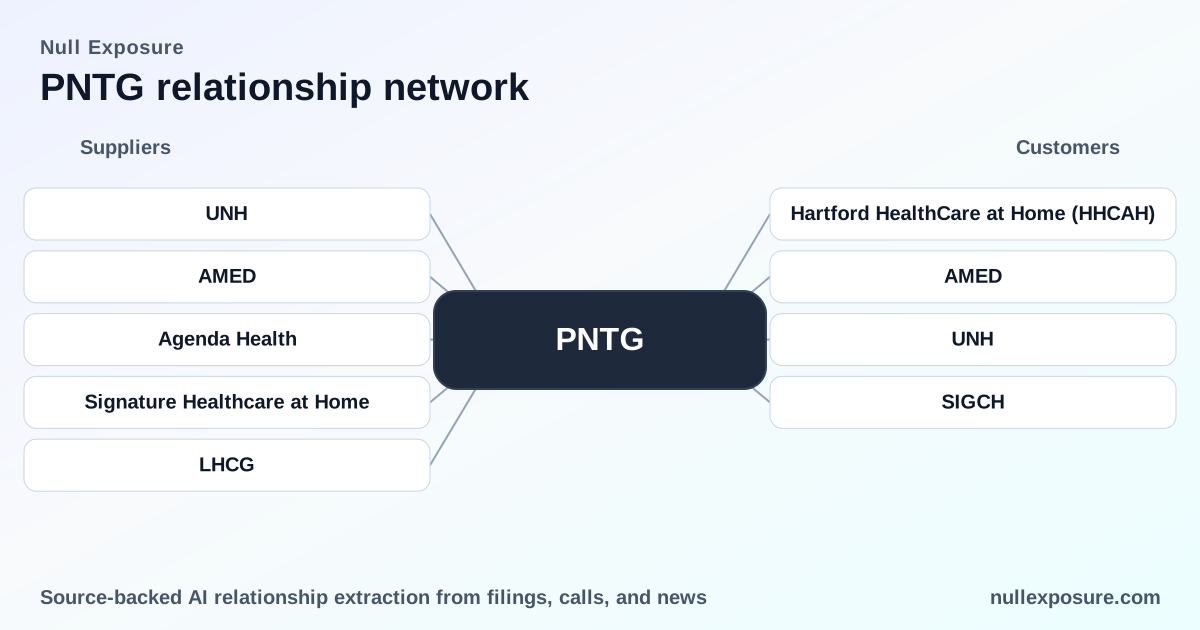
Pennant Group (PNTG): Acquisition-Driven Home Health Consolidator — supplier relationships and strategic constraints
Pennant Group operates as an acquisition-first operator of home health and hospice agencies, monetizing through scale-driven clinical and operational integration: acquiring regional operators, folding them into a centralized operating model, improving admissions and occupancy, and driving margin expansion across a growing geographic footprint. The company’s monetization is increasingly dependent on successful integration of large divestitures from national players and on managing long-term lease obligations tied to certain senior living operations. For a concise view of Pennant’s supplier ecosystem and strategic posture, visit https://nullexposure.com/.
Growth by acquisition — a clear commercial playbook
Pennant’s 2025–2026 trajectory is defined by large inbound asset purchases from national home-health consolidators. The company reported record 2025 results and positioned 2026 for continued revenue and adjusted EBITDA growth driven by recent acquisitions, particularly in the Southeast and Pacific Northwest. Financially, Pennant is a mid-cap healthcare operator with roughly $948 million in trailing revenue and $59 million in EBITDA, trading at an elevated multiple consistent with roll-up growth expectations (Trailing PE ~39.9; Forward PE ~25.4). The commercial model: buy underperforming or divested agency assets, apply a repeatable operating playbook, and extract margin uplift.
Every named partner and why each relationship matters
UnitedHealth / UnitedHealth Group — Pennant acquired assets that had been divested as part of a larger transaction involving UnitedHealth, adding more than 50 locations and expanding the company’s Southeast footprint; management cites these assets as a major driver of 2025 admissions and hospice census improvements (press release summarized by The Globe and Mail and company remarks in late-2025 earnings commentary: https://www.theglobeandmail.com/investing/markets/stocks/PNTG-Q/pressreleases/455546/pennant-group-posts-record-2025-results-eyes-2026-growth/, https://www.insidermonkey.com/blog/the-pennant-group-inc-nasdaqpntg-q4-2025-earnings-call-transcript-1705198/).
Amedisys — Pennant completed purchase of home health and hospice agencies divested in connection with the UnitedHealth/Amedisys arrangements and has described integration of those assets as a key element of its recent expansion, supporting occupancy and profitability gains (Home Health Care News reporting on the acquisition and integration in late 2025: https://homehealthcarenews.com/2025/11/pennant-group-flexes-acquisition-muscle-as-it-integrates-amedisys-lhc-group-assets/, and remarks on the October acquisition in the Q4 earnings transcript: https://www.insidermonkey.com/blog/the-pennant-group-inc-nasdaqpntg-q4-2025-earnings-call-transcript-1705198/).
Signature Healthcare at Home — Pennant closed the acquisition of Signature Healthcare at Home in the Pacific Northwest on January 1, and management states the asset was rapidly integrated into Pennant’s operating model with material performance improvement during the year (earnings call transcript describing the January 1 close and integration results: https://www.insidermonkey.com/blog/the-pennant-group-inc-nasdaqpntg-q4-2025-earnings-call-transcript-1705198/, and Home Health Care News noting the company’s use of the deal as an integration model: https://homehealthcarenews.com/2025/11/pennant-group-flexes-acquisition-muscle-as-it-integrates-amedisys-lhc-group-assets/).
LHC Group — Portions of LHC Group assets that had been sold to UnitedHealth were included in the transaction set Pennant purchased, further amplifying the company’s scale in newly-acquired markets and reflecting the secondary relayering that happens after large strategic divestitures (Home Health Care News coverage of the deal structure and acquired assets: https://homehealthcarenews.com/2025/11/pennant-group-flexes-acquisition-muscle-as-it-integrates-amedisys-lhc-group-assets/).
Agenda Health — Pennant used external M&A advisory support for at least some transactions; Agenda Health is credited as the M&A advisor on the Southwestern Palliative Care & Hospice acquisition, signaling Pennant’s continued use of specialist advisers to source and execute regional deals (Hospice News noting Agenda Health’s advisory role in the FY2023 transaction: https://hospicenews.com/2023/12/01/the-pennant-group-buys-southwestern-palliative-care-hospice/).
Each of these relationships underscores a consistent pattern: Pennant is synthesizing assets divested from national platforms into a single operating platform, using third-party advisors as needed and executing rapid integration to lift clinical and financial metrics.
Operational constraints and what they mean for supplier risk
Pennant’s public disclosures indicate two important, company-level operating constraints that shape supplier risk and balance-sheet exposure:
-
Long-term lease posture: The company’s independent operating subsidiaries hold non-cancelable operating leases for senior living communities with initial terms generally in the 15–25 year range. This signals a commitment to multi-decade occupancy and cost structures for a subset of operations, turning real-estate relationships into durable supplier obligations (evidence cited in company lease disclosures).
-
Operator (not owner) model for real estate: Subsidiaries lease and operate—they do not own the underlying real estate—so rent payments flow through cost of services rather than capital expenditure. Lease expense is a recurring operating cash requirement and creates counterparty exposure to landlords and lease terms rather than mortgage or property risk on Pennant’s balance sheet.
Taken together these constraints imply a contracting posture that is structurally long-dated and operationally committed: suppliers of staffing, clinical services, and facility management operate against a backdrop of durable lease obligations. For investors, that has four practical implications: (1) stable demand assumptions are critical, (2) integration-driven margin expansion must outpace fixed lease step-ups, (3) counterparty risk with landlords is non-trivial, and (4) growth via acquisition increases leverage on integration execution. Visit https://nullexposure.com/ for a broader supplier-risk framework.
What to watch next — integration, cash conversion, and lease covenants
-
Integration execution: The acquisitions from UnitedHealth/Amedisys and Signature Healthcare at Home are the proximate growth drivers; track admissions, hospice census, and occupancy trends as short-term performance indicators. Management has said these assets materially contributed to 2025 improvements, so quarterly cadence will validate the thesis (management comments and press reporting in early 2026).
-
Lease economics and cash flow: Long-term operating leases convert real estate economics into recurring rent expense. Investors should scrutinize lease escalators, landlord covenants, and how rent shows up in cost of services—these are key to free-cash-flow conversion under the operator model.
-
Deal sourcing and advisor use: Agenda Health and other advisors will continue to matter for deal flow; assess whether Pennant’s M&A pipeline is opportunistic or dependent on divestitures from larger payers and consolidators.
Bottom line and next steps
Pennant’s model is a repeatable roll-up that converts divested national assets into a centralized, higher-margin operating platform, but that model carries integration and lease-related execution risk. For investors evaluating supplier relationships, prioritize diligence on the terms and duration of operating leases, the timeliness of integration benefits, and how acquisitions alter operational concentration across states.
To evaluate Pennant’s supplier exposures and to see comparable supplier intelligence across healthcare providers, go to https://nullexposure.com/. If you’d like a focused supplier-risk briefing or a custom relationship map for Pennant and peers, request a tailored report at https://nullexposure.com/ — our team will synthesize filings, press reports, and transaction histories into an actionable view.
Key takeaway: Pennant monetizes through acquisitive scale and integration-driven margin uplift, but its operator-not-owner real-estate posture and long-term lease commitments make supplier and landlord relationships central risk vectors for realizing the company’s growth thesis.