Insulet (PODD): Supplier relationships that drive Omnipod’s product economics
Insulet develops, manufactures, and sells the Omnipod family of insulin delivery systems and captures revenue through device sales, recurring pod consumables, and integrations with continuous glucose monitor (CGM) partners that expand clinical utility and customer retention. The company monetizes both hardware replacement cycles and ecosystem stickiness created by CGM integrations, and investor analysis must weigh commercial partnerships alongside manufacturing and sourcing constraints that can materially affect margin and availability. For a structured supplier intelligence feed tailored to these dynamics, visit https://nullexposure.com/.
Why supplier relationships matter to Omnipod’s unit economics
Insulet’s product strategy is platform-driven: the Omnipod pod is a recurring consumable, and integrations with third-party CGM sensors increase user value and reduce churn. That commercial model makes supplier partnerships strategic revenue multipliers rather than simple components transactions. At the same time, contract manufacturing and single-source component exposures create operational leverage that can swing gross margin and shipment cadence.
- Contract manufacturing in APAC: Insulet produces devices on manufacturing lines at a contract manufacturer facility in China, which introduces geographic concentration in manufacturing capacity and exposes the company to APAC operational risk and logistics variables.
- Critical single-source parts: Company disclosures note the existence of sole-sourced components that are critical to product design and function, which elevates supply chain risk if a vendor or a single production line is disrupted.
- Broad use of contract manufacturers and dual-sourcing where possible: Insulet reports purchasing many components and sub-assemblies from manufacturers that are at least dual-sourced, indicating a pragmatic sourcing posture that balances cost, redundancy, and speed.
These are company-level signals that affect contracting posture, concentration, and maturity of the supply base; they are not attributable to any single integration partner unless explicitly stated in the underlying evidence.
Partner-by-partner realities: what the market is already pricing
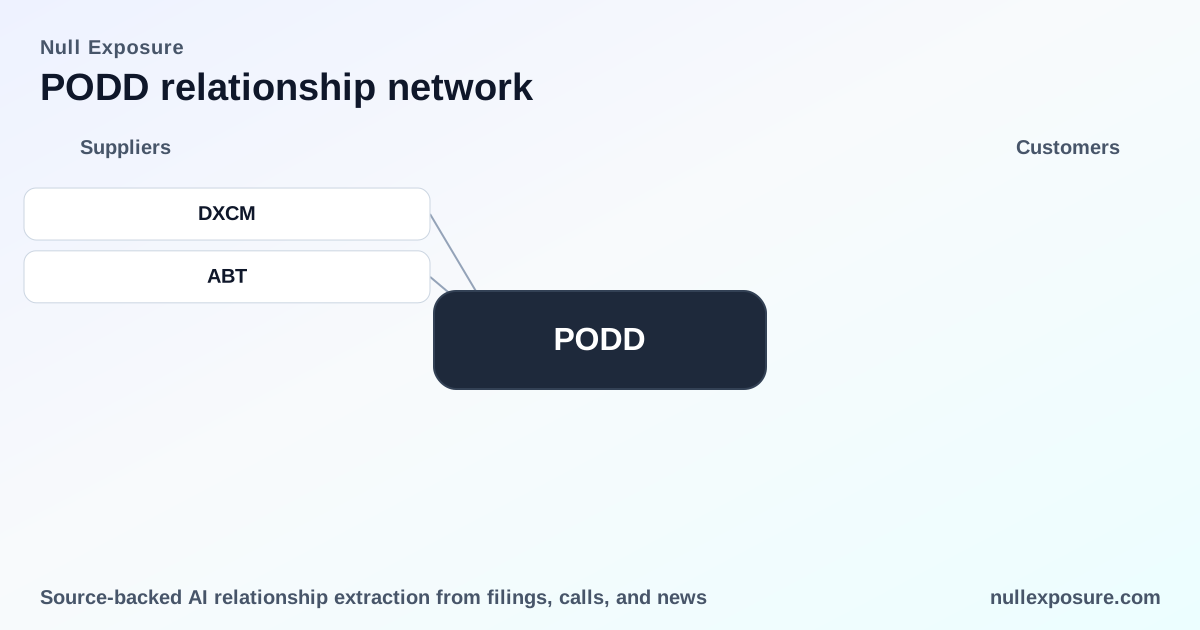
Dexcom — integration that expands Omnipod’s addressable market
Insulet launched Omnipod 5 with Dexcom’s G7 sensor in the U.S. and several European markets during 2025, and management highlighted that sensor integrations like G7 supported solid European performance in FY2026. According to Insulet’s Q4 2025 earnings call transcript coverage, the Dexcom G7 integration is an active contributor to regional growth (InsiderMonkey, March 2026). A TradingView summary of Insulet’s filings also references the Omnipod 5 launch with Dexcom’s G7 (TradingView, Mar 2026).
Abbott — roadmap work that broadens CGM compatibility
Insulet’s product development roadmap explicitly includes integration of Omnipod 5 with Abbott’s FreeStyle Libre 3 Plus and forward development toward Omnipod 6, signaling strategic multi-vendor CGM compatibility to defend and expand market share. This integration strategy is documented in Insulet’s SEC filing summaries and public commentary on product development (TradingView, Mar 2026).
What these relationships mean for supply risk and commercial upside
The two CGM partners covered here are commercial complements rather than component suppliers in the traditional sense; their value is measured in uptake, retention, and reimbursement wins. Dexcom’s G7 integration and Abbott compatibility both strengthen Omnipod’s clinical proposition across markets and have a direct correlation with revenue growth and margin durability as device adoption scales.
Operationally, the manufacturing and sourcing constraints alter the risk profile:
- Concentration risk: Reliance on a Chinese contract manufacturer for device lines centralizes production capacity in APAC and increases the operational impact of regional events, logistics slowdowns, or trade disruptions. This elevates the sensitivity of Insulet’s supply continuity to APAC conditions.
- Criticality vs. redundancy: While Insulet notes numerous dual-sourced components, the explicit existence of sole-sourced, critical components creates asymmetric failure modes where a single vendor outage could halt shipments and impair revenue recognition.
- Maturity signal: The presence of launched integrations (Dexcom G7 in 2025) signals product maturity and commercial execution capability, which de-risks future integrations but raises the importance of consistent supply and regulatory alignment.
For investors, these factors create a straightforward risk/reward: strong commercial partnerships drive predictable recurring revenue; singular sourcing and concentrated production amplify downside volatility.
If you want a supplier intelligence view built for investment teams, explore our coverage at https://nullexposure.com/.
Operational indicators investors should track next
Monitor these operational and commercial metrics to convert qualitative supplier assessment into investable signals:
- Regulatory and rollout milestones for Omnipod 6 and additional Abbott integrations.
- Volume and gross margin trends tied to Omnipod 5 pod sales and regional mix following the Dexcom G7 launches.
- Inventory days and backorder metrics that would reveal bottlenecks stemming from sole-sourced parts or APAC manufacturing constraints.
- Announcements from contract manufacturers and any moves to diversify or onshore capacity.
- Reimbursement and payer coverage updates in Europe and the U.S. that amplify the commercial lift from CGM integrations.
These indicators will move valuation faster than high-level commentary because they bridge product adoption with supply execution.
Bottom line: how to position around PODD supplier dynamics
Insulet’s approach blends platform monetization through pod consumables and strategic CGM integrations with a sourcing model that pairs contract manufacturing in China and a mixture of dual- and sole-sourced components. That combination delivers strong upside when integrations and reimbursement align, and material downside when a critical vendor or a concentrated manufacturing node experiences disruption.
- Bull case: Continued uptake from Dexcom G7 and Abbott compatibility drives recurring revenue while margin expands with scale and improving mix.
- Risk case: A single-source component failure or APAC manufacturing disruption creates outsized shipment and revenue risk.
For investor-grade supplier intelligence and ongoing monitoring of these dynamics, visit https://nullexposure.com/ for tailored feeds and analyst-ready signals.
Sources cited in this note include Insulet’s public filings and coverage: Insulet Q4 2025 earnings call transcript and commentary (InsiderMonkey, Mar 2026), SEC filing summaries and product development notes (TradingView, Mar 2026), and market reporting on launches and recalls (MassDevice, Finviz, Mar 2026).