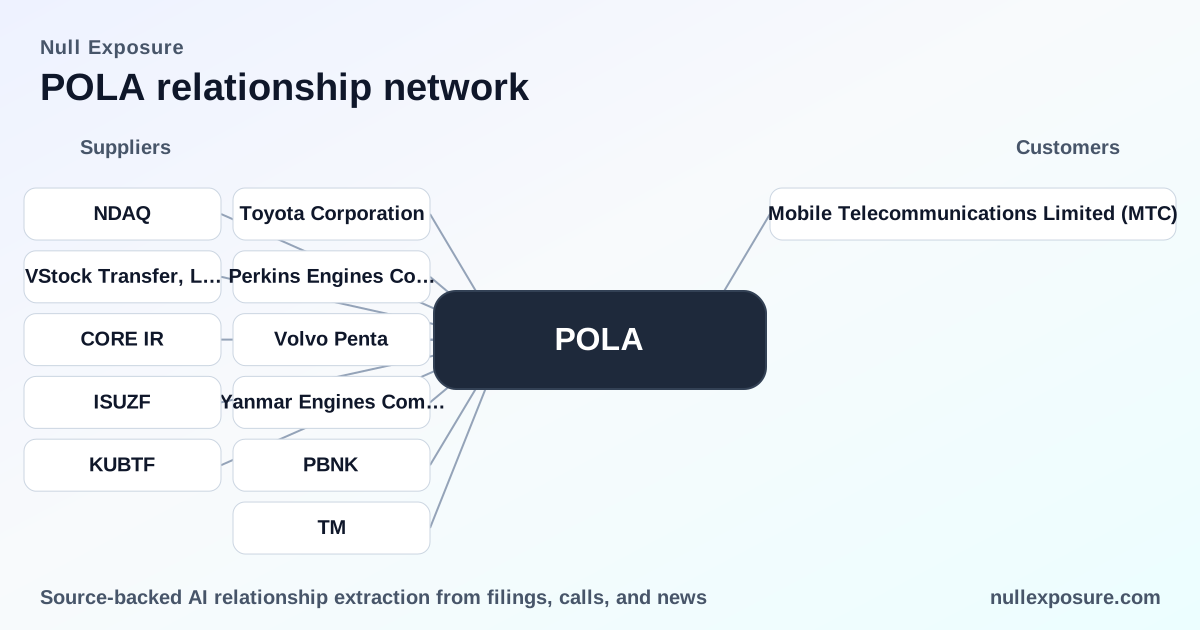
POLA: Polar Power’s supplier map and what it means for investors
Polar Power designs and sells direct‑current generators, renewable energy and cooling systems and monetizes primarily through product sales and associated installation/warranty services delivered via a dealer/service network. The business is component‑intensive: engines from third‑party OEMs and short‑term working capital (including a bank line) are central to throughput and margins. Revenue TTM is roughly $12.0M with negative profitability metrics, underscoring that supplier and financing relationships materially affect near‑term cash flow and operational stability. For a concise exposure analysis and supplier tracking tools, visit https://nullexposure.com/.
Engines are the backbone — who Polar buys from
Polar explicitly sources standard engine configurations for its DC power systems from a small group of OEMs, which creates a concentrated supplier footprint and a direct operational lever for investors.
- Toyota / Toyota Corporation / Toyota Motor Corporation — Polar cites Toyota engines as a key source for propane and natural‑gas prime power units and notes heavy COVID‑era inventory purchases of Toyota LPG and natural‑gas engines due to long lead times; press coverage also describes Toyota 1KS engines powering new Prius‑style DC generators for EV charging. — FY2024 10‑K; GlobeNewswire and TradingView press releases (Nov 2025) and related news (Nov 2025).
- Perkins Engines Company Ltd — Identified in the FY2024 10‑K as one of the company’s key engine suppliers for standard configurations used in Polar’s DC power systems. — FY2024 10‑K.
- Yanmar Engines Company — Named alongside Perkins and Toyota in the FY2024 10‑K as a primary engine supplier for Polar’s DC generator products. — FY2024 10‑K.
- Volvo Penta — Polar reports using Volvo Penta engines “to a lesser extent,” indicating a secondary source for specific product variants. — FY2024 10‑K.
- Isuzu — Listed among additional engine suppliers used to support product breadth. — FY2024 10‑K.
- Kubota — Also listed as an engine source, reflecting Polar’s multi‑OEM approach for supply flexibility. — FY2024 10‑K.
Key takeaway: Polar’s product delivery depends on a handful of engine OEMs; investors should treat engine supply as a first‑order operational risk.
Finance and investor relations: who supports capital and market access
Polar’s non‑product relationships reveal funding sources and market infrastructure that affect liquidity and investor communications.
- Pinnacle Bank (PBNK) — Interest expense disclosures attribute primary borrowings to a line of credit with Pinnacle Bank, making the bank relationship a near‑term funding dependency. — GlobeNewswire / Manila Times press coverage of Q3 2025 results (Nov 2025).
- Nasdaq Capital Market — Polar completed a reverse stock split and continues trading on the Nasdaq Capital Market under POLA, with subsequent Nasdaq correspondence acknowledged by the company in late 2024. This affects marketability and compliance oversight. — GlobeNewswire press releases (Nov–Dec 2024).
- VStock Transfer, LLC — Listed as Polar’s transfer agent and the contact point for non‑brokerage shareholders concerning the reverse split. — GlobeNewswire press release (Nov 15, 2024).
- CORE IR — CORE IR is named as the company’s investor relations contact, indicating outsourced IR support for capital markets engagement. — GlobeNewswire press releases (Nov–Dec 2024).
Key takeaway: Working capital is routed through a single bank line and market access rests on Nasdaq listing and external IR/transfer service providers — these are operational controls investors should monitor.
(If you want a consolidated supplier exposure report for portfolio monitoring, check https://nullexposure.com/.)
How Polar operates with its service network — a company‑level constraint
Polar uses a nationwide network of dealers and service providers to perform installation and warranty services. This operational model creates several company‑level signals investors should incorporate into diligence:
- Contracting posture: Purchase model for standard engine configurations coupled with dealer/service contracts for field installation and warranty work, implying transactional purchasing and outsourced after‑sales execution rather than captive field teams.
- Concentration: Supplier concentration around a small set of engine OEMs raises supply‑shock risk and puts negotiation leverage with OEMs and lead‑time variability into the P&L equation.
- Criticality: Engines are mission‑critical components for Polar’s DC systems; delays or quality issues at engine OEMs translate directly to shipment delays, warranty exposure and margin compression.
- Maturity and flexibility: Use of multiple OEMs (Toyota, Perkins, Yanmar, Isuzu, Kubota, Volvo Penta) suggests intentional redundancy but also operational complexity in procurement, inventory and aftermarket support.
These constraints, derived from company disclosures about dealers and service providers, are company‑level signals and not assigned to any single supplier unless the disclosure explicitly does so.
What the relationships imply for risk and return
- Supply risk is concentrated and actionable. A disruption at one of the named engine OEMs would have immediate operational impact; conversely, multi‑OEM sourcing provides tactical options if Polar can reprice or redesign quickly.
- Working capital is materially leveraged to short‑term credit. The Pinnacle Bank line funded interest expense in Q3 2025, which means cash burn and receivables dynamics will govern near‑term solvency more than product backlog alone.
- Market and governance infrastructure is outsourced. Nasdaq listing status, VStock transfer agent services and CORE IR engagement indicate standard small‑cap public company governance, with attendant compliance and shareholder communications costs.
Investors should stress‑test scenarios where engine lead times lengthen or credit becomes constrained; both are realistic given historical COVID inventory behavior the company disclosed.
Recommendations for investors evaluating supplier exposure
- Prioritize direct dialogue on engine lead times, ordering cadence and vendor scorecards for Toyota, Perkins and Yanmar.
- Request covenant and maturity details on the Pinnacle Bank line and monitor interest‑expense trends in upcoming quarters.
- Use IR and transfer agent contact points to validate market mechanics after structural actions such as the reverse split.
For a supplier‑focused monitoring solution that maps these exact relationships into portfolio alerts, visit https://nullexposure.com/ — and contact our team if you want tailored reports on POLA supplier concentration and financing links.
Bottom line
Polar Power is a niche industrial OEM with supplier concentration around a small set of engine manufacturers and a visible dependence on a bank line for working capital; both elements are central to its cash‑flow and execution risk profile. Investors evaluating POLA should treat engine OEM performance and short‑term financing as primary value drivers and monitor press releases and 10‑K disclosures for changes in those relationships. For ongoing tracking and alerts on supplier shifts, go to https://nullexposure.com/.