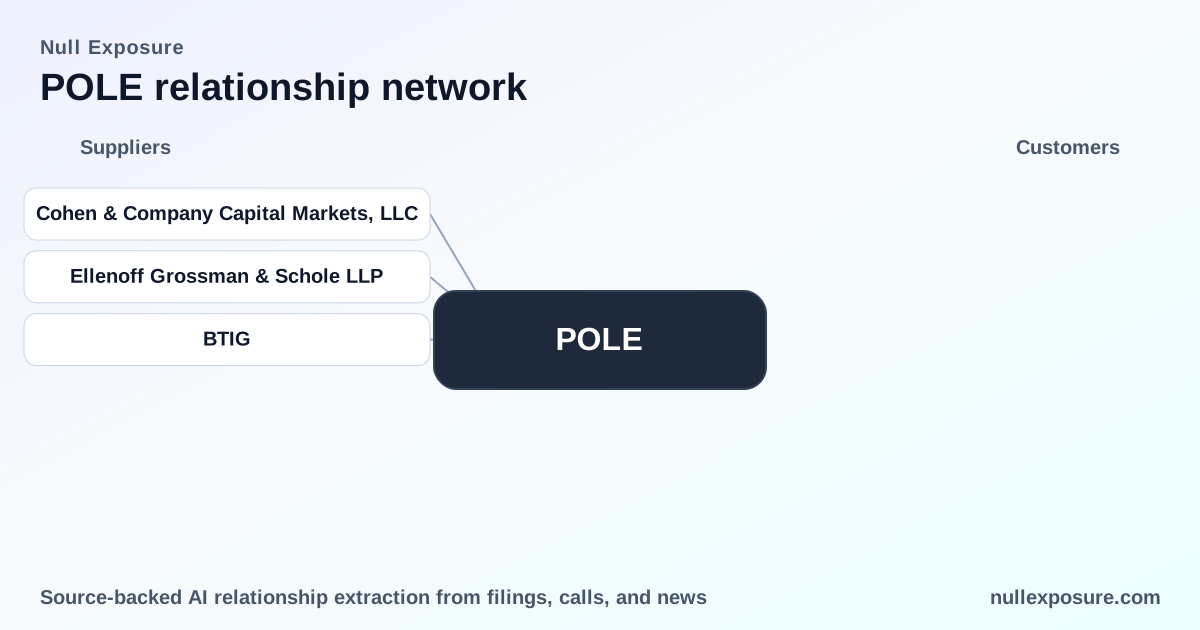
POLE supplier map: what Andretti Acquisition Corp. II’s advisors and underwriters reveal to investors
Andretti Acquisition Corp. II (POLE) is a Nasdaq‑listed SPAC that monetizes primarily through underwriting and sponsor economics tied to completing a business combination: it holds IPO proceeds in a U.S. trust account, pays recurring sponsor and management service fees, and compensates underwriters with both upfront and deferred fees payable only upon consummation of a target merger. For investors and operator teams evaluating supplier risk, the supplier roster and contract excerpts show a classic SPAC profile: capital held in trust, concentrated underwriting economics, and active external service providers tied to a single event-driven outcome.
Explore supplier intelligence and relationship analytics at https://nullexposure.com/.
A compact roster with outsized strategic leverage
POLE’s supplier relationships are limited in number but consequential in function: legal counsel, investment banks/underwriters, and accounting/administrative sponsors. Each plays a discrete role in enabling or blocking a business combination, and the contracts embed asymmetric payoffs—small recurring fees for admin and significant deferred payments for deal completion.
Cohen & Company Capital Markets, LLC
Cohen & Company acted as financial advisor to Andretti Acquisition Corp. II in the context of the proposed reverse merger with StoreDot. According to a MarketScreener article published March 10, 2026, Cohen & Company’s role was advisory on the transaction that ultimately was publicly discussed in relation to the StoreDot deal (https://www.marketscreener.com/news/storedot-ltd-cancelled-the-acquisition-of-andretti-acquisition-corp-ii-in-a-reverse-merger-transac-ce7e5dd2d98ef621).
Ellenoff Grossman & Schole LLP
Ellenoff Grossman & Schole LLP served as legal advisor to POLE, handling transaction and regulatory counsel functions connected to the SPAC’s activities. MarketScreener reported this legal advisory relationship in March 2026 in coverage of the StoreDot reverse‑merger story (https://www.marketscreener.com/news/storedot-ltd-cancelled-the-acquisition-of-andretti-acquisition-corp-ii-in-a-reverse-merger-transac-ce7e5dd2d98ef621).
BTIG
BTIG is the underwriter party that modified its underwriting agreement with POLE to adjust deferred underwriting fees tied to the pending business combination; an amendment was reported in March 2026. TradingView coverage notes POLE entered into an amendment with BTIG to change the deferred fee structure for the transaction with StoreDot (https://www.tradingview.com/news/tradingview:e76b48eaecdad:0-andretti-acquisition-ii-signs-underwriting-agreement-amendment-with-btig/).
How supplier contracts shape POLE’s operating posture
The contract excerpts and disclosures reveal corporate‑level operational characteristics that investors must price.
-
Contracting posture: POLE relies on short‑term, event‑contingent compensation profiles. Recurring administrative fees are modest (examples: $2,500/month to the Sponsor, $12,500/month to the CEO for services), while underwriter economics include upfront cash discounts and materially larger deferred fees payable only on deal close. This structure aligns supplier incentives to consummation rather than ongoing service delivery.
-
Concentration and criticality: A relatively small set of external suppliers perform mission‑critical functions: trustees for the trust account, lead underwriters for distribution and fee mechanics, and legal counsel for regulatory clearance. The trust account ($230M+ noted in filings) is the single largest asset under management — control and trustee integrity are essential.
-
Maturity and lifecycle: POLE is in an active pre‑business combination phase. Disclosures show the IPO and over‑allotment closed in September 2024 and the SPAC remains operationally active through FY2026, with supplier fees structured to cease upon combination or liquidation. The supplier relationships therefore sit at an advanced but event‑driven lifecycle stage.
-
Spend profile: Spend buckets show a mix of sub‑$100k recurring administrative and audit engagements (e.g., Withum audit fees near $91.5k), mid‑range cash underwriting discounts (~$4.6M paid at IPO close), and deferred fees in the $10M+ band contingent on transaction completion. These bands concentrate financial exposure on the outcome of the merger process.
What this means for investor risk and supplier counterparty management
The supplier list and contract signals produce three actionable investor conclusions.
-
Event risk dominates. The SPAC’s economics and supplier incentives are concentrated on closing the business combination; deferred fees create leverage for underwriters and advisors to influence timeline and terms. Traders and portfolio managers should price execution risk and potential fee acceleration or renegotiation into valuations.
-
Counterparty selection is meaningful. Underwriters and legal counsels with transaction experience reduce execution friction; the BTIG amendment demonstrates active renegotiation is possible and can affect both cash flow timing and dilution.
-
Operational cash exposure is limited but structural. Recurring administrative costs are immaterial relative to the trust account, but the trust account is the key liability anchor—control, trustee contracts, and redemption mechanics determine available capital for a deal or liquidation.
Practical next steps for procurement and investors
- Review underwriting agreements and deferred fee provisions closely to quantify downside if a business combination fails or is restructured.
- Confirm trustee arrangements and redemption waterfall to model worst‑case liquidity outcomes.
- Monitor legal advisor engagement and any disclosed amendments that alter fee timing or regulatory risk.
For teams wanting supplier diligence and ongoing monitoring, start here: https://nullexposure.com/.
Final read: supplier relationships are sparse but strategically heavy
POLE’s supplier roster—BTIG (underwriting), Ellenoff Grossman & Schole LLP (legal), and Cohen & Company Capital Markets (financial advisor)—is small and targeted, exactly what investors expect of a deal‑focused SPAC. The structural reality is straightforward: modest recurring operating spend, concentrated deferred underwriting economics, and a trust account that centralizes capital risk. Investors should value POLE primarily on execution probability and counterparty resilience rather than on operating cashflow metrics.
If you want a tailored vendor‑risk briefing or continuous monitoring for SPAC counterparties, visit https://nullexposure.com/ for tools and analyst coverage.