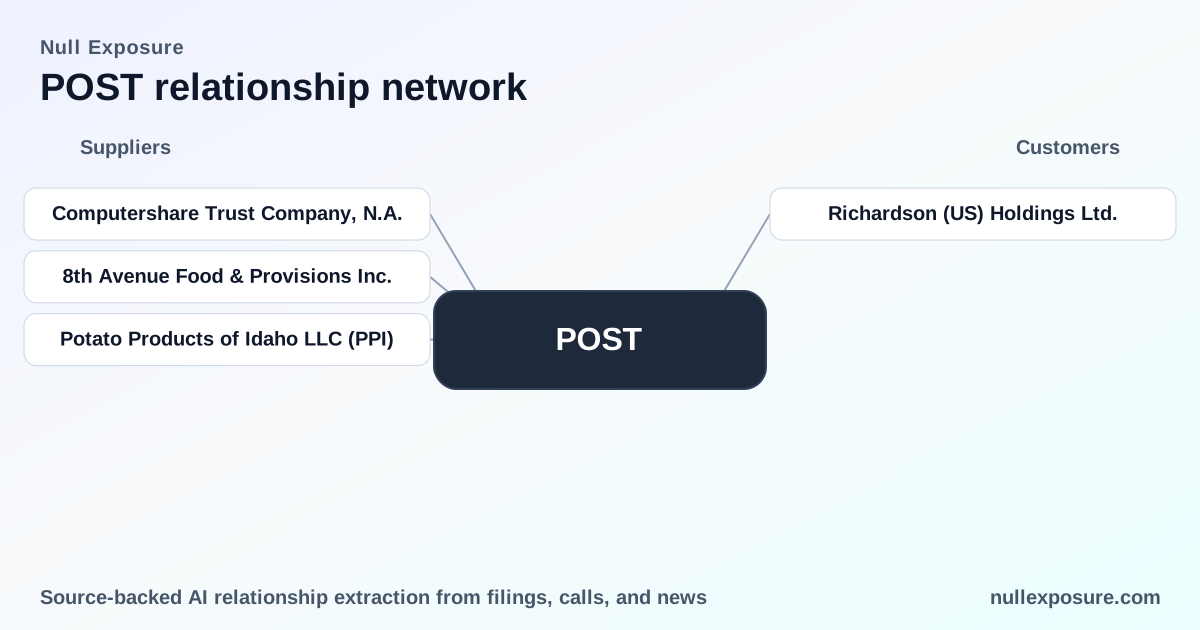
Post Holdings (POST) — the supplier map investors need to price risk and upside
Post Holdings operates as a consumer packaged goods holding company that monetizes through branded food sales, manufacturing scale and disciplined M&A — buying specialty food businesses, integrating operations, and selling products through retail and foodservice channels. Revenue comes from product sales across its portfolio, with margin and cash-flow expansion driven by integration synergies, procurement scale, and control of manufacturing and distribution. Capital allocation and supplier commitments are therefore central to both operational execution and valuation.
For more on supplier risk frameworks and supplier intelligence for investors, visit https://nullexposure.com/.
Why supplier relationships matter to the Post thesis
Post’s business model is dependent on three operational levers: manufacturing continuity, raw-material sourcing, and acquired brand integration. Long-term supplier commitments and large capital expenditure obligations translate directly into fixed-cost exposure and working-capital demand; conversely, successful integration of recently acquired assets can expand gross margin and accelerate revenue per share. These are not abstract inputs — they drive near-term free cash flow variability and influence leverage and refinancing flexibility.
Active counterparties to track now
Computershare Trust Company, N.A.
Computershare serves as the trustee for Post’s 5.50% senior notes due December 2029; that role surfaces in the company’s announced redemption activity for those notes. This relationship is procedural but material for bondholder and liquidity analysis because the trustee is involved when Post executes redemptions or restructurings of its public debt. According to a PR Newswire release dated March 2026, Computershare Trust Company, N.A. is the trustee for the 2029 Notes (https://www.prnewswire.com/news-releases/post-holdings-announces-redemption-of-1-235-0-million-5-50-senior-notes-due-december-2029--302630824.html).
8th Avenue Food & Provisions Inc.
Post completed the acquisition of 8th Avenue Food & Provisions Inc., adding specialty manufacturing and branded SKUs to its portfolio. The transaction increases Post’s exposure to acquired-brand integration risk and upside from cross-selling and procurement optimization. Food Business News reported Post’s completion of the 8th Avenue acquisition in a March 2026 article covering Post’s cereal outlook (https://www.foodbusinessnews.net/articles/29760-post-sees-encouraging-signs-for-cereal).
Potato Products of Idaho LLC (PPI)
Post finalized the purchase of Potato Products of Idaho LLC (PPI), expanding its manufacturing footprint and ingredient sourcing channels for potato-based products. This brings production capacity and raw-material contracts under Post’s management, creating opportunities to realize scale economics while increasing exposure to agricultural input price cycles. The same Food Business News piece covering Post’s cereal business noted the completion of the PPI acquisition (https://www.foodbusinessnews.net/articles/29760-post-sees-encouraging-signs-for-cereal).
What the supplier constraints tell investors (company-level signals)
Post’s disclosed supplier and contract profile shows several characteristics that materially shape operational risk and strategic optionality:
- Long-term contracting posture and sizable committed spend. As of September 30, 2025, Post reported minimum amounts committed of $7,382.7 million, with $2,497.3 million due in fiscal 2026, driven by long-term egg contracts, open purchase orders and accrued capital expenditures. This level of committed spend signals important fixed-cost and working-capital commitments that constrain near-term cash flow flexibility (company disclosure as of Sep 30, 2025).
- High spend concentration. The spend band classification of $100m+ indicates that Post depends on large, high-dollar supplier relationships and capital projects that are contractually locked in, amplifying vendor concentration risk and the consequences of supplier disruption.
- Mixed supplier roles — manufacturers, distributors and service providers. Disclosures identify third parties across manufacturing, distribution and specialized services (for example, annual penetration testing performed by independent vendors). That breadth creates operational interdependencies: manufacturing and distribution partners are critical to shelf presence and fill rates, while service providers are essential for compliance and systems security.
- Active engagements and operational maturity. The relationships are classified as active, reflecting ongoing, currently operational contracts rather than one-off or concluded arrangements. This supports short-to-medium term revenue continuity but also requires sustained capital to honor commitments.
These signals collectively indicate a company operating with high contractual commitments, centralized supplier exposure, and active third-party dependencies, factors that elevate the importance of procurement execution and integration discipline in sustaining margins.
Operational and valuation implications
- Cash-flow sensitivity. Large near-term commitments ($2.5bn due in FY2026) increase pressure on operating cash flow and reduce margin for error if integration synergies from acquisitions (8th Avenue, PPI) are delayed. Investors should adjust free-cash-flow forecasts to reflect committed spend timing and likely working-capital swings.
- Refinancing and capital-allocation flexibility. Trustee activity around the 2029 notes (Computershare’s role in the redemption) signals active balance-sheet management; successful redeployments improve leverage metrics but the scale of supplier commitments means capital markets access remains a critical lever.
- Integration execution as a value driver. Completed acquisitions expand revenue and manufacturing capacity but require integration capital and procurement harmonization to deliver promised synergies. Execution risk here is a core determinant of whether acquisitions add to EPS immediately or depress short-term cash flow.
- Operational concentration risk. Large, long-term contracts—especially in commodity inputs such as eggs and agricultural products—create exposure to input-price inflation and single-source supplier disruption. Hedging and supplier diversification strategies become material to downside protection.
Practical next steps for investors and operators
- Review upcoming cash-flow and debt amortization schedules relative to the $2.5bn due in FY2026 and the company’s stated working-capital expectations (company fiscal disclosures through Sep 30, 2025).
- Monitor integration KPIs for 8th Avenue and PPI (SKU rationalization, factory utilization, procurement savings) across the next two quarters; track whether these acquisitions deliver immediate margin improvement or incur transitional costs.
- Watch disclosures around bond redemptions and trustee filings for signals on refinancing strategy and balance-sheet flexibility.
For a deeper supplier risk profile and scenario analysis tailored to investors, explore our methodology and supplier intelligence at https://nullexposure.com/.
Final view and action
Post’s supplier footprint is large, contractual and active — a structural feature of its buy-and-build consumer strategy. That structure creates both the pathway to margin expansion through scale and a concentration of operational and cash-flow risk tied to large long-term commitments and integration outcomes. Investors should price in committed spend and integration execution when valuing the business and monitor trustee and debt activity as leading indicators of balance-sheet flexibility.
If you want a tailored supplier-risk brief for POST or a watchlist that flags covenant, maturity and procurement risk in real time, start here: https://nullexposure.com/.