Power Integrations (POWI): Wafer partners are the backbone — and the risk
Power Integrations designs and sells high-voltage mixed-signal and analog ICs for power conversion; it monetizes by licensing its proprietary processes into silicon, outsourcing wafer fabrication to long-standing foundry partners, and selling packaged ICs to electronics OEMs. The company’s economics therefore depend on stable wafer supply, favorable contract pricing, and efficient assembly/test partners—factors that convert foundry relationships into a direct operating lever for margin and continuity of revenue. For a deeper supplier-risk view and contract mapping, visit https://nullexposure.com/.
Why wafer contracts matter more than chip counts
Power Integrations runs a fabless model but differs from many peers because its proprietary high-voltage processes demand foundries that can run legacy and specialized process steps. Foundry relationships are strategic and operationally critical: they determine capacity, cost, currency exposure, and product qualification timelines. Assembly and test subcontractors then affect finished-goods throughput and delivered quality. Investors should treat wafer arrangements as core operating assets rather than peripheral procurement agreements.
Supplier-by-supplier: what the FY2025 10‑K actually lists
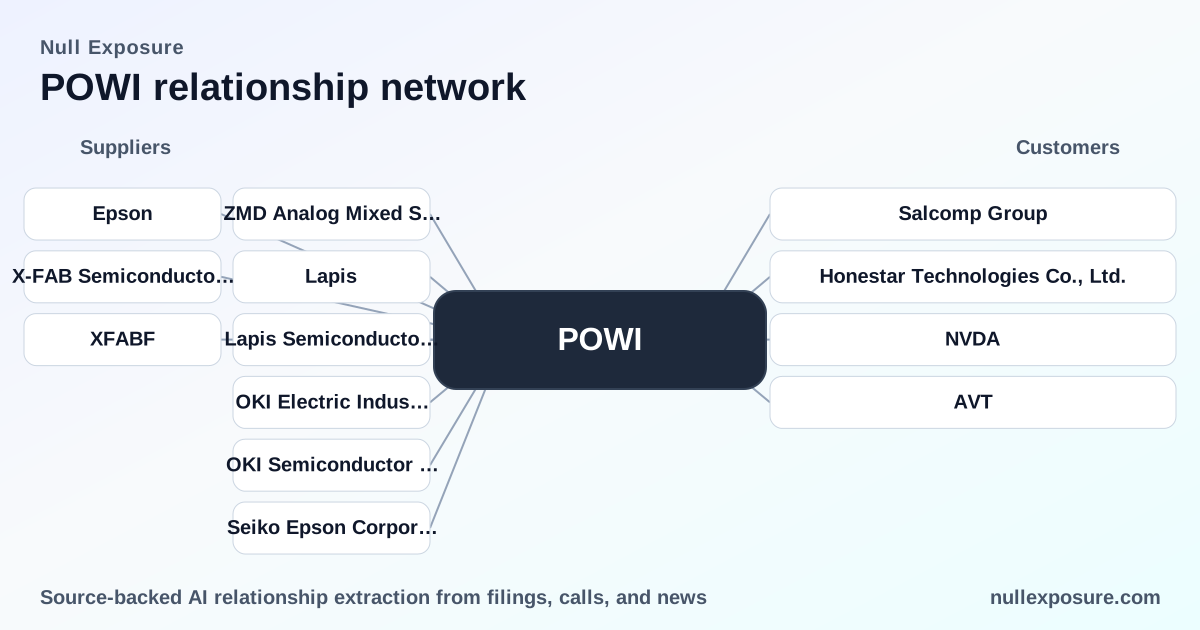
Below are every supplier relationship cited in Power Integrations’ FY2025 Form 10‑K, summarized in plain language with source notes.
ZMD Analog Mixed Signal Services GmbH & Co. KG
Power Integrations references a long-dated wafer supply agreement with ZMD Analog Mixed Signal Services, originally dated May 23, 2003, indicating a contractual manufacturing relationship for wafers. According to Power Integrations’ FY2025 Form 10‑K, this agreement remains on the books as a named supplier (10‑K, fiscal 2025).
Lapis
The company lists Lapis among its primary wafer producers, reflecting an ongoing production arrangement used for the company’s proprietary high-voltage processes. Power Integrations identifies Lapis as a core supply partner in its FY2025 10‑K (10‑K, fiscal 2025).
Lapis Semiconductor Co., Ltd.
Power Integrations filed an Amendment Number Fourteen to an existing amended and restated wafer supply agreement with Lapis Semiconductor, effective September 16, 2024, demonstrating a long-term contractual relationship that is actively amended rather than restarted (10‑K, fiscal 2025).
OKI Electric Industry Co., Ltd.
Power Integrations cites an Amended and Restated Wafer Supply Agreement with OKI Electric Industry, originally dated April 1, 2003, indicating another legacy foundry contract incorporated into its wafer sourcing strategy (10‑K, fiscal 2025).
OKI Semiconductor Co., Ltd.
The filing records a specific amendment (Amendment Number Five, effective November 14, 2008) to the wafer supply agreement with OKI Semiconductor, signaling continuing contractual ties dating back many years (10‑K, fiscal 2025).
Seiko Epson Corporation
Power Integrations lists a wafer supply agreement with Seiko Epson effective April 1, 2005, which is cited alongside other long-term foundry contracts—underlining Epson’s role in wafer production for the company’s product lines (10‑K, fiscal 2025).
Epson
Epson is included in the text as one of the three primary wafer suppliers (Epson, Lapis and X‑FAB) for the production of wafers, reinforcing that Seiko Epson and the shorthand “Epson” are treated as the same supply source in practice (10‑K, fiscal 2025).
X‑FAB Semiconductor Foundries AG
Power Integrations documents a wafer supply agreement with X‑FAB dated October 1, 2010, which places X‑FAB among the contractual partners that manufacture wafers under Power Integrations’ proprietary process requirements (10‑K, fiscal 2025).
X‑FAB (XFABF)
The 10‑K repeats X‑FAB’s inclusion among the primary wafer producers and the results also map X‑FAB to the market ticker XFABF, indicating the company is an identified public foundry partner in the filing (10‑K, fiscal 2025).
What the supplier footprint signals for investors
Power Integrations’ disclosures and constraint signals paint a clear operating picture:
- Contracting posture — long‑term, negotiated pricing. The company negotiates pricing annually with primary suppliers and uses contractual mechanisms for exchange‑rate provisions; this is consistent with long-term wafer supply agreements and multiple documented amendments in the 10‑K.
- Geographic concentration — APAC exposure. The disclosure highlights exchange‑rate sensitivity between the Japanese yen and the U.S. dollar and notes significant wafer supply from Japanese suppliers; this creates currency and geopolitical exposure concentrated in APAC.
- Role split — manufacturers and service providers. The firm contracts multiple foundries for wafer manufacture and relies on independent subcontractors in China, Malaysia, Thailand and the Philippines for assembly, packaging and test; manufacture and service roles are both operationally critical.
- Relationship maturity and active stage. The presence of multi‑decade agreements and multiple amendments shows mature, long-standing relationships that remain active and negotiated rather than ad hoc sourcing.
- Concentration risk. Despite diversification across three primary foundries, the company’s reliance on a small set of qualified partners for specialized high-voltage processes means capacity or quality disruptions at any one partner can have outsized impact on shipments.
For contract-level mapping and supplier exposure analytics, see https://nullexposure.com/ — it’s a practical next step for modeling counterparty and operational risk.
Risk synthesis and investor takeaways
- Key strength: Long-term, amended wafer agreements with Lapis, Epson, OKI and X‑FAB create predictable production continuity and make supplier relationships a defensible operating moat for high‑voltage analog products.
- Key risk: Currency exposure to Japanese suppliers and geographic concentration in APAC raise financial and operational risk—exchange‑rate pass‑through provisions and mutual sharing clauses help but do not eliminate currency or geopolitical shocks.
- Operational sensitivity: Assembly and test subcontractors in Southeast Asia are a second layer of operational risk; failure there affects time‑to‑revenue even if wafers are available.
If your investment thesis relies on stable supply and improving margins from scale, monitor contract amendments, supplier capacity statements, and any changes in the geographic mix of wafer sourcing. For a supplier map and ongoing monitoring tools, visit https://nullexposure.com/.
Final verdict for investors and operators
Power Integrations runs a contractually anchored, high-dependency supply model: its margins and delivery cadence are tightly coupled to the stability of a small group of specialized wafer foundries and a dispersed assembly/test network. That structure is both a competitive advantage and a single‑point vulnerability—advantageous when contracts hold, risky if capacity or currency shocks occur. Monitor 10‑K updates, amendment filings, and supplier capacity disclosures quarterly; prioritize due diligence on currency clauses and contingency sourcing. For ongoing supplier intelligence and contract exposure visualization, go to https://nullexposure.com/.