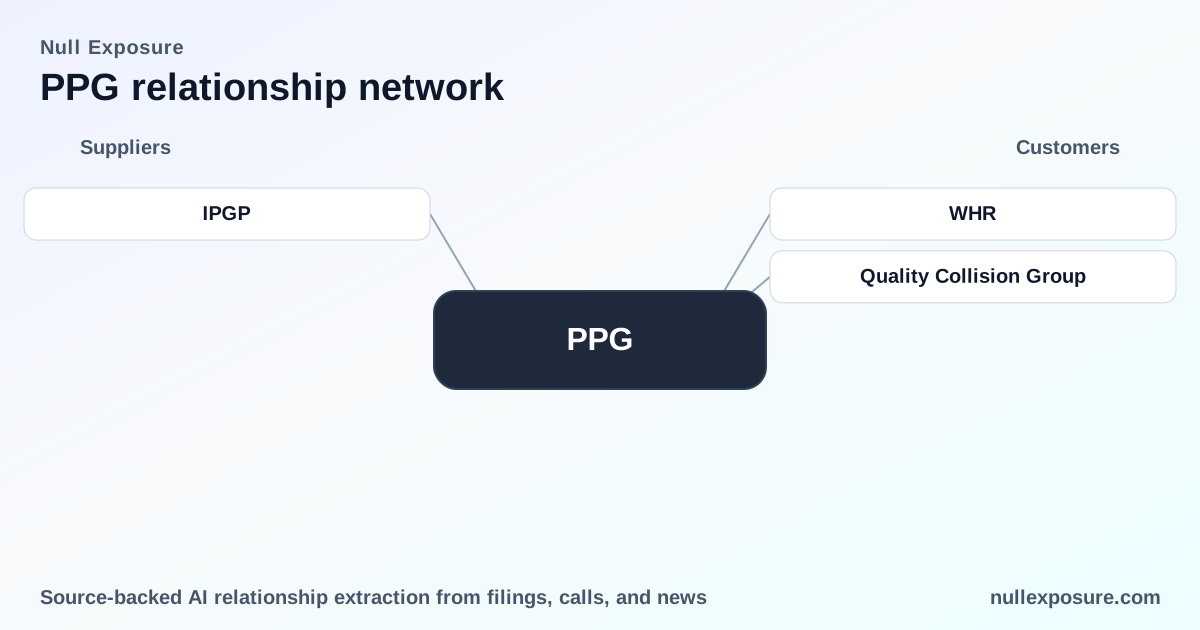
PPG Industries: supplier relationships, strategic posture, and what investors should price in
PPG Industries operates and monetizes as a global producer of paints, coatings, and specialty materials, selling finished products and technical services to industrial, automotive, and consumer markets while controlling margins through product mix, scale, and incremental innovation. PPG’s profitability rests on large-scale raw-material sourcing, manufacturing footprint, and its ability to commercialize process improvements—such as advanced curing systems—that lower cycle times and support premium formulations. For investors, supplier relationships are not ancillary: they influence input-cost volatility, capex effectiveness, and the feasibility of product-innovation programs that underpin long-term margin expansion. Explore supplier position details at https://nullexposure.com/.
Quick macro snapshot that frames supplier risk and leverage
PPG reported trailing revenue of $15.875 billion and EBITDA of $2.652 billion, with an operating margin near 11% (TTM). The company sources most raw materials and energy externally and pursues multi-source contracts, local qualifying, and occasional on-site resin production to reduce exposure to single suppliers. Raw-material cost management and supplier diversification are central to PPG’s operating model. High institutional ownership (≈92%) and a market capitalization around $23.15 billion mean supplier shocks transmit quickly to valuation multiples.
What the recent supplier mentions tell investors
PPG’s public supplier activity in early 2026 centers on technology partnerships to accelerate finishing and curing processes—actions that have clear operational and margin consequences.
IPG Photonics — pilot laser curing at Strongsville and Pittsburgh (Optics.org)
PPG installed IPG Photonics’ PhotoniCURE laser curing system in a pilot finishing line at its powder manufacturing and technical facility in Strongsville, Ohio, and placed a laboratory unit at the PPG Coatings Innovation Center near Pittsburgh. According to Optics.org (March 10, 2026), the installations are positioned for feasibility studies and pilot scale-up supporting powder-coating process improvements.
Source: Optics.org, March 10, 2026 — https://optics.org/news/17/3/11
IPG Photonics — third-party coverage confirms pilot installation (TradingView / Zacks)
Independent coverage reiterated that PPG installed IPG’s PhotoniCURE system at Strongsville and a lab unit at the Pittsburgh innovation center, underlining PPG’s push to evaluate laser curing for production acceleration and potential material-property benefits. TradingView relayed the Zacks report on March 10, 2026.
Source: TradingView (Zacks republished), March 10, 2026 — https://www.tradingview.com/news/zacks:ccca35c34094b:0-ppg-teams-up-with-ipg-and-whirlpool-to-advance-laser-curing/
How these supplier moves change the investment calculus
PPG’s adoption of IPG’s laser-curing equipment is operationally meaningful: faster, more precise curing directly impacts cycle time, throughput, and energy consumption in powder coatings—items that affect gross margins and capital productivity. The pilot installations indicate a deliberate, staged validation approach rather than a full-scale roll-out, which fits PPG’s operating posture of piloting innovation at technical centers before committing larger CAPEX.
- Contracting posture: PPG uses pilot-and-scale trials to convert technology suppliers into strategic partners rather than transactional vendors. This reduces implementation risk and accelerates vendor lock-in when performance justifies expansion.
- Maturity: The relationship is in an active pilot phase; technical validation is the near-term deliverable before any broad procurement.
- Criticality: For the powder-coatings business, advanced curing technology is a medium-to-high criticality input because it can materially influence cost per unit and product quality.
- Concentration: PPG’s procurement strategy emphasizes multiple sources; the company will likely retain alternate curing or finishing routes until the IPG technology demonstrates clear economic advantage.
Explore how these supplier engagements map to PPG’s overall supplier exposure at https://nullexposure.com/.
Constraints and supply-chain signals investors should internalize
PPG’s public disclosures and supplier program excerpts surface two company-level signals that define contracting risk and working-capital dynamics.
-
Geography: PPG is aggressively broadening supply within Asia and lower-cost regions and is qualifying multiple and local sources to manage raw-material and energy supply. This is a deliberate strategy to lower input-cost sensitivity and reduce geographic concentration risk. The company also highlights initiatives to diversify resin supply, including on-site resin production at certain facilities, and to reduce dependence on titanium dioxide and other costly inputs. This is a company-level signal about sourcing flexibility and cost containment.
-
Relationship stage & working capital: PPG operates voluntary supplier finance programs with financial intermediaries that let participating suppliers receive accelerated payment. As of the twelve months ended December 31, 2024, the rollforward of confirmed obligations under these programs was material to payables. This indicates an active relationship-management posture that uses third-party financing to optimize payables and support supplier liquidity while preserving PPG’s DPO profile.
These constraints produce practical implications:
- Contracting flexibility is high—PPG negotiates multi-source arrangements and will internalize some resin production to reduce supplier concentration risk.
- Working-capital dynamics leverage supplier finance to stabilize supply chains and reduce supply-side disruption risk, but also create counterparty exposure to financial intermediaries that investors should track.
- Input-risk mitigation includes formula changes to lower titanium dioxide reliance, which reduces raw-material price pass-through into margins over time.
Practical investment implications and risk checklist
Investors should spotlight three variables when valuing PPG given supplier dynamics:
- Innovation adoption cadence: Successful scale-up of IPG’s curing tech would be a positive operating leverage event; failure to scale raises capex write-off risk and slower product-cycle improvements.
- Input-cost trajectory: Track titanium dioxide pricing and resin availability; PPG’s active diversification and on-site production are offsets that reduce long-term volatility.
- Supplier finance exposure: The supplier finance program improves supplier stability but increments counterparty and short-term liquidity complexity; monitor disclosures for program balances and intermediary counterparties.
For a deeper read on supplier exposure and scenario analysis, visit https://nullexposure.com/ to review consolidated supplier intelligence.
Bottom line: where to position
PPG manages supplier relationships as an operational lever, not as a passive procurement function. The IPG Photonics pilots are a clear example of turning supplier technology into potential margin expansion, while company-level sourcing diversification and supplier finance programs reduce single-point supply risk. Investors should underwrite a path where incremental process innovations lift ROIC, but also stress-test models for slower-than-expected technology adoption and commodity-driven margin pressure.
If you want an investor-grade supplier risk brief tailored to PPG’s capital plan and raw-material scenarios, request an analysis at https://nullexposure.com/.