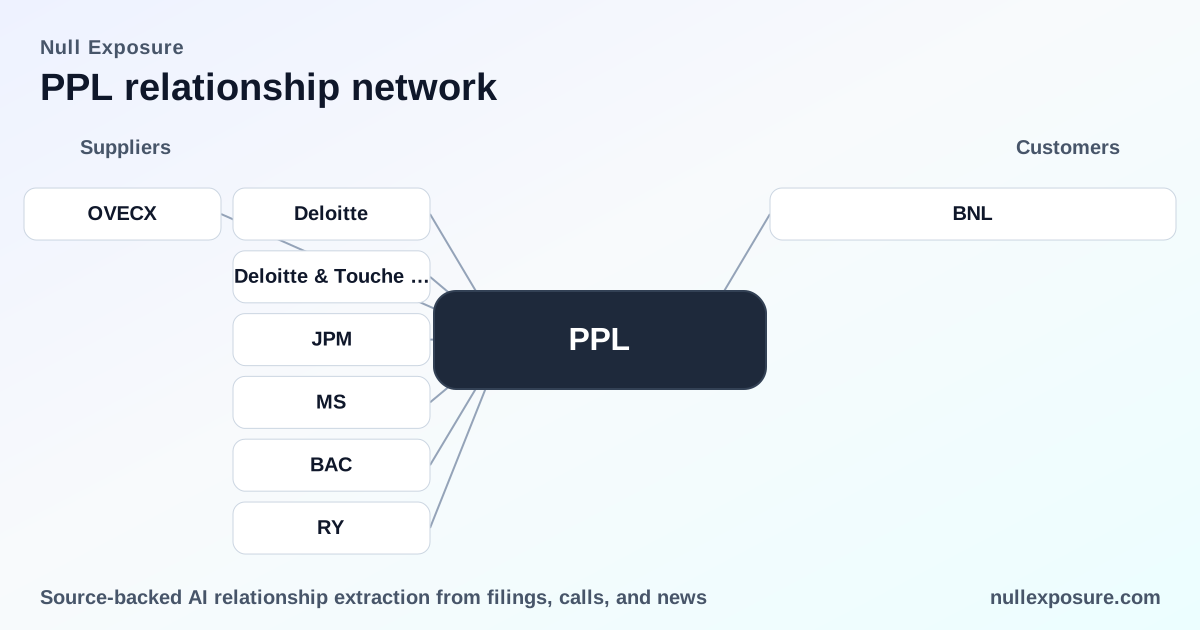
PPL Corporation: Supplier relationships and what they mean for investors
PPL Corporation operates as a regulated electric utility holding company that monetizes a regulated rate base, long-term power purchase arrangements, and merchant-capital markets activity. The company generates stable cash flows through delivery and generation subsidiaries while periodically tapping capital markets — most recently through an equity units offering in March 2026 — to fund investments and manage balance-sheet composition. PPL’s business model blends regulated earnings stability with intermittent capital-markets dependence, a profile that drives the supplier relationships and contracting posture discussed below. For a broader supplier-risk view, visit https://nullexposure.com/.
How the supplier map defines operational risk and capital access
PPL’s supplier relationships fall into three observable clusters: audit & oversight, capital markets providers, and long-dated energy counterparties. Audit relationships support governance and reporting integrity; bank syndicates enable funding/underwriting events; and power/pipeline counterparties underpin physical supply and reliability.
- Contracting posture: PPL discloses a mix of long-term contracts (pipeline capacity and PPAs through 2040–2056) together with short-term and spot purchases (natural gas and some coal), reflecting a dual strategy of securing capacity while optimizing fuel costs in merchant markets. This is a company-level signal taken from PPL’s 2024 Form 10‑K.
- Concentration and diversification: Capital markets work is executed via syndicated book-runners (J.P. Morgan, BofA, Morgan Stanley, RBC), which spreads underwriting risk across major investment banks and reduces single-counterparty concentration for financing events (March 2026 press reports).
- Criticality and maturity: Several contracts extend decades (pipeline and lease expirations out to the 2040s–2050s), locking in capacity and cost exposure that are critical to reliability and long-term cash flow stability. PPL’s 10‑K documents these long maturities.
- Role posture: PPL acts primarily as a buyer of commodity supply and purchaser of long-term transport capacity while outsourcing some transmission reliability services; PPL’s disclosures indicate both buyer and service‑procurement roles across its subsidiaries.
For an integrated supplier-risk dashboard of this profile, see https://nullexposure.com/.
Detailed supplier relationships investors should track
Deloitte
Deloitte is identified in PPL’s 2024 Form 10‑K as the independent auditor serving KU (Kentucky Utilities). According to the 2024 10‑K filings, Deloitte provided audit services to KU, reflecting an established external-audit relationship supporting regulatory and financial reporting integrity.
Deloitte & Touche LLP
Deloitte & Touche LLP served as PPL Electric’s independent auditor for the fiscal years ended 2024 and 2023, per PPL’s 2024 Form 10‑K; this confirms continuity in external audit oversight for the regulated Pennsylvania electric business.
J.P. Morgan Securities LLC
J.P. Morgan Securities LLC acted as a joint book‑running manager for PPL’s March 2026 equity units offering, indicating direct access to top-tier underwriting capability for balance-sheet transactions (reported in March 2026 press releases on the offering).
Morgan Stanley & Co. LLC
Morgan Stanley & Co. LLC served as a joint book‑running manager on the same equity‑units transaction in March 2026, giving PPL another leading capital‑markets partner for securities distribution and pricing execution.
BofA Securities
BofA Securities was named a joint book‑running manager for the March 2026 equity units offering, signaling participation from a major global bank in underwriting and distribution functions for PPL’s capital markets activity.
RBC Capital Markets, LLC
RBC Capital Markets, LLC completed the syndicate of joint book‑running managers for the March 2026 equity units offering, broadening the underwriting base and investor reach for PPL’s transaction (reported in multiple March 2026 news releases).
Sources for the four book‑runners: press releases and market coverage of PPL’s equity units offering published in March 2026 (Finviz and SG/Yahoo Finance coverage).
OVEC (Ohio Valley Electric Corporation)
LG&E and KU have a power purchase agreement (PPA) with OVEC that expires in June 2040, establishing a long-dated supply relationship that contributes to generation availability and contractually defined capacity and energy deliveries (disclosed in PPL’s 2024 10‑K).
What these relationships imply for valuation, risk, and operations
- Regulatory stability with long-tail operational commitments. Long-term PPAs and pipeline capacity agreements through the 2040s–2050s are value-supporting because they stabilize earnings and justify regulated investments, but they also create locked-in cost exposures that require active management.
- Capital markets access is robust. The March 2026 equity units offering, underwritten by J.P. Morgan, BofA, Morgan Stanley and RBC, demonstrates ready access to diversified underwriters, reducing execution risk for financing events and improving optionality for deleveraging or funding capex.
- Commodity exposure remains an active risk vector. PPL combines long-term coal and capacity contracts with spot natural gas purchases; this mix preserves reliability while exposing the company to fuel-price volatility. The 10‑K notes spot market purchases for natural gas and augmenting coal contracts with spot buys through 2030.
- Operational contracts are often long-maturity and critical. Leases and transport capacity contracts extend into the 2050s, making counterparties and contract terms a strategic lever for cash-flow stability and resilience planning.
- Governance and audit continuity is intact. Continued audit coverage by Deloitte/Deloitte & Touche LLP supports investor confidence in financial reporting and regulatory compliance.
Company-level constraints and governance signals
PPL’s disclosures establish clear company-level constraints: a meaningful portion of supply and transport is secured via long-term contracts, leases have expirations far into mid-century, and variable lease payments were immaterial in 2024 — all of which signal predictable cash‑outflows and limited short-term volatility from leasing arrangements. The company also uses short-term and spot procurement where flexibility is operationally warranted, and it has engaged transition services that were completed in 2024, indicating legacy integration work is concluded (all described in PPL’s 2024 Form 10‑K).
If you evaluate supplier risk for portfolio allocation or operational counterparty monitoring, PPL’s mix of long-term, credit-worthy banking partners and long-dated energy contracts merits focused review on contract terms, counterparty credit quality, and fuel‑price hedging strategy. Learn more about mapping suppliers to investment risk at https://nullexposure.com/.
Bottom line and recommended next steps
PPL’s supplier network combines regulatory earnings insulation from long-term PPAs and pipeline capacity with flexible commodity sourcing that preserves cost optimization options. The company’s diversified underwriting partners reduce financing execution risk, while audit continuity supports reporting integrity. For investors, the next steps are to (1) monitor counterparty credit for long-duration suppliers, (2) stress-test commodity and contract roll-off scenarios, and (3) track capital markets activity that changes leverage or equity dilution.
For a deeper supplier-risk briefing tailored to institutional investors and operators, visit https://nullexposure.com/.