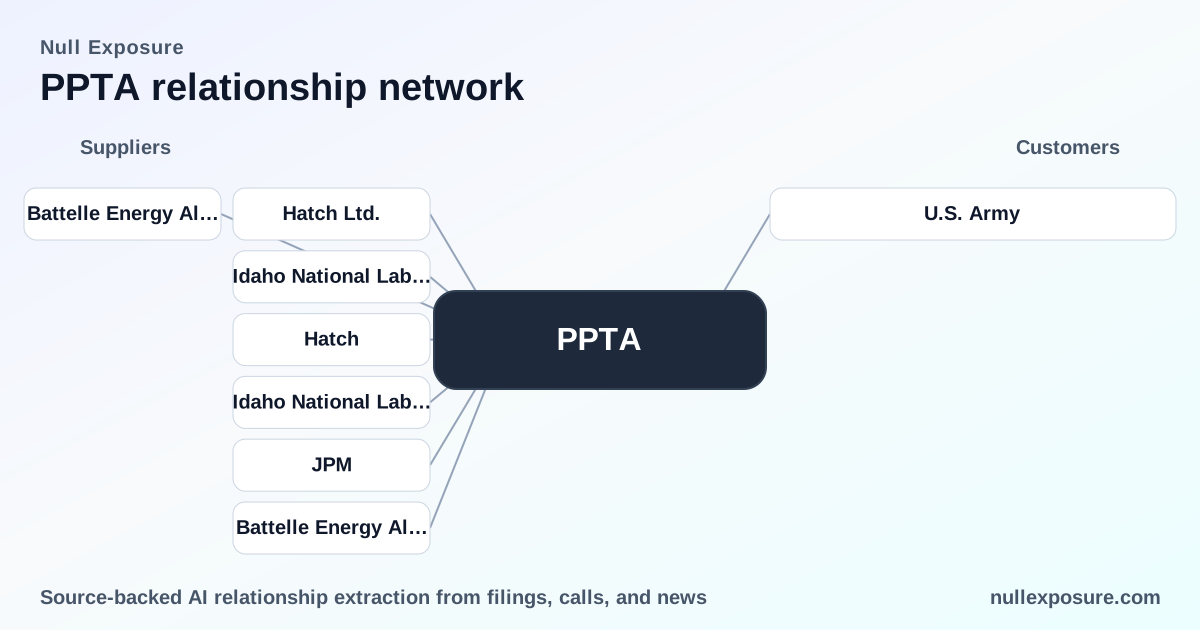
Perpetua Resources (PPTA): What the new supplier and advisor slate says about execution risk and optionality
Perpetua Resources operates as a project developer in the precious metals and mining sector, advancing the Stibnite Gold Project from permitting and design into large-scale construction and processing. The company monetizes by developing ore-processing capacity to produce gold and critical minerals (notably antimony), funding development through equity partnerships and capital markets activity, and outsourcing specialized engineering, pilot testing, and financial advisory services necessary to de‑risk and execute a capital‑intensive build. Investors evaluating supplier relationships should view recent hires as a shift from feasibility to execution — and a corresponding reallocation of technical and counterparty risk to third‑party providers. For deeper supplier intelligence and structured relationship tracking visit https://nullexposure.com/.
Why the EPCM choice matters: Hatch joins the execution team
Perpetua announced the selection of Hatch as the Engineering, Procurement and Construction Management (EPCM) contractor for defined portions of the Stibnite Gold Project. According to a company release on Yahoo Finance in mid‑December 2025, Hatch will deliver design, engineering, procurement management, construction management, project controls, and commissioning and operational readiness support. This is a pivotal execution move: selecting a global EPCM firm transfers significant execution and scheduling risk off Perpetua while concentrating project delivery exposure in a single integrator.
-
Hatch Ltd. — Perpetua selected Hatch as the EPCM contractor for the Stibnite Gold Project, with responsibilities spanning design, procurement oversight, construction management and commissioning (company press release, Dec 16, 2025; reported via Yahoo Finance and The Globe and Mail).
Source: Yahoo Finance press release (Dec 16, 2025) and The Globe and Mail coverage. -
Hatch — Industry trade coverage reiterated that Hatch’s appointment is an execution milestone because EPCM performance will be a central determinant of capex and schedule outcomes (IM‑Mining and FinViz analyses, Dec 2025).
Source: IM‑Mining (Dec 17, 2025) and FinViz commentary.
Pilot processing and national‑security optionality: INL and Battelle partnerships
Perpetua is actively pursuing pilot‑scale processing validation with national laboratory partners to recover antimony and other defense‑relevant minerals from Stibnite ore. These engagements improve technical de‑risking while positioning the project within U.S. critical‑minerals initiatives.
-
Idaho National Laboratory (INL) — Perpetua signed an agreement under which INL will host, commission and operate a modular pilot processing plant to test recovery of antimony and other critical minerals from Stibnite material (company announcement and trade press, Dec 9, 2025).
Source: IM‑Mining and FinViz coverage referencing Perpetua’s Dec 9, 2025 announcement. -
Idaho National Laboratory (INL) — Multiple outlets reported that INL will operate a flexible modular plant roughly 150 km northeast of Boise, strengthening Perpetua’s validation pathway for non‑gold revenue streams (Mugglehead and TS2.tech, Dec 2025).
Source: Mugglehead and TS2.tech (Dec 2025). -
Battelle Energy Alliance — Reporting identifies Battelle Energy Alliance as the operator of INL and the entity facilitating the pilot plant hosting, commissioning and operations for Perpetua’s pilot program (TS2.tech and IM‑Mining reporting, Dec 2025).
Source: TS2.tech (Dec 9, 2025) and IM‑Mining (Dec 10, 2025). -
Battelle Energy Alliance LLC — Trade reporting used the corporate variant “Battelle Energy Alliance LLC” when describing the contractual arrangement that enables INL’s support, underlining government‑lab operational involvement rather than a purely commercial contractor (IM‑Mining, Dec 2025).
Source: IM‑Mining (Dec 10, 2025).
Capital markets and strategic advisory: J.P. Morgan’s role
Perpetua used a recognized investment bank in recent equity transactions, indicating a standard capital‑markets pathway for raising development capital and strategic partnership facilitation.
- J.P. Morgan Securities LLC — J.P. Morgan acted as M&A financial advisor to Perpetua in connection with the company’s equity sale to Agnico Eagle, a financing and strategic step reported in a December 2025 release. This underscores reliance on top‑tier advisors for raising and syndicating development capital.
Source: Yahoo Finance press release regarding the $255 million sale (Dec 2025).
What the relationship slate signals about Perpetua’s operating model
Perpetua’s public supplier and advisor roster and supporting filing evidence collectively reveal a company that is structurally outsourcing high‑execution complexity while retaining strategic control of permitting and offtake optionality.
- Contracting posture: Perpetua is using large, specialized service providers (global EPCM firm, national lab operators, and major investment banks) to move from design to construction and pilot validation. This demonstrates an intentional transfer of project execution and technical validation risk to third parties.
- Concentration: The appointment of a single EPCM contractor concentrates execution exposure; a positive from a coordination perspective but a single‑point‑failure from counterparty concentration and schedule risk perspectives. Suppliers and lenders must price the counterparty concentration into contract terms and contingency reserves.
- Criticality: Partners are materially critical to the project’s de‑risking: Hatch controls construction outcomes; INL/Battelle provide proof of process for critical minerals that expand revenue optionality beyond gold. These relationships are high‑impact for project value and timeline.
- Maturity: The mix of EPCM hiring, pilot plant agreements, and capital advisory work indicates transition from earlier-stage permitting/feasibility to capital‑intensive execution and commercialization phases. This elevates near‑term cash needs and counterparty performance as primary investor risks.
Company‑level constraint signals from filings reinforce these operational signals without tying them to a single supplier. For example, an excerpted employment agreement referenced in filings establishes presence of individual counterparty arrangements at management level; other filing language confirms that raw materials are sourced through usual U.S. and Canadian supply channels — a company‑level geography signal that implies local procurement is feasible. Finally, multiple filings and disclosures list Perpetua’s extensive use of external service providers (Idaho Power procurement contract, early contractor involvement awards, and auditor consents), supporting a high confidence signal that Perpetua’s business model deliberately relies on third‑party service providers for project delivery.
For supplier managers and investors, this means contract terms, performance bonds, and schedule protections are priority negotiation levers. If you evaluate or underwrite supplier exposure to Perpetua, insist on clear milestone payments, liquidated damages, and independent assurance mechanisms for schedule and cost.
Explore deeper relationship maps and supplier monitoring tools at https://nullexposure.com/ to track counterparty exposure and contract milestones.
Risk, return and a short playbook for investors and operators
- Upside: Successful EPCM execution and validated pilot‑scale processing for antimony open diversified revenue streams and justify re‑rating of development risk into execution value. Hatch and INL/Battelle bring technical credibility that materially de‑risks capex delivery and product pathway.
- Downside: Concentrated execution exposure to a single EPCM contractor and the inherent schedule and capex escalation risk of mines remain the principal downside drivers. Financial advisor involvement signals ongoing capital raises; equity dilution and funding execution risk remain investor control points.
- Actionable posture for suppliers and counterparties: Negotiate staged scope, performance metrics tied to commissioning milestones, and robust change‑order governance to limit exposure to scope creep.
If you are managing supplier risk or evaluating an operator relationship, view Perpetua’s supplier roster as a transition signal — the company is moving into the stage where supplier performance will directly determine project value. For supplier exposure dashboards and curated counterparty intelligence, visit https://nullexposure.com/.
Bold decisions about contracting, surety and contingent financing will determine whether Perpetua’s relationships are an execution multiplier or a concentration risk. For vendor due diligence and to monitor future relationship disclosures, start with the Perpetua profile and supplier tracker at https://nullexposure.com/.