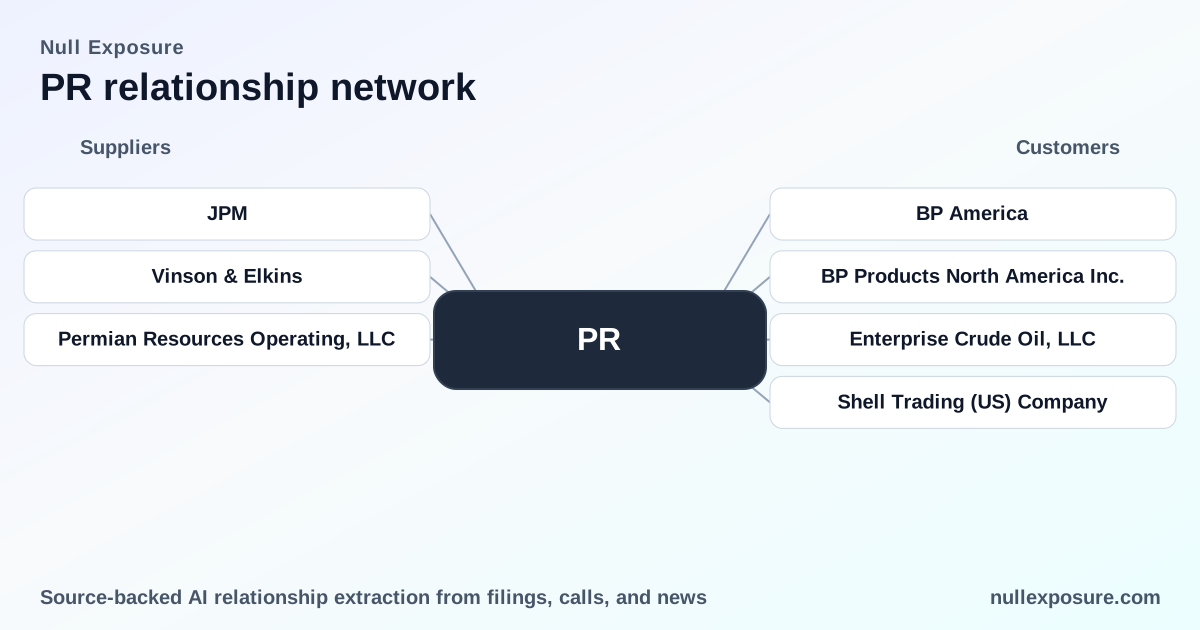
Permian Resources (PR) — Supplier relationships, capital partners and what they mean for investors
Permian Resources is an independent oil and gas E&P focused on developing crude oil and liquid-rich natural gas in the Permian Basin. The company monetizes through production sales, periodic equity offerings and secured borrowing under credit facilities to fund drilling and completion activity; its public metrics show a sizeable free-cash flow engine (FY TTM EBITDA roughly $3.95B and market capitalization near $16.3B) balanced against recurring capital and operating commitments. For investors and operators, the mix of long-term purchase obligations and active capital-market transactions paints a picture of predictable operating spend combined with deliberate balance-sheet management. Learn more about supplier intelligence and partner risk at https://nullexposure.com/.
How these supplier facts reveal the operating posture
Permian Resources’ supplier signals are consistent with a midstream-capable E&P operator that locks-in key inputs to stabilize field economics. Company disclosures identify multi-year electricity purchase agreements and a take-or-pay frac sand contract through December 31, 2026. Those contractual features establish a buyer posture with fixed minimums rather than purely spot sourcing.
- Contracting posture: Multi-year and take-or-pay clauses create downside cost rigidity but protect deliverability and planning for high-activity drilling programs.
- Concentration and criticality: Electricity and frac sand are operationally critical; interruptions or cost increases would directly affect completions and produced volumes.
- Maturity and timing risk: The frac sand agreement’s explicit term to 2026 creates a near-term maturity event that requires management attention ahead of expiry.
- Financial scale of commitments: Public disclosures list remaining minimum obligations of $53.5 million and another remaining obligation of $90.0 million (through 2026), consistent with a $10M–$100M spend band that is material but not balance-sheet destabilizing for a company of Permian’s scale.
These signals should be read as company-level operating realities rather than being tied to any single counterparty unless the contract text explicitly does so.
Counterparty relationships investors should track
Below are the named counterparties and what each relationship signals for financial and operational risk.
JPMorgan Chase — lender role and liquidity runway
Permian amended its credit agreement with JPMorgan Chase on December 22, 2025 to ensure continued access to credit during a planned holding-company reorganization, preserving a lender backstop through the transaction. This amendment reduces near-term liquidity and covenant risk while management executes corporate restructuring. Source: TradingView coverage of the December 22, 2025 credit amendment (published March 2026).
Vinson & Elkins — capital markets and securities counsel
Vinson & Elkins acted as counsel to Permian Resources and certain selling stockholders on an underwritten secondary offering of 48,500,000 Class A shares priced at $15.76 per share, demonstrating the company’s active use of equity markets to manage shareholder base and liquidity. Legal counsel engagement on large equity transactions signals management’s willingness to access public capital as part of its financing toolkit. Source: Vinson & Elkins announcement regarding the secondary offering (FY2024 disclosure).
Permian Resources Operating, LLC — internal capital structure simplification
Concurrently with the share offering, Permian Resources repurchased 2,000,000 common units in Permian Resources Operating, LLC at a price equal to the offering underwriter’s purchase price per Class A share, indicating a deliberate consolidation of public equity economics and simplification of the upstream operating vehicle. This transaction aligns ownership interests between the holdco and the operating unit. Source: Vinson & Elkins announcement regarding repurchase of common units (FY2024 disclosure).
What these relationships imply for credit, capital and operations
- Credit flexibility: The JPMorgan amendment is a material credit-side positive — it preserves access to working capital and term liquidity during a structural reorganization. That reduces refinancing risk and supports continued field activity.
- Capital markets access: The use of a large equity offering advised by Vinson & Elkins shows management can access institutional buyers to refresh the share register and raise capital when required. This supports balance-sheet optionality.
- Operational alignment: Repurchasing operating-unit common units suggests management is aligning incentives and eliminating potential frictions between the public equity and the operating company cash flows.
- Procurement rigidity: Long-term electricity and take-or-pay frac sand contracts create fixed-cost exposure that limits short-term operating leverage when commodity prices fall, but they also secure inputs during peak completion activity.
Place special attention on covenant language in the JPMorgan facility and the timing of the frac sand contract expiry on December 31, 2026; both are high-impact near-term levers that will shape capital allocation decisions.
If you need a consolidated view of counterparty risk and supplier commitments for investment due diligence, explore the supplier intelligence hub at https://nullexposure.com/.
Practical steps for investors and operators
- Monitor the amended credit facility for covenant step-downs or pricing resets tied to the holding-company reorganization; covenant relief or tightening will directly affect free-cash-flow allocation.
- Track the frac sand contract expiry and electricity purchase minimums as drivers of completion-cost volatility in 2026; hedging or alternative sourcing decisions will be decision points for management.
- Evaluate follow-on capital needs given the equity offering and unit repurchase: equity access is intact but dilutive; repurchases signal simplification which can improve per-share economics over time.
Actionable recommendation: stress-test near-term cash flow against scenarios where completion intensity increases and take-or-pay obligations are fully drawn. For more supplier-level signals and partner scoring, visit https://nullexposure.com/.
Bottom line
Permian Resources operates with a balanced approach: secured supplier contracts that stabilize operations combined with active capital-market engagement and lender support to maintain liquidity through structural changes. The interplay of fixed procurement obligations and deliberate balance-sheet actions creates a predictable yet inflexible cost base that investors must price into valuation and stress scenarios. Watch the JPMorgan credit amendment language and the December 31, 2026 contract maturity for the next meaningful inflection points. For tailored partner risk analysis and ongoing monitoring of supplier relationships, return to https://nullexposure.com/.