ProAssurance (PRA): Supplier posture, reinsurance dynamics, and the audit relationship investors should track
ProAssurance underwrites U.S. property & casualty insurance with a clear monetization model: collect premiums, cede portions of risk via reinsurance, and distribute products through independent agents and brokers, capturing margin between underwriting returns and investment income. For investors evaluating supplier and service-provider exposure, the critical items are counterparty credit in reinsurance, distribution concentration, and the operational controls supplied by external auditors. Learn more about supplier intelligence and monitoring at https://nullexposure.com/.
How ProAssurance actually makes money — and where suppliers fit in
ProAssurance’s core revenue comes from written premiums for P&C policies; Revenue TTM is roughly $1.11 billion, with gross profit of $312 million and a modest profit margin of 4.6%, per the most recent company data. The firm reduces net loss exposure by purchasing reinsurance, which functions both as capital leverage (to allow larger limits) and as a loss-absorption mechanism. Distribution is routed largely through independent agents and brokers, who are essential to new business flow and retention. Investors should note the balance-sheet and underwriting sensitivity: a short-term contracting posture in reinsurance and distribution can create periodic exposure spikes tied to renewals and reinsurer performance.
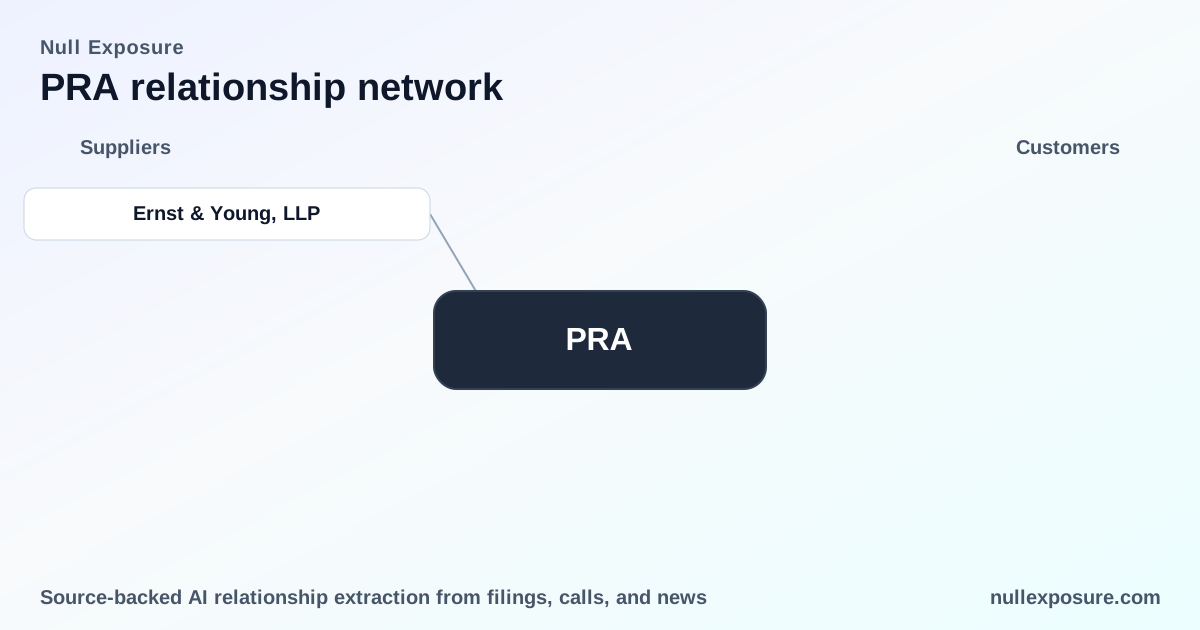
The single supplier relationship surfaced: Ernst & Young, LLP
Ernst & Young, LLP is listed as ProAssurance’s independent auditor after shareholder ratification for the fiscal year ending December 31, 2024. A report in Insurance Business Magazine (March 10, 2026) noted shareholders approved the company’s 2024 Equity Incentive Plan and ratified Ernst & Young, LLP as the independent auditing firm for fiscal 2024. Auditor continuity and scope of work are relevant to financial control risk and investor confidence. (Insurance Business Magazine, March 10, 2026.)
What the operating constraints tell investors about supplier risk
The company-level constraints extracted from filings and disclosures frame how supplier and counterparty exposure behaves in practice:
-
Contracting posture — short-term renewals dominate. ProAssurance’s Medical Professional Liability and Medical Technology Liability treaties renew annually on October 1, and the workers’ compensation treaty renews annually on May 1. That calendar of short-term treaty renewals creates repeated points of negotiation and potential capacity or pricing shocks when market conditions shift.
-
Materiality — supplier failures are consequential. Management explicitly flags that losing independent agents or reinsurers, or facing reinsurer non-payment, can have a material adverse effect on operations and cash flow. This is not a peripheral risk; it is core to underwriting economics and revenue access.
-
Relationship role — suppliers are service providers with outsized functional roles. Independent agents/brokers are the primary distribution channel, while reinsurers are functionally providers of loss-absorbing capacity. Both categories act as essential service providers rather than mere vendors.
These constraints are company-level signals about how supplier relationships influence business outcomes rather than attributes of any single supplier.
Why the EY relationship matters to investors and operators
An external auditor like Ernst & Young provides independent assurance over ProAssurance’s financial reporting, reserve adequacy, and internal controls — all of which are material when reinsurance recoverables and loss reserves drive volatility. With annual treaty renewals and the potential for reinsurer disputes to affect reported reserves, audit quality and continuity are practical risk mitigants for the investor base.
- Takeaway: Maintain attention on auditor reports and any modified opinions or key audit matters that relate to reinsurance recoverables and reserve assumptions. (Insurance Business Magazine, March 10, 2026.)
Concentration and ownership context that change the supplier calculus
Two balance-sheet and market signals sharpen the supplier assessment:
-
Institutional holders represent about 97.9% of shares outstanding, concentrating voting and stewardship. That level of institutional ownership can accelerate governance responses to supplier or counterparty failures but also centralizes pressure on management to meet earnings guidance.
-
Market valuation metrics show a Price/Book around 0.94 and a forward P/E of ~16.9, implying the market prices some upside but also discounts capital adequacy or underwriting risk; monitor how supplier events (reinsurer delays, agent consolidation) affect this valuation gap.
Practical actions for supplier and relationship managers
For investor analysts and operator-level procurement teams, the following actions flow directly from ProAssurance’s operating signals:
- Prioritize counterparty credit monitoring for reinsurers and track reinsurer payment timeliness relative to reported recoverables; reinsurer credit risk is explicitly material in the company’s disclosures.
- Monitor distribution concentration trends: loss or consolidation of independent agents is listed as materially impactful to new business and retention.
- Watch auditor communications — any emphasis on reinsurance recoverables, claims reserves, or internal control weaknesses should trigger a deeper due diligence cycle.
For assistance structuring supplier monitoring and risk scoring for insurance counterparties, consider the supplier intelligence resources at https://nullexposure.com/.
What to watch next and investor checklist
- Quarterly reserve development and the auditor’s commentary on reserve methodology.
- Reinsurer payment timelines and any disputes logged in regulatory filings.
- Renewal cycle outcomes in May and October — these dates align with workers’ comp and MPL treaty renewals and are potential inflection points.
- Governance actions driven by large institutional holders if supplier issues threaten near-term earnings.
Analyst signals indicate mixed sentiment — four holds and one sell among tracked analysts, with an analyst target of $25 — so supplier shocks that affect reserves or premium volume could quickly alter consensus. For ongoing supplier intelligence tailored to financial and operational stakeholders, visit https://nullexposure.com/.
Bottom line
ProAssurance operates a model where distribution partners and reinsurers are not peripheral suppliers but operational linchpins, and the auditing relationship with Ernst & Young is a meaningful element of investor trust in reported results. Short-term contract renewals and explicit materiality of counterparty performance elevate supplier oversight to a first-order investment consideration. For investors and operators, the recommended focus is robust reinsurer credit surveillance, active monitoring of agent network health, and close reading of auditor commentary at each reporting cycle. For the tools and monitoring frameworks that support those activities, explore https://nullexposure.com/.