Perdoceo (PRDO): Supplier relationships, legal overlays, and what investors should price in
Perdoceo Education operates and monetizes by delivering postsecondary education through online, campus-based, and blended programs, converting tuition and related student funding into recurring revenue; the company reported $846.1M in trailing revenue, $237.6M of EBITDA, and a market capitalization of roughly $2.23B as of the latest filings. Its operating model pushes significant spend into student acquisition and campus/administrative leases, creating persistent counterparty exposure across marketing vendors, collection agents, legal monitors, and landlords. For investors assessing supplier risk, the combination of high marketing spend, long-dated real estate leases, and third‑party service providers handling sensitive student data are the decisive lenses to apply.
For a concise platform review and supplier-risk intelligence on Perdoceo, visit https://nullexposure.com/.
Why supplier relationships matter for Perdoceo now
Perdoceo’s financial profile—strong margins and predictable revenue—masks operational dependencies that translate directly into investment risk. Student acquisition is a high-dollar function for the company (advertising and marketing expense reported above $100 million), meaning vendor performance and contract terms with lead generators and advertising agencies materially affect top-line trajectory. Simultaneously, long-term leases through 2049 and a revolving credit facility extended to January 31, 2027 create multi-year fixed-cost commitments that limit short-term flexibility and amplify vendor continuity risk.
- Contracting posture: The company operates with long-term commitments (leases and credit facilities), which increases switching costs and makes supplier performance or disruption more consequential.
- Spend concentration: Advertising and marketing is a multi-hundred‑million dollar line item, representing a major controllable lever for growth or cost control.
- Criticality and maturity: Third-party service providers (lead aggregators, debt collectors) handle critical student-facing processes and sensitive data; contractual maturity and oversight of these services are therefore central to operational risk management.
- Event risk: Perdoceo has recorded terminations and monitored compliance obligations historically, signaling active legal and regulatory oversight of supplier relationships.
These are company-level signals derived from Perdoceo’s filings and contemporaneous reporting; they inform how investors should weight supplier-related downside.
Explore our broader coverage at https://nullexposure.com/ for benchmarking and supplier exposure models.
What the reporting shows — specific supplier relationships
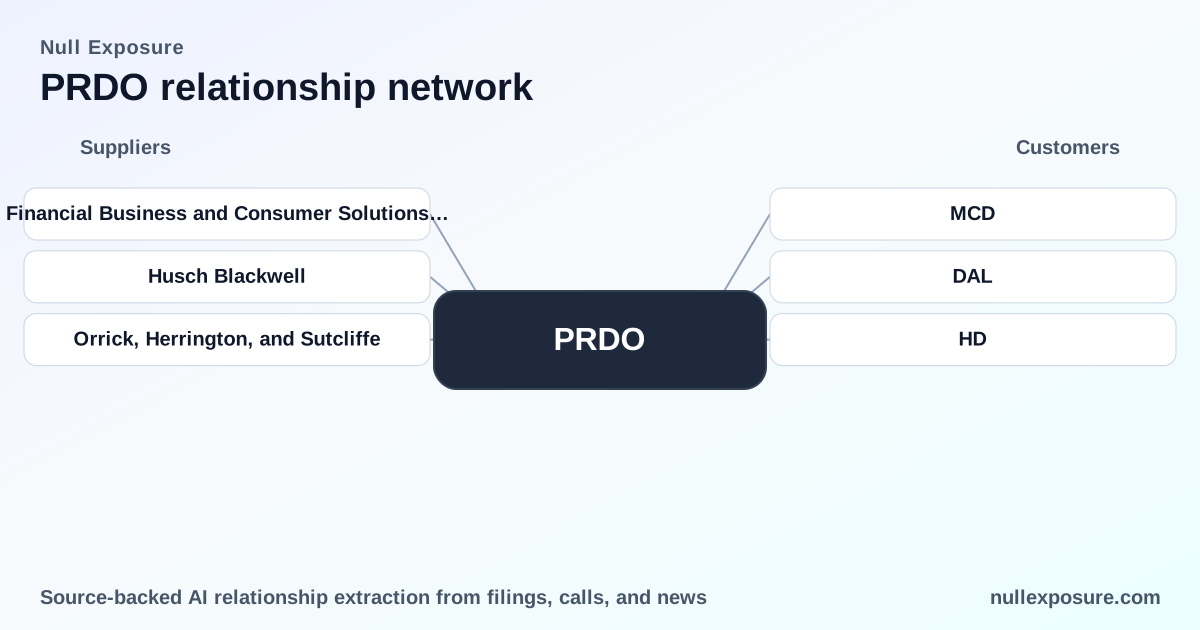
Financial Business and Consumer Solutions, Inc. Perdoceo disclosed that personal information for current and former students was potentially exposed in a data breach at Financial Business and Consumer Solutions, Inc. (FBCS), a firm engaged for debt collection activities, directly implicating a vendor that processes sensitive student financial data. According to a class action summary tied to Perdoceo (FY2024), FBCS’s breach created a data confidentiality incident for Perdoceo-affiliated students. Source: classaction.org report on the FBCS incident (FY2024), https://www.classaction.org/data-breach-lawsuits/perdoceo-education-corporation-october-2024.
Husch Blackwell Public reporting documents Perdoceo’s engagement of the large law firm Husch Blackwell in litigation and regulatory matters; media commentary noted Perdoceo’s legal team and its interactions with watchdog reporting. Republic Report covered litigation activity referencing Husch Blackwell’s role in representing Perdoceo (reported 2024). Legal counsel relationships are therefore active and visible in public controversy and litigation defense. Source: Republic Report coverage (2024), https://www.republicreport.org/2024/for-profit-college-operation-perdoceo-fails-to-halt-fraud-lawsuit/.
Orrick, Herrington, and Sutcliffe A compliance monitor from Orrick reported on Perdoceo’s obligations under a major multi-state settlement; the monitor concluded the company was in “substantial compliance” with a majority of settlement obligations per a Republic Report item (FY2021). This relationship indicates long-term external compliance oversight tied to regulatory settlements, which imposes recurring obligations and vendor oversight. Source: Republic Report analysis of the monitor’s second annual report (2021), https://www.republicreport.org/2021/the-monitor-insists-perdoceo-is-doing-ok-whistleblowers-evidence-shows-otherwise/.
How these supplier ties change the investment case
Each documented relationship maps to a distinct risk vector:
- The FBCS data breach demonstrates operational and reputational exposure when third parties process sensitive data; investors should treat collection agents and any vendor with student PII as high‑criticality suppliers.
- Engagements with major law firms and monitors (Husch Blackwell, Orrick) indicate elevated legal and compliance workloads and show that regulatory remediation remains part of the business operating budget.
- The presence of a monitor tied to a prior settlement implies ongoing regulatory scrutiny and contractual obligations that persist beyond headline legal settlements.
Collectively, these relationships justify active monitoring of vendor controls, contract terms (indemnity, liability caps, data-security obligations), and the adequacy of cyber and compliance insurance.
Operational constraints and what they signal about Perdoceo’s supplier posture
Perdoceo’s public disclosures reveal several company-level constraints that shape supplier risk:
- Long-term contracts dominate: revolving credit facility maturity extended to January 31, 2027, and leases that run through 2049 demonstrate a multi-year commitment profile that reduces operational flexibility.
- High marketing spend: advertising and marketing expense reported above $100 million shows that vendor performance in student acquisition is a direct lever on revenue and cost.
- Vendor roles are service-oriented: the company explicitly uses third-party lead aggregators and generators, indicating reliance on external marketing and enrollment funnel operators.
- Contract lifecycle events occur: at least one termination event was effective July 30, 2024, and the company characterized early termination penalties as immaterial for that event, signaling active contract rotation or clean exits when necessary.
- Balance sheet financing linkages: letters of credit availability under the credit agreement up to $125 million point to contingent liquidity arrangements tied to supplier or landlord commitments (company-level signal from FY filings).
These constraints together produce a supplier-risk profile of high spend, long commitments, and elevated regulatory friction—factors that investors must model into worst-case scenarios for margin compression or remediation costs.
Practical next steps for investors and operators
- Require disclosure of vendor concentration and data-security attestations for any supplier handling student PII; prioritize remediation and contract clauses for collectors and lead aggregators.
- Stress-test marketing spend elasticity: quantify how a 10–30% reduction in advertising spend affects enrollment and revenue given the company’s high marketing baseline.
- Monitor legal docket and monitor reports closely; any change in compliance status or monitor findings is a potential catalyst for valuation re-rating.
- Review lease schedules and debt covenants to understand the implications of long-term fixed costs under scenarios of enrollment volatility.
For tools that aggregate supplier signals and regulatory overlays relevant to PRDO, see https://nullexposure.com/.
Conclusion and investor action
Perdoceo’s fundamentals are strong on headline metrics, but supplier relationships—particularly those involving student data processing, high-dollar marketing channels, and long-dated real estate and financing commitments—are material to downside risk. Investors should treat vendor security and contractual terms as key drivers of operational resilience and run scenario analyses that price remediation, litigation, and enrollment shocks. For a deeper supplier-risk view and tailored exposure reports, visit https://nullexposure.com/.