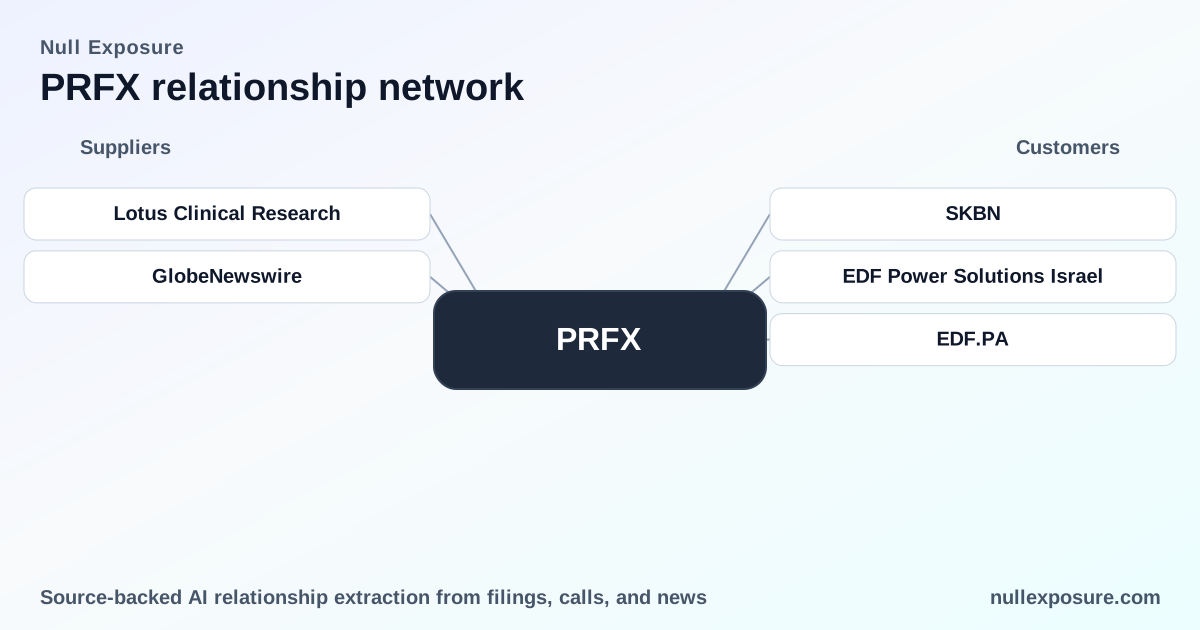
PainReform Ltd (PRFX) — Supplier Relationship Review for Investors and Operators
PainReform is a clinical-stage Israeli pharmaceutical company developing PRF-110, an extended post-surgical pain relief therapy. The company is currently pre-revenue and monetizes through clinical development value capture — advancing pivotal study results to create licensing, partnership, or commercialization opportunities; near-term value drivers are trial readouts and regulatory progress rather than product sales. For a deeper supplier and counterparty map, visit the NullExposure homepage: https://nullexposure.com/.
Why supplier relationships matter for a clinical-stage biotech
In a company without product revenue, third-party suppliers — especially contract research organizations (CROs), clinical vendors and news distributors —are functionally mission-critical. Trial execution, data integrity, and public disclosure cadence directly translate into valuation inflection points. For PainReform, the public record shows an operational model built around outsourced clinical execution and press release distribution; those relationships are primary levers that determine trial timelines, regulatory submissions, and investor sentiment.
What the reported supplier relationships are, in plain English
Below are the supplier relationships surfaced in the available results. Each relationship is summarized in one or two sentences with a concise source note.
Lotus Clinical Research
Lotus Clinical Research is acting as PainReform’s contract research organization for the Phase 3 PRF-110 bunionectomy trial and provided partial topline data for that study. The CRO relationship is the direct conduit for pivotal trial outcomes; control of data delivery timing and quality sits with Lotus under PainReform’s contracting framework. According to a company press release distributed via GlobeNewswire in November 2024, PainReform announced receipt of partial topline data from Lotus Clinical Research for the PRF-110 Phase 3 trial.
GlobeNewswire (picked up by QuiverQuant)
GlobeNewswire served as the distributor for a press release that was later summarized and indexed by QuiverQuant; QuiverQuant’s March 2026 feed noted an AI-produced summary of a GlobeNewswire release concerning a corporate name change for a related entity. Press distributors and financial aggregators shape the market’s information flow, and the QuiverQuant pickup shows how newswire content is propagated into investor channels. QuiverQuant reported this item in FY2026, characterizing the GlobeNewswire piece as an AI-produced summary.
Operational constraints and company-level signals
The supplied constraints list contains no explicit supplier constraints. That absence is itself a company-level signal. From the public profile and financial snapshot, derive the following operational characteristics:
- Contracting posture: PainReform relies on external CROs for trial execution rather than internal clinical operations, consistent with a lean, outsourced operating model. This implies high dependency on contract terms for timelines, data rights, and quality control.
- Concentration: Institutional ownership is low (institutional holders ~2.45%), and insider ownership is meaningful (~9.4%), which signals limited institutional oversight and concentrated operational control at the company level.
- Criticality: With zero reported revenue (RevenueTTM = 0) and active Phase 3 work, relationships that secure clean, auditable trial data are critical to near-term valuation.
- Maturity: Financial metrics (negative EBITDA, no product revenue) confirm a pre-commercial, clinical-stage maturity profile; supplier relationships are more consequential than vendor relationships for revenue-stage firms.
These signals combine to profile PainReform as a small-cap, clinical-stage sponsor whose value and risk profile hinge on outsourced trial delivery and reliable information flow to markets.
Investment implications and risk considerations
- Operational risk: Outsourcing Phase 3 execution concentrates operational risk in a small set of suppliers. The Lotus relationship is not optional — trial data delivery and integrity determine the next valuation inflection.
- Information risk: Reliance on newswires and aggregators for disclosure increases the chance of distribution lags or downstream reinterpretation; investors should prioritize primary filings and clinical registries for confirmation.
- Liquidity and governance: Market cap (~$1.87M) and low institutional ownership suggest limited market liquidity and reduced institutional governance pressure; these traits elevate downside volatility on adverse trial news.
- Valuation sensitivity: With no revenue and negative operating cash flow, any delay or adverse result in the PRF-110 program will have an outsized impact on market valuation.
For operational teams evaluating supplier contracts, focus on data rights, audit access, milestone-based payments, and penalty clauses tied to deliverables. Learn more about supplier risk mapping at NullExposure: https://nullexposure.com/.
Practical next steps for operators and commercial partners
- Confirm contractual provisions with Lotus Clinical Research for data access, source data verification, and timing of topline and patient-level data releases.
- Require explicit publication and disclosure protocols with news distributors to prevent misinformation or ambiguous summaries from propagating into investor feeds.
- Build redundancy in critical vendor categories (data monitoring, safety reporting) to avoid single-point failures during a pivotal readout.
- Monitor institutional coverage and trade liquidity to plan financing or partnership rounds around major milestones.
Bottom line and recommended monitoring
PainReform’s immediate supplier risk is concentrated in its CRO relationship; Lotus Clinical Research is the primary counterparty for the Phase 3 PRF-110 readout that will drive valuation. Press distribution channels also matter because they control market perception at the moment of disclosure; the QuiverQuant/GlobeNewswire event underscores how releases can be repackaged in the financial media. For investors and counterparties, the actionable priorities are contractual clarity on data rights and an independent verification strategy for trial results.
For a full supplier relationship map and ongoing monitoring tools, visit NullExposure: https://nullexposure.com/.
Key takeaways:
- CRO execution = valuation driver.
- Disclosure channels shape market reaction.
- Low institutional ownership and zero revenue amplify information and operational risk.
For further supplier diligence or bespoke relationship analysis, see the NullExposure homepage: https://nullexposure.com/.