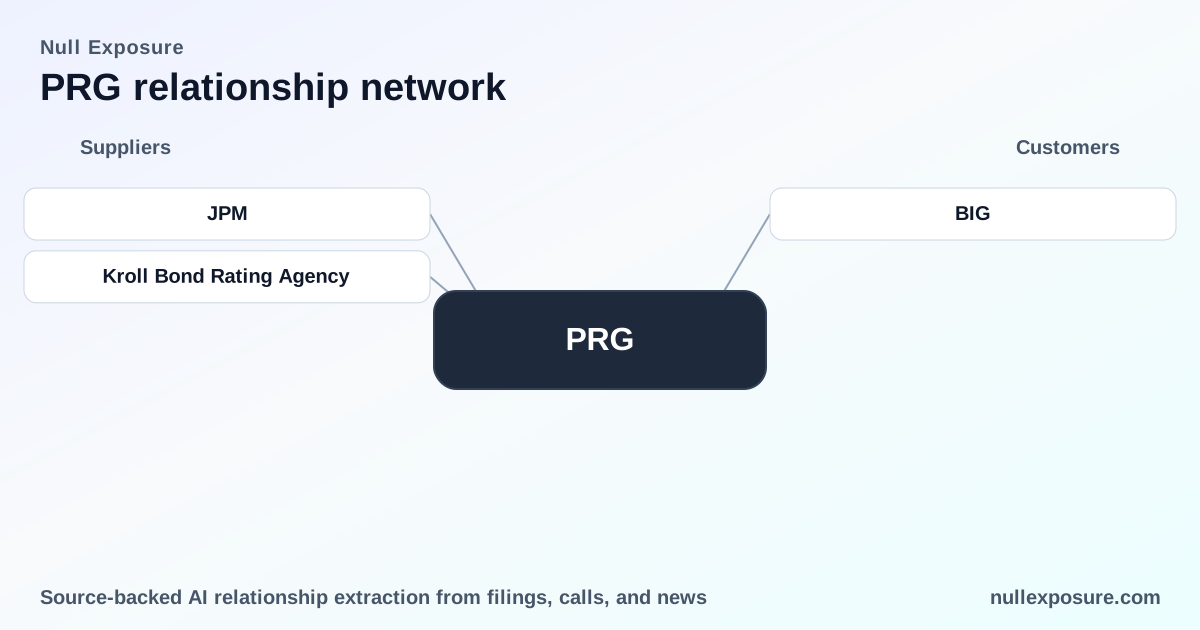
PROG Holdings (PRG): Supplier relationships that finance the lease-to-own engine
PROG Holdings runs a lease-to-own platform for credit-distressed customers: the company purchases merchandise from point-of-sale partners, finances that inventory through lending and securitization, and monetizes via lease payments and ancillary fees. For investors evaluating PRG as a supplier counterparty or platform partner, the relevant question is how capital providers and market validators (banks and rating agencies) support the company’s asset-heavy model and governance. For primary research and counterparty diligence, start here: https://nullexposure.com/
Why suppliers and counterparties drive PROG’s economics
PROG is an omnichannel lessor that converts retail purchases into cancellable lease-to-own contracts; the company’s balance sheet and access to capital determine growth and risk. Financials show $2.41B revenue (TTM) and ~$400M EBITDA, with a market cap roughly $1.12B, yielding attractive multiples (trailing P/E ~9.3, EV/EBITDA ~0.77) that underscore a capital-efficient but capital-dependent business. Capital partners underwrite portfolio purchases, fund receivables and provide liquidity for origination spikes. Given this structure, bank lenders and ratings validation are operationally critical — they determine cost of funds and access to securitization markets that sustain origination volumes.
If you want a concise supplier map and counterparty scoring for PRG, begin your diligence here: https://nullexposure.com/
Lending counterparty: JPMorgan Chase Bank — what was reported
PROG executed a credit agreement amendment that lists JPMorgan Chase Bank among the lending counterparties. The amendment was reported in March 2026 and identifies JPMorgan as a formal counterparty alongside other lenders, placing the bank squarely in the company’s capital stack for FY2026. According to a TradingView news brief (Mar 2026), this amendment positions JPMorgan as a named lender to PROG’s facilities. Source: TradingView reporting on PRG credit agreement amendment (Mar 10, 2026).
Why it matters: a large, diverse bank relationship reduces refinancing risk and signals institutional credit capacity for near-term originations and working capital needs.
Ratings and securitization validation: Kroll Bond Rating Agency
Kroll Bond Rating Agency provided ratings to a multi-tranche offering linked to PROG’s receivables, including an AAA rating for the Class A notes, which the market interpreted as strong investor demand and credit support for the securitization. The coverage comes from a March 2026 market write-up summarizing the offering and Kroll’s asserted ratings. Source: Intellectia/press summary on PROG’s dividend and securitization remarks (Mar 2026).
Why it matters: investment-grade credit support on senior tranches materially lowers funding costs and makes high-volume securitizations feasible, directly affecting margin expansion and origination capacity.
Company-level constraints that shape supplier posture and risk
Two disclosures from PROG’s corporate materials and filings frame supplier diligence beyond named counterparties:
-
PROG positions itself as the buyer of merchandise from POS partners and then leases that merchandise to customers through cancellable lease-to-own contracts. That contracting posture means inventory procurement and vendor payment terms are fundamental operational levers, and supplier relationships are both a source of product flow and a contingent financing exposure (company-level disclosure on merchandising and lease structure).
-
Management disclosed that internal control over financial reporting has been assessed and audited by Ernst & Young LLP as of December 31, 2024, indicating a level of financial governance maturity and third-party assurance that supports transparent reporting to lenders and rating agencies.
Taken together these constraints generate clear signals: contracting is supplier-facing and procurement-driven, concentration risk is concentrated in POS partner pipelines rather than a diffuse vendor universe, criticality of financing partners is high, and governance maturity is sufficient to satisfy major lenders and rating agencies.
What investors and operators should weigh next
-
Funding concentration: the JPMorgan amendment and an active securitization program rated by Kroll indicate a mixed funding model — direct bank facilities plus public/private note issuance. That split reduces single-source risk but ties the company to market liquidity cycles.
-
Cost of capital and margin sensitivity: AAA-rated senior tranches and institutional bank lines compress funding costs and improve yield on originations, but downgrades or market dislocation would immediately stress margins given the asset-heavy model.
-
Operational dependency: because PROG actually purchases merchandise before leasing to customers, vendor terms and supply flows are operationally critical; any disruption to POS partner channels or deterioration in vendor terms increases working capital draw and reliance on lenders.
-
Governance and audit trail: the Ernst & Young audit of internal controls is a positive signal for counterparties requiring transparent reporting and covenant compliance.
Concrete takeaways for counterparties and investors
- Banks and rating agencies are not peripheral — JPMorgan and Kroll are active parts of PRG’s funding and securitization architecture, and their involvement materially reduces refinancing and execution risk in the near term.
- Procurement-first model: PROG’s role as buyer creates supplier credit exposure and operational dependence on point-of-sale partners, so due diligence should include vendor concentration and payment terms.
- Governance supports scale: audited internal controls lower counterparty operational risk and facilitate more sophisticated funding structures.
If you want an actionable counterparty matrix or a tailored supplier risk memo on PRG, see our coverage and request templates at https://nullexposure.com/
How to act on these signals
For investors, treat PRG as a capital-market-driven growth business: monitor bank facility amendments, tranche ratings, and quarterly covenant disclosures as real-time indicators of funding flexibility. For potential suppliers or retail partners, negotiate payment terms with awareness that PROG’s liquidity and funding rates directly affect their willingness to prepay or accelerate purchases.
Further diligence resources and supplier templates are available on our main page: https://nullexposure.com/
Final read: what matters most
PROG’s economics are simple and decisive: it buys, finances, and earns over time — and the company’s ability to scale is controlled by lenders (e.g., JPMorgan) and market validators (e.g., Kroll). For counterparties, the two signals that matter are access to diversified, institutional funding and operational credit discipline in procurement, both of which are currently supported by reported bank amendments and high-grade tranche ratings. For investors, these are the levers that will move valuation and execution risk over the next 12–24 months.
For a deeper supplier-risk evaluation or to commission a counterparty scorecard on PRG, start here: https://nullexposure.com/