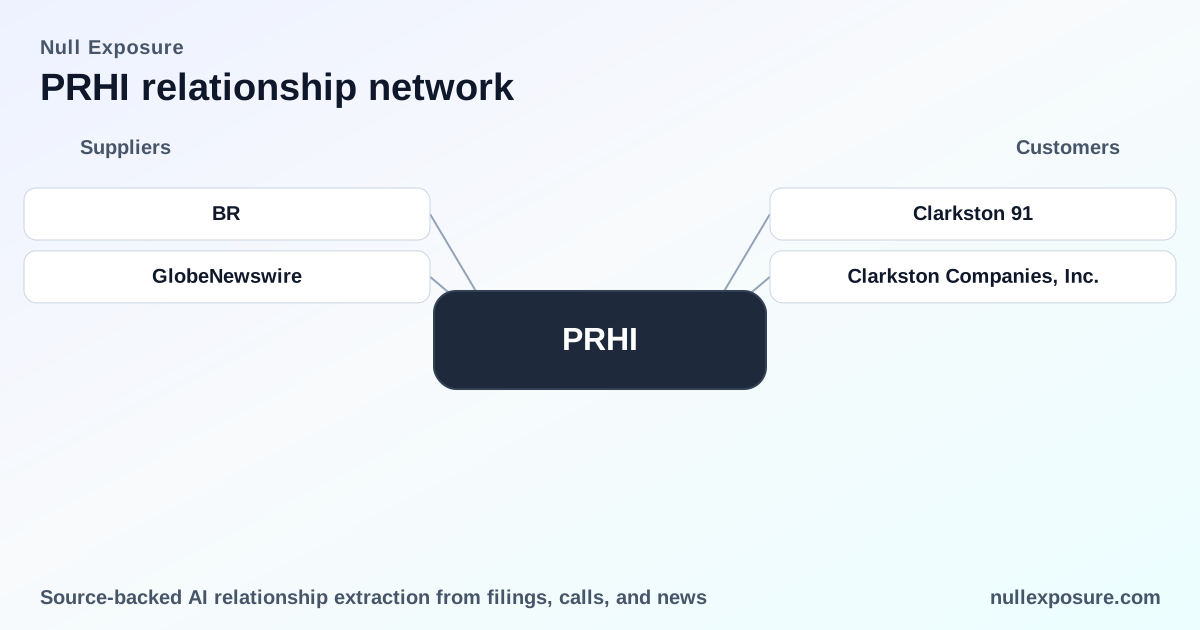
Presurance Holdings (PRHI): supplier map and what it means for investors
Presurance Holdings monetizes by operating specialty property & casualty insurance businesses while increasingly leaning on third-party program administrators and distributors to drive non–risk-bearing revenue. The company has repositioned from a capital-intensive underwriting model toward an asset-light, services-and-distribution posture: it collects fees from program administration and fronting arrangements while outsourcing underwriting, claims, and systems to partners. For investors, the core trade is concentrated operational leverage — lower balance-sheet insurance exposure in exchange for dependency on a small set of external service and distribution providers.
Explore more supplier intelligence at https://nullexposure.com/ and review the full supplier profile for PRHI.
Two disclosed supplier touchpoints from the March 2026 release
Presurance’s recent shareholder communications reference two external vendors in connection with a rights offering and press distribution. Each relationship is transactional and limited in scope.
-
Broadridge Corporate Issuer Solutions, LLC: Presurance directs shareholders with questions about a March 2026 rights offering to Broadridge for subscription and administrative support, indicating Broadridge is acting as the issuer services agent for the offer. According to a QuiverQuant summary of the March 10, 2026 press release, Broadridge’s contact details are provided for investor inquiries.
Source: QuiverQuant / company press release, March 10, 2026. -
GlobeNewswire: The company used GlobeNewswire to distribute the rights offering press release that was later captured and summarized by QuiverQuant on March 10, 2026. This is a standard public-relations distribution engagement rather than an ongoing operational supplier relationship.
Source: QuiverQuant capture of GlobeNewswire press distribution, March 10, 2026.
These items are narrow in scope — investor communications and filing distribution — and do not supplant the more strategic supplier relationships described below.
The deeper supplier landscape and how it shapes Presurance’s operating model
Presurance’s operating posture is defined by a few high‑impact features drawn from recent disclosures and contract excerpts:
-
Contracting posture: short-term transition and administration agreements. The company has used transition services agreements intended to run less than 12 months to separate shared systems after transactions, signaling frequent short-term contracts during restructurings rather than long-duration vendor lock-in. This is a company-level signal from post-transaction language in filings.
-
Concentration around a small set of program partners. Presurance shifted to a model where certain entities — referenced in filings as CIS and SSU — control large swaths of distribution and underwriting support. The filing language notes CIS “has control over almost all of our commercial lines premium volume” and SSU controls the homeowners book; these excerpts identify those partners as critical distribution and administration nodes. This concentration raises single‑counterparty risk for revenue and operational continuity.
-
Service-provider dependency for core functions. The company relies heavily on external teams for underwriting, claims, and IT, documented through program administration and claims administration agreements with CIS and SSU. Filings state the internal headcount is roughly ten people and many functions are managed through those agreements, indicating Presurance’s role has become primarily oversight and contract management — a strategic shift toward services revenue.
-
Counterparty quality and reinsurer relationships. Filings reference facultative reinsurance arrangements with a large reinsurer (for high-severity commercial auto physical damage), signaling reliance on established reinsurance counterparties for loss-bearing protection. This is a company-level signal that risk transfer remains a part of the structure even as fronting and administration expand.
-
Relationship maturity and lifecycle: active and terminated elements coexist. Some agreements are active — for example, third‑party claims servicing across multiple states — while others, such as a property catastrophe treaty that provided coverage up to $27.0 million in excess of a $3.0 million retention, were terminated on June 1, 2024. This mix demonstrates a company in transition: de-risking in some dimensions while maintaining active outsourced operations elsewhere.
-
Spend and scale signals. Fronting and written-premium assumptions provide a sense of scale: the company assumed $1.5 million of written premiums in 2024 and $43.6 million in 2023 under fronting arrangements. These figures place some supplier spend and operational exposure in the $1M–$100M band, consistent with material but not enterprise‑scale vendor engagements.
Collectively, these characteristics show an insurance holding company that has turned to third‑party platform partners to execute underwriting and servicing, trading off capital risk for operational dependency.
Explore supplier profiles and supplier concentration analysis at https://nullexposure.com/ for a deeper look at counterparty exposure and contract vintage.
Implications for investors and operators
-
Operational concentration is the principal risk. With CIS and SSU controlling underwriting and distribution flows, any termination, attrition, or performance degradation at those partners would immediately compress Presurance’s revenue and increase execution risk. Investors should treat counterparty continuity as a primary monitoring metric.
-
Capital profile interacts with supplier posture. The company’s move toward fee-based revenue reduces capital-at-risk but increases sensitivity to contract renewals and third‑party pricing. The March 2026 rights offering — administered via Broadridge — is a direct reminder of the company’s ongoing capital needs and its use of external agents for corporate finance actions.
Source: QuiverQuant press release, March 10, 2026. -
Short-term contracting creates re‑procurement risk but enables flexibility. Transition services and short program administration terms allow Presurance to reconfigure partnerships quickly, which is positive for strategic repositioning; however, the company’s small internal team means that rapid partner turnover would still strain operations.
-
Regulatory and claims execution exposure remains delegated. Outsourced claims handling across multiple states centralizes operational execution outside the corporate payroll, creating reliance on vendor processes for loss adjustment and customer experience. Investors should monitor service-level disclosures and claims outcome metrics where available.
What to watch next
- Monitor partner contract renewals and any changes in the CIS/SSU relationship given their outsized role in distribution.
- Track the outcome and use of proceeds from the rights offering and any follow-up capital actions advertised through issuer services providers like Broadridge.
- Watch for renewed reinsurance treaties or replacements for the terminated catastrophe treaty noted as ending in mid‑2024.
For ongoing supplier intelligence and to track Presurance’s supplier exposure over time, visit https://nullexposure.com/.
Bottom line
Presurance has repositioned toward an asset-light, partner-driven model that reduces direct underwriting risk but concentrates operational and revenue risk in a small number of external administrators and distributors. The March 2026 communications show routine use of Broadridge and GlobeNewswire for capital-raising and PR mechanics, while filings reveal deeper, business-critical relationships with program administrators (CIS, SSU) and reinsurers. Investors should price in counterparty concentration and monitor contract renewals, claims performance, and capital actions as the primary drivers of short-term company value.
Check updated supplier analyses and counterparty concentration reports at https://nullexposure.com/ to inform investment and operational decisions.