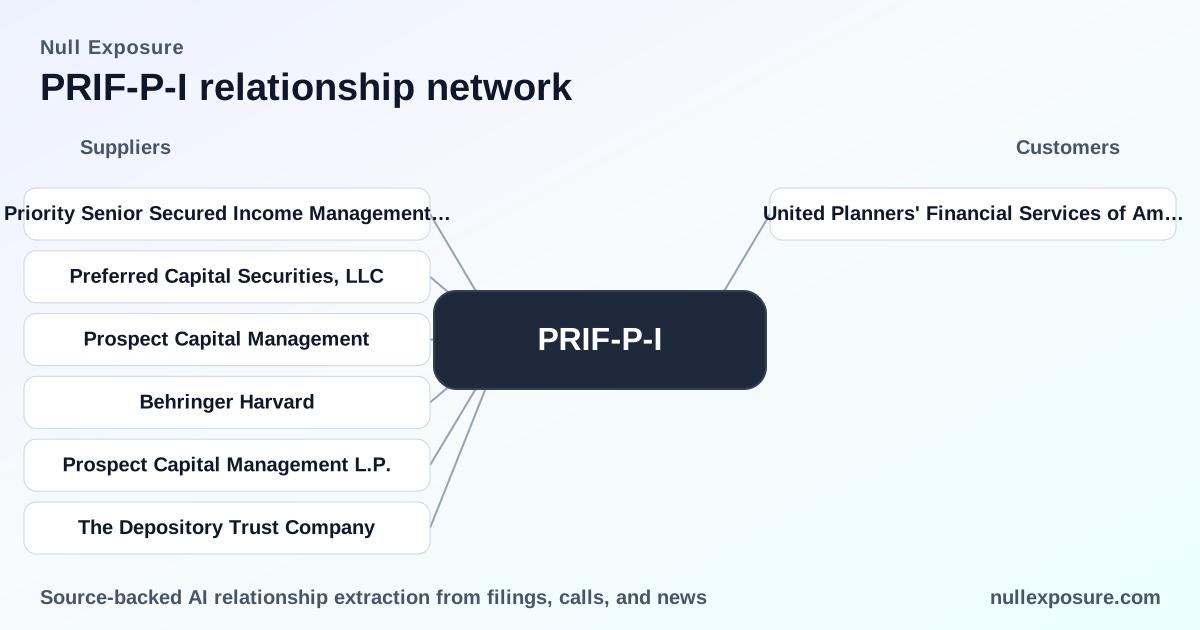
Priority Income Fund (PRIF‑P‑I) — supplier relationships and operational profile
Priority Income Fund is a fee‑driven closed‑end investment vehicle that monetizes through yield distributed to shareholders and through contractual management and dealer‑manager fees tied to its portfolio of collateralized loan obligations (CLOs) and related credit instruments. The Fund outsources portfolio management and distribution, which concentrates economic and operational control in a small set of external providers; investors should value the Fund on the basis of yield sustainability, counterparty strength, and the integrity of the manager/distribution chain. For a quick companion read on supplier risk scoring and monitoring, visit https://nullexposure.com/.
High‑level takeaway for investors
Priority Income Fund runs an outsourced operating model: an external manager executes investment strategy, a dealer‑manager runs distribution and capital raising, and market infrastructure providers handle custody and settlement. That concentration creates clear operational leverage — efficient if counterparties are capable, hazardous if they are not. Investors should treat the manager and dealer‑manager as primary operational counterparties and monitor newsflow, regulatory standing, and litigation risk closely.
Visit https://nullexposure.com/ for deeper counterparty mapping and ongoing alerts.
The supplier map, in plain English
Below I list every counterparty cited in public filings and press releases related to PRIF‑P‑I in the available records and summarize the practical role each plays for investors.
Priority Senior Secured Income Management, LLC
Priority Senior Secured Income Management, LLC is the Fund’s external manager and runs day‑to‑day investment decisions; the team is drawn from the investment and operations staff of Prospect Capital Management L.P., giving the manager direct operational lineage to an established credit investor. According to multiple press releases, including a GlobeNewswire release (June 11, 2025) and a Manila Times notice (March 9, 2026), the Fund is managed by Priority Senior Secured Income Management, LLC. (GlobeNewswire, June 11, 2025; Manila Times, March 9, 2026).
Preferred Capital Securities, LLC
Preferred Capital Securities (PCS) serves as the Fund’s dealer‑manager and handles capital raising and distribution; PCS is a FINRA/SIPC member since 2015, which positions it as the primary retail and institutional conduit for preferred share placements. This role is documented in GlobeNewswire and Yahoo syndications describing PCS as dealer‑manager for Priority Income Fund. (GlobeNewswire, June 11, 2025; Yahoo Finance, Dec 29, 2025).
Prospect Capital Management / Prospect Capital Management L.P.
Prospect Capital Management supplies personnel and operational experience to the Fund through secondment or team transfers: the manager’s investment and operations team traces back to Prospect, providing continuity of credit underwriting expertise. Press coverage and releases explicitly link the Fund’s management team to Prospect Capital Management L.P. (Yahoo Finance, various March–December 2025 references; PR Newswire, March 2026).
Behringer Harvard
Behringer Harvard is identified as a co‑originator at the Fund’s launch and as part of the Fund’s origination history for the CLO strategy; that institutional pedigree informs the product design and investor pitch. PR Newswire coverage that chronicles the Fund’s origin cites Behringer Harvard alongside Prospect in the Fund’s genesis narrative. (PR Newswire, March 2026).
The Depository Trust Company (DTCC)
The Depository Trust Company is the custody and settlement vehicle for the Fund’s Series F Preferred Shares; operational processes such as redemptions and transfers are processed through DTC procedures. A Yahoo Finance redemption notice specifically references DTC handling of Series F preferred shares and the related redemption mechanics. (Yahoo Finance, Feb 2025).
How these relationships shape the Fund’s operating posture
- Contracting posture: The Fund is heavily outsourced. Management and distribution are third‑party contracted functions, so counterparty performance and contractual terms determine execution risk and fee leakage. This is a company‑level signal — there are no explicit contractual constraint excerpts in the records provided, but the outsourcing pattern is clear from the manager/dealer roles.
- Concentration and criticality: Operational control concentrates in a small set of providers (manager + dealer‑manager + custodial infrastructure). This creates single‑point dependencies where manager or PCS operational failures would have an outsized impact on cash flows and investor servicing.
- Maturity and capability: The manager’s lineage to Prospect Capital Management and the involvement of Behringer Harvard signal experienced credit operations behind the strategy, which supports credibility in underwriting and CLO execution.
- Regulatory and reputational risk: Dealer‑manager FINRA membership is a positive control; however, public notices referencing third‑party investigations and litigation involving the Fund’s strategy require active monitoring. A PR Newswire investor notice in 2026 referenced law‑firm investigations into potential investor losses tied to the product’s CLO exposures, making legal and reputational risk a material watch item. (PR Newswire, March 2026).
Practical investor implications
-
Primary diligence priority: Focus on the manager (Priority Senior Secured Income Management) and dealer‑manager (Preferred Capital Securities) operational history, contractual alignment (fee waterfalls, redemption mechanics), and regulatory standing. A small group of counterparties controls distribution and portfolio execution.
-
Operational checklist: Confirm custody and settlement flows through DTCC; validate FINRA registration and any broker‑dealer disclosures for PCS; review manager personnel continuity with Prospect Capital Management. The redemption mechanics referenced in press releases indicate standard DTCC processes for preferred shares. (Yahoo Finance, Feb 2025).
-
Key risks to price: Concentration of outsourced operations, exposure to CLO performance, and the potential for litigation or enforcement action that could affect distributions.
-
Major relationship takeaways:
- Manager: Outsourced, but staffed by Prospect‑experienced professionals — operational capability is high. (GlobeNewswire; Manila Times)
- Dealer‑manager: PCS is the distribution engine and FINRA member — distribution execution and disclosures are primary controls. (GlobeNewswire; Yahoo Finance)
- Custody: Standard DTCC handling reduces settlement idiosyncrasy risk but does not remove counterparty concentration. (Yahoo Finance)
- Founders/Originators: Prospect and Behringer Harvard give the strategy market pedigree but also interlink reputational exposures across entities. (PR Newswire)
If you want a deeper supplier risk scorecard or ongoing alerts on these provider relationships, explore how we map counterparty concentration at https://nullexposure.com/.
Bottom line
Priority Income Fund’s economics are straightforward: investor distributions funded by a CLO‑centric portfolio, with fees and distribution economics flowing to an outsourced manager and a dealer‑manager. The structure offers yield opportunity offset by concentrated operational reliance and the credit cyclicality of CLO exposure. Active monitoring of the manager, PCS, and any litigation or regulatory developments is essential for anyone evaluating PRIF‑P‑I exposure. For ongoing monitoring, analysis, and bespoke counterparty reporting, visit https://nullexposure.com/.