PRIF-P-J: What investors need to know about the supplier relationships behind this preferred REIT exposure
Prison Realty Investment Trust (PRIF-P-J) operates as a specialized REIT that acquires, owns and manages correctional facilities and monetizes through long-term leases with government agencies, producing predictable cash flows from contractually stable tenants. For capital allocators and operators assessing counterparty and intermediary risk, the company’s supplier footprint—dealer-managers, fund managers and affiliated investment advisers—directly shapes financing flexibility, distribution mechanics and governance oversight. Visit https://nullexposure.com/ for full supplier intelligence and sourcing on PRIF-P-J.
Why the supplier map matters for a correctional REIT
PRIF-P-J’s sector is niche and contract-heavy: revenue depends on long dated public-sector leases, while capital and distribution structures often run through intermediaries and fund managers. That combination elevates the importance of knowing who places securities, who manages affiliated funds, and which investment advisers supply talent and oversight. These relationships influence liquidity, the cost of capital for preferred equity, and exposure to third‑party operational constraints.
Counterparties and intermediaries — the relationships you should track
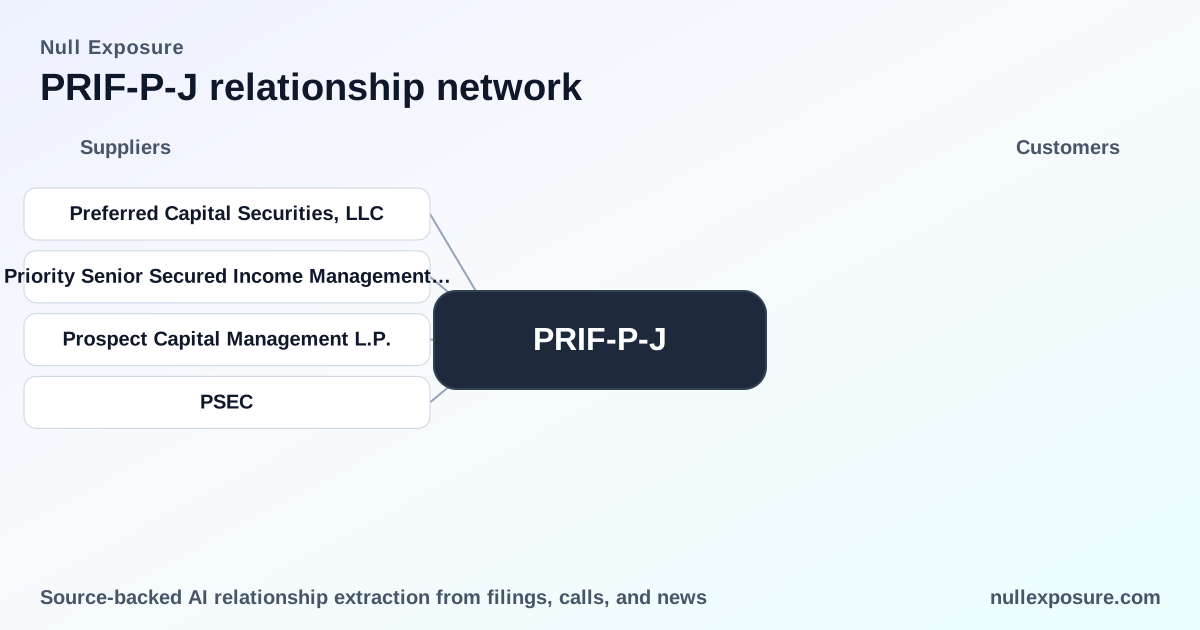
Below I cover every relationship surfaced in the records and explain what each partner contributes to PRIF-P-J’s commercial and financing profile.
Preferred Capital Securities, LLC
Preferred Capital Securities, LLC acts as a dealer-manager for related preferred stock offerings, providing placement and distribution services that connect the REIT’s preferred issuance to retail and institutional channels. According to a GlobeNewswire release reprinted by The Manila Times in December 2025, PCS has been a FINRA/SIPC member since 2015 and was cited in connection with preferred-stock distributions (FY2025).
Priority Senior Secured Income Management, LLC
Priority Senior Secured Income Management, LLC is the named manager for the Priority Income Fund referenced alongside PRIF-P-J’s preferred movements, serving as a vehicle-level manager that executes dividend and distribution programs tied to preferred tranches. The GlobeNewswire/Manila Times notice (December 2025) identifies this firm as the Fund manager and links its team composition to Prospect Capital’s professionals (FY2025).
Prospect Capital Management L.P.
Prospect Capital Management L.P. supplies investment and operations personnel to the manager overseeing priority preferred activities, indicating operational integration between a larger listed credit manager and the fund vehicles supporting PRIF-P-J securities. The GlobeNewswire/Manila Times disclosure in December 2025 notes that Priority Senior Secured Income Management’s team comes from Prospect Capital’s investment and operations ranks (FY2025).
Prospect Capital Management (PSEC)
Prospect Capital Management is the broader, SEC-registered investment adviser that underpins the manager relationship; public reporting highlights its scale and industry standing. CFI.co in 2023 noted Prospect Capital Management’s registration and asset scale—$8.8 billion AUM as of December 31, 2022—contextualizing the depth of resources backing the advisory and operational personnel connected to these preferred instruments (FY2023).
What the relationship set signals about PRIF-P-J’s operating model
The relationship map yields several company-level signals about how PRIF-P-J runs and where risk concentrates:
- Contracting posture — long-term, fee-driven intermediation. The use of dealer-managers and an external fund manager signals that PRIF-P-J’s preferred issuance and distribution are outsourced to specialized intermediaries rather than handled in-house, increasing reliance on external placement channels for liquidity.
- Concentration — niche asset class, concentrated counterparties. The supplier list is small and tightly coupled to one advisory ecosystem (Prospect Capital and affiliated managers), which raises concentration risk if the adviser’s business model or regulatory position changes.
- Criticality — high for capital and distribution, moderate for operations. Dealers and fund managers are critical for financing and distributions (direct impact on preferred holders); facility operations remain the company’s core, but these suppliers materially affect investor returns through funding and payout mechanics.
- Maturity — professionally managed, institutional overlay. Association with a large SEC-registered adviser indicates institutional maturity in fund governance and distribution practices, which supports predictable administration of preferred dividends.
No explicit constraints were reported in the supplier records; the signals above derive from firm-level disclosures and the apparent structure of financing and management relationships.
Risk and upside — what this means for investors and operators
- Upside: Association with an established investment manager and a dedicated dealer-manager reduces execution risk for preferred offerings and supports stable distribution mechanics. Prospect Capital’s scale is a positive governance and operational signal.
- Risk: Counterparty concentration—reliance on a small set of external managers and dealers—creates single‑point vulnerabilities for capital placement and investor communications. A disruption at either the dealer-manager or the manager firm would directly affect preferred security servicing.
- Operational caveat: The underlying business—correctional real estate—delivers stable cash flows under long leases but remains sector-concentrated, exposing holders to political and regulatory shifts in public procurement of correctional services.
Key takeaways:
- Distribution and liquidity for PRIF-P-J preferreds are intermediated by a compact group of counterparties.
- Prospect Capital’s involvement provides institutional heft; Preferred Capital Securities supplies placement capability.
- Concentration of supplier roles is the primary counterparty risk for preferred-holders.
For deeper supplier profiles, governance disclosures and counterparty risk scoring, start your diligence at https://nullexposure.com/.
Practical next steps for investors and operators
- Request detailed counterparty service agreements and dealer engagement letters during any underwriting or secondary purchase process to understand termination rights, fees, and replacement procedures.
- Monitor Prospect Capital’s public filings and fund notices for changes to personnel, AUM, or registration status—these drive operational continuity for PRIF-P-J preferred servicing.
- Build a recovery plan that models dealer or manager replacement timelines and likely liquidity impacts under stressed market conditions.
For a tailored supplier risk brief and monitoring feed on PRIF-P-J, see https://nullexposure.com/ — we track dealer-manager linkages and adviser exposures across capital stacks.
Bottom line — how to position around PRIF-P-J’s supplier reality
PRIF-P-J’s monetization is straightforward: long-term government leases underpin cash flow, while preferred-stock economics are layered through an external distribution and management chain. That chain is compact and institutionally backed, offering efficient execution but concentrating counterparty risk. Investors should treat dealer and manager continuity as a first‑order underwriting item for preferred holdings and incorporate supplier replacement scenarios into liquidity planning. For ongoing supplier-level monitoring and primary-source documentation, review the records at https://nullexposure.com/.