Priority Income Fund (PRIF-P-L): who supplies the capital stack and why it matters to investors
Priority Income Fund’s listed preferred share (PRIF-P-L) functions as a packaged funding instrument for a closed‑end private credit and specialty finance vehicle; the security delivers contractual distributions to holders while the underlying enterprise generates returns through bespoke debt and equity investments. PRIF-P-L monetizes via yield distributions funded by the Fund’s loan and credit portfolio, with upstream operations outsourced to external managers and distribution partners. For a deeper read on counterparty exposures and supplier profiles, visit https://nullexposure.com/.
The quick orientation investors want
Priority Income Fund issues term preferred series to raise capital for its investment activities; those preferred shares are held through standard industry custodial arrangements and sold to investors through a dealer‑manager. The core economic equation is straightforward: asset cash flow funds fixed preferred distributions, while outsourced managers and dealer‑managers handle sourcing, operations and distribution.
If you evaluate preferred securities on counterparty risk, concentrate your diligence on the small set of service providers that support the fund’s capital structure and liquidity. Learn more about supplier intelligence at https://nullexposure.com/.
Who the suppliers are and what they do (direct, plain-English summaries)
-
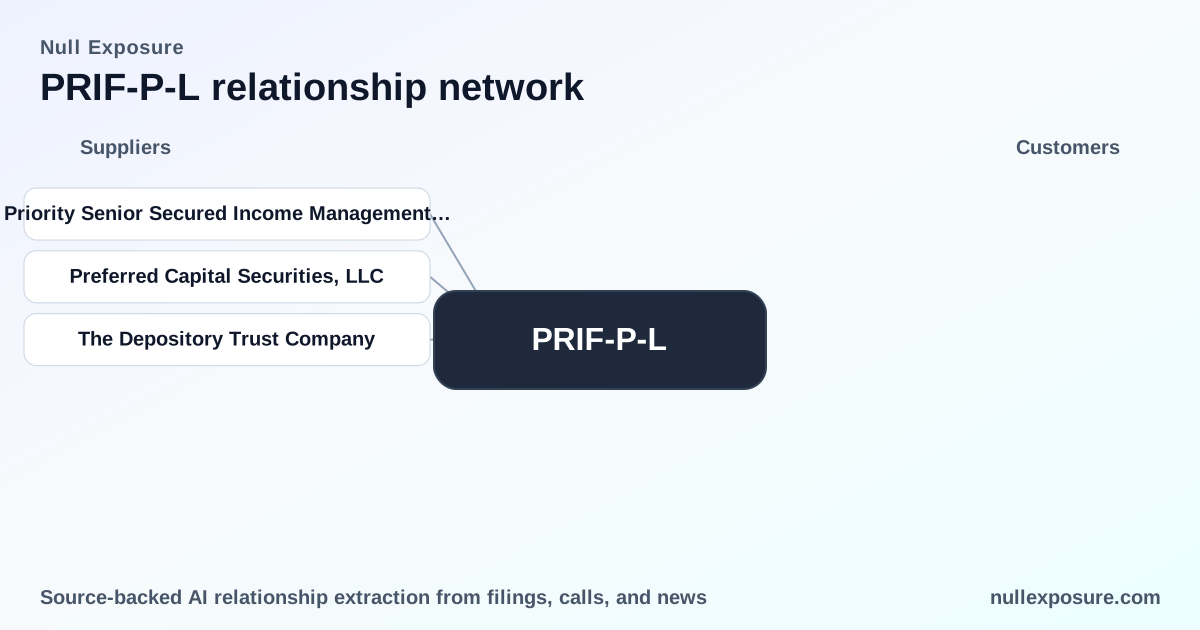
Priority Senior Secured Income Management, LLC runs the Fund’s investment activities through a team drawn from Prospect Capital Management’s investment and operations staff. According to GlobeNewswire and other press releases in FY2025–FY2026, the Fund is managed by Priority Senior Secured Income Management and that team is explicitly sourced from Prospect Capital Management’s investment and operations professionals (GlobeNewswire, Dec 2025; Finance Yahoo, FY2026).
-
Preferred Capital Securities, LLC acts as the Fund’s dealer‑manager and distribution partner, holding FINRA/SIPC membership since 2015 and responsible for offering the Fund’s preferred shares to investors. GlobeNewswire’s December 2025 release identifies Preferred Capital Securities as the dealer‑manager for Priority Income Fund (GlobeNewswire, Dec 2025; ManilaTimes republishing, FY2025).
-
The Depository Trust Company (DTC) is the custodial intermediary where the Fund’s preferred shares are held and processed for redemption and settlement; press releases note that specific preferred series were held through DTC and that redemptions followed DTC procedures (GlobeNewswire Nov 2024; GlobeNewswire Jan 2026; Yahoo Finance, FY2026).
What the relationship map implies about how the business operates
The extracted relationships form a compact, functionally complete supplier set: manager, dealer‑manager, and custody/settlement. From an operating and governance standpoint that produces several company-level signals for investors:
-
Contracting posture: externally outsourced operations. The Fund uses an external management company for investment decisions and uses a separate dealer‑manager for distribution; this is a classic outsourced model where the sponsor/manager holds operational control but the Fund’s public interface and capital distribution rely on third parties.
-
Concentration of critical services is high. With management, distribution and custody represented by a small number of counterparties, counterparty concentration is a primary operational risk — disruptions at any of these providers would have immediate consequences for yield delivery, redemptions and settlement.
-
Counterparty criticality is significant and binary. The manager runs portfolio decisions that directly support preferred distributions; DTC custody affects daily settlement and redemption mechanics. These are not ancillary vendors; they are functionally critical to the preferred security’s cash‑flow plumbing.
-
Maturity and standardization of partners reduce execution risk. The partners named — a fund manager with ties to Prospect Capital’s team, a FINRA‑registered dealer‑manager, and DTC custody — indicate industry‑standard arrangements that reduce operational novelty and legal ambiguity relative to bespoke servicing setups.
-
No supplier constraints were extracted in the source payload. The data returned no explicit constraint documents; therefore there is no machine-extracted contractual limit or restriction to cite from supplier filings in this dataset.
Investment implications: what investors and operators must watch
- Counterparty resilience is central. Assess operational continuity plans for the manager and dealer‑manager; any reputational or regulatory issue at these firms will transmit to preferred holders quickly.
- Settlement and redemption mechanics matter. Because preferred series are held through DTC, liquidity and redemption timing will follow established DTC procedures — diligence on settlement windows and redemption notice protocols is essential.
- Alignment of incentives. Confirm how the manager’s compensation and the dealer‑manager’s distribution economics interact with the preferred share’s fixed obligations; misaligned incentives can pressure distribution coverage.
A short checklist for portfolio teams:
- Verify the manager’s performance track record and governance controls.
- Confirm dealer‑manager registration, distribution channels, and historical uptake of preferred issuances.
- Validate DTC holdings and redemption mechanics for the specific preferred series.
For a supplier‑level risk report and on‑demand counterparty dashboards, visit https://nullexposure.com/ — the best way to translate these relationships into actionable exposure metrics.
Final read and next steps
Priority Income Fund’s preferred security PRIF-P-L is backed by a narrow set of professional service providers: an external manager closely affiliated with Prospect Capital personnel, a FINRA‑member dealer‑manager, and DTC custody for settlement. That arrangement combines industry standardization with high counterparty concentration — a classic tradeoff for yield‑oriented preferred instruments. Investors should prioritize counterparty due diligence over headline yield when evaluating PRIF‑P‑L exposure.
For a tailored supplier exposure brief or to commission deeper counterparty analysis, go to https://nullexposure.com/ and request a supplier intelligence packet.