Perimeter Solutions (PRM): Supplier Relationships That Shape Operational Risk and Growth
Perimeter Solutions sells advanced firefighting chemicals and services to government and industrial customers and monetizes through product sales, margin expansion on specialty formulations, and bolt‑on acquisitions that expand market reach and technical capability. Revenue comes from formulated chemical products and related services, with strategic M&A and external advisors routinely engaged to execute transactions and manage legal/regulatory risk. For a focused view of supplier and advisor exposure, visit https://nullexposure.com/ to see how these relationships map to operational and financial risk.
The operating model investors should read first
Perimeter runs a manufacturing-plus-outsourcing model: it owns core formulation IP and product lines while relying on third‑party manufacturing (tolling) and logistics for capacity and distribution. The company’s public statements make two company‑level signals explicit: Perimeter uses third‑party tolling/manufacturing in Moreland, Idaho and Pasco, Washington, and the firm relies on third‑party logistics providers for distribution, storage and transportation. These are operational choices with clear tradeoffs.
- Contracting posture: Transactional for tolling and logistics; legal and financial advisors are engaged on a deal basis.
- Concentration and criticality: Manufacturing and logistics providers are critical single points in the supply chain; supplier concentration is elevated for specialized tolling locations and 3PL networks that handle hazardous formulations.
- Maturity and governance: The use of external tollers and 3PLs signals mature outsourcing practices but increases dependency on external operational controls and safety standards.
Those constraints translate to investor considerations: outsourcing preserves capital and speeds capacity scaling, but operational control and safety histories at third‑party sites materially affect earnings volatility and reputational risk. For a practical supplier-risk dashboard tailored to investors, see https://nullexposure.com/.
Key third‑party relationships that show up in the record
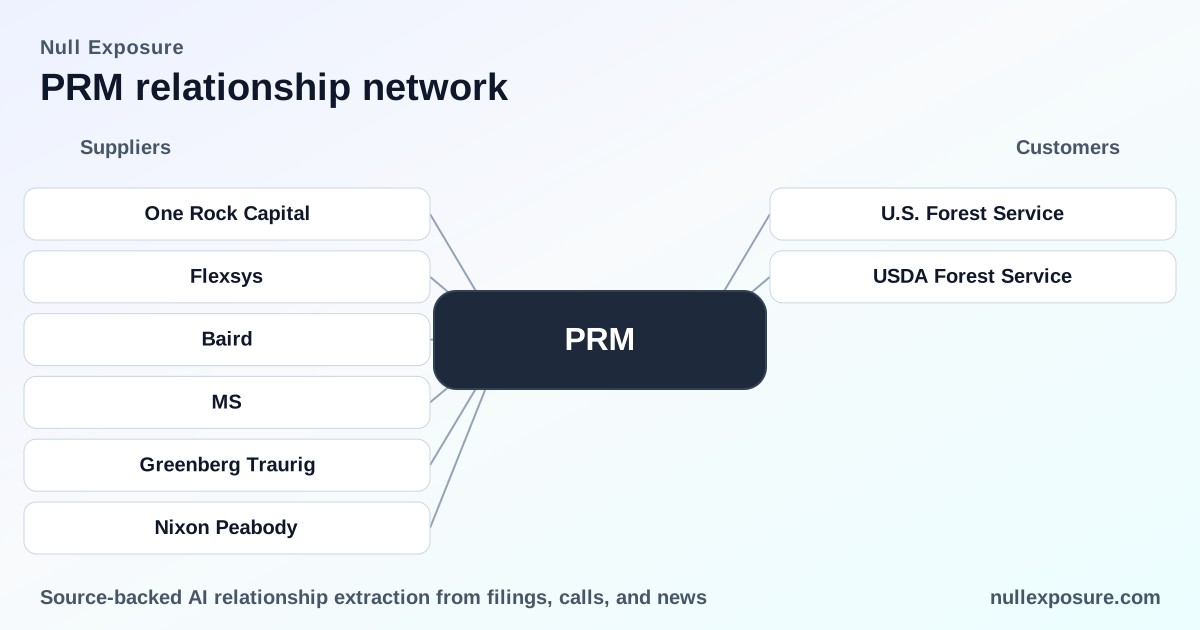
Below are every named relationship in the recent disclosures, with a one‑to‑two sentence investor summary and the cited source.
-
One Rock Capital — Perimeter’s Q4 2025 earnings call directly identified One Rock as the controlling owner of Flexsys and held One Rock responsible for strategic, financial and operational decisions, citing a pattern of declining operational performance and safety standards under its ownership. This frames One Rock as an upstream controller of an operational counterparty rather than a simple supplier (Perimeter Q4 2025 earnings call, first reported March 7, 2026).
-
Flexsys — The company reported ongoing operational and safety challenges at the Sauget Lenore facility operated by Flexsys that persisted into late 2025 and into 2026, highlighting a direct operational exposure where third‑party site performance can disrupt supply or reputation (Perimeter Q4 2025 earnings call, March 7, 2026).
-
Baird — Baird served as a financial advisor to Perimeter on the MMT acquisition, signaling reliance on mid‑market investment banking expertise during M&A execution (GlobeNewswire press release announcing the MMT agreement, Dec. 10, 2025; Manila Times coverage of completion, Jan. 23, 2026).
-
Morgan Stanley — Morgan Stanley also served as a financial advisor on the MMT transaction, providing institutional M&A capability and syndication access for the $685 million purchase, a signal that Perimeter deploys global advisory resources for large strategic deals (GlobeNewswire release, Dec. 10, 2025; Manila Times, Jan. 23, 2026).
-
Greenberg Traurig — Greenberg Traurig was retained as legal counsel for the MMT acquisition; law firm engagement reduces execution risk on regulatory and transactional legal issues and is specifically cited in both the initial agreement announcement and subsequent closing communications (GlobeNewswire, Dec. 10, 2025; Manila Times, Jan. 23, 2026).
-
Nixon Peabody — Nixon Peabody also provided legal counsel to Perimeter for the MMT deal, reinforcing a dual‑counsel approach that spreads legal execution risk and supports cross‑jurisdictional work on the acquisition (GlobeNewswire, Dec. 10, 2025; Manila Times, Jan. 23, 2026).
What these relationships mean for cash flow and risk
Perimeter’s supplier and advisor roster reveals two parallel dynamics. First, operational dependence on third‑party manufacturers and logistics creates a levered operational exposure: production disruptions, safety incidents, or contract disputes at tolling or 3PL sites directly affect throughput and margin realization. Second, a repeat pattern of external advisors on M&A—Baird, Morgan Stanley, Nixon Peabody, Greenberg Traurig—shows disciplined use of external expertise to execute growth, which is capital‑intensive but de‑risked through professional counsel.
- Earnings sensitivity: Outsourced manufacturing and logistics raise the odds of episodic EBITDA volatility from operational incidents or downtime.
- M&A execution: Engagement of top‑tier financial and legal advisors lowers execution risk on acquisitions but increases transaction costs that investors should net against revenue synergies.
- Reputational risk: The Flexsys/Sauget Lenore citations underscore that third‑party safety performance can carry substantial reputational and regulatory consequences.
For an investor‑grade supplier exposure scorecard and to map these counterparties against operational sites, explore https://nullexposure.com/ for a concise view.
Risk checklist investors can act on now
- Validate tolling contracts and KPIs for Moreland, Idaho and Pasco, Washington operations; check uptime, safety metrics, and termination rights.
- Stress test logistics continuity under 3PL failure scenarios and quantify lead‑time and cost impacts.
- Audit M&A integration plans and synergy realization timelines tied to the MMT acquisition advisory work.
- Monitor litigation and regulatory filings related to safety at third‑party sites; operational issues there are immediate earnings risks.
Each of these items flows directly from Perimeter’s public disclosures on manufacturing outsourcing, logistics reliance, and the named third‑party relationships.
Bottom line and next steps for investors
Perimeter’s commercial model combines proprietary specialty chemicals with a pragmatic outsourcing strategy: outsourcing accelerates scale but concentrates operational risk at third‑party manufacturing and logistics partners, and the company leans on established financial and legal advisors to execute acquisitions. Investors should weigh the growth benefits of acquisitions against the operational risk profile created by tolling and 3PL dependencies, and watch for remediation actions at third‑party sites cited for safety issues.
For tailored analysis that maps supplier relationships to balance‑sheet and operational risk, visit https://nullexposure.com/ and request the PRM supplier exposure briefing. Conducting that supplier‑level diligence is the next practical step to quantify downside risk and upside from integration synergies.