Prime Medicine (PRME): supplier relationships and what they signal for investors
Prime Medicine develops and seeks to commercialize prime editing gene‑editing therapeutics. The company monetizes primarily through advancing an internal pipeline toward product approvals, licensing intellectual property, and financing operations via equity offerings and partnership economics; today the balance sheet and third‑party relationships drive near‑term value rather than product revenue. For investors evaluating supplier and capital-market counterparties, the operating model is centered on IP‑heavy R&D, outsourced execution, and periodic capital raises.
Learn more background and relational intelligence at https://nullexposure.com/
How Prime runs the business and where the dollars flow
Prime Medicine is a research‑stage biotechnology company with very limited product revenue (TTM revenue $4.6M) and negative operating results (EBITDA -$201M, operating margin -58%). The company’s economics are therefore dominated by R&D spend funded through equity markets and partnerships rather than commercial sales. Market capitalization ($663M) and a high Price/Sales multiple reflect investor expectations for future therapeutic value rather than current cash generation.
Contracting posture and partner profile are central to Prime’s operating model:
- Licensing/IP backbone. Prime’s technology position is underpinned by license agreements (notably a 2019 license with Broad Institute) that shape exclusivity and royalty obligations. According to a corporate filing, the Broad agreement included an upfront payment of $0.5 million and grants of exclusive rights relevant to the company’s core platform.
- Outsourced execution. The company has no internal large‑scale manufacturing footprint and relies extensively on CROs, contract manufacturers and academic collaborators to run preclinical and clinical work.
- Capital‑market dependence. Recent activity shows active use of underwriters and public offerings to finance operations; underwriting relationships therefore double as both capital partners and signalers of market access.
These attributes create a business that is IP‑centric, externally executed, and capital reliant—a profile investors and procurement teams must weigh when assessing supplier criticality and concentration.
What the observed supplier and market relationships are saying
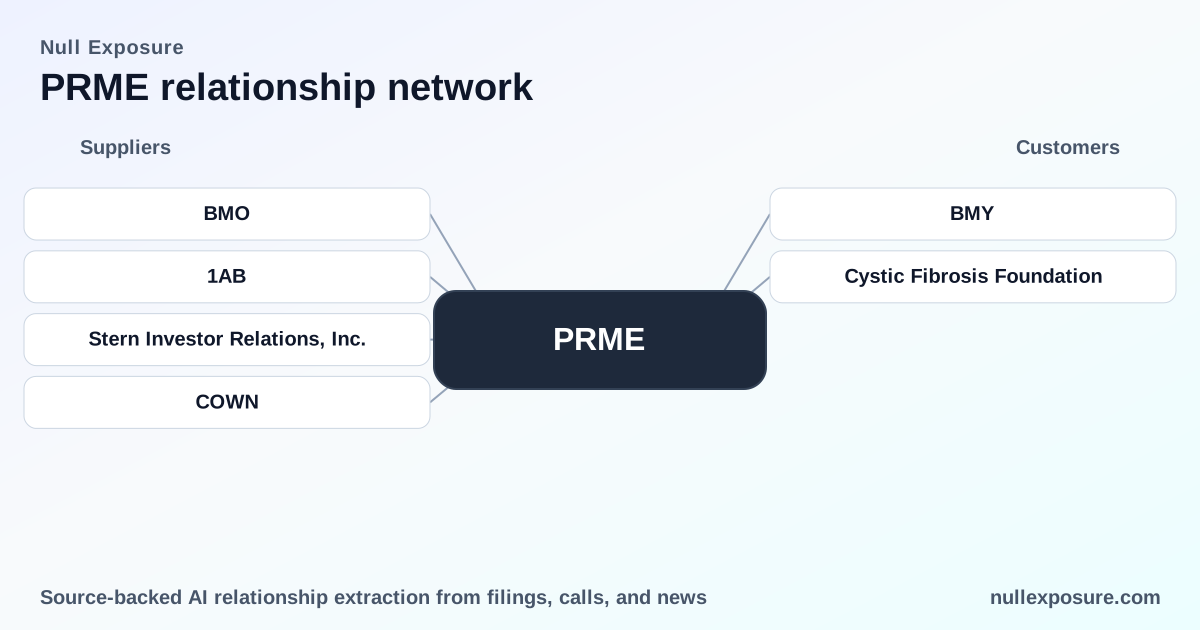
The disclosed relationships in public filings and press coverage are a mix of capital‑markets counterparties and comms firms. Each relationship below is included in the public record and is relevant to how Prime executes operations and funds development.
BMO Capital Markets — joint book‑running manager on equity offering
BMO Capital Markets acted as a joint book‑running manager on Prime Medicine’s public offering that priced at $125.4 million. This placement indicates BMO’s role in providing underwriting distribution and execution for Prime’s equity financing (QuiverQuant coverage, March 10, 2026).
Source: QuiverQuant news report on the March 2026 public offering.
TD Cowen — joint book‑running manager on equity offering
TD Cowen served alongside BMO as a joint book‑running manager for the same $125.4 million offering, confirming TD Cowen’s role in Prime’s capital‑markets access and primary issuance execution (QuiverQuant report, March 10, 2026).
Source: QuiverQuant news report on the March 2026 public offering.
1AB — media contact for scientific communications
Prime used 1AB (Dan Budwick) as a media contact for an April 2024 announcement about presenting preclinical prime‑editing data at scientific meetings, showing the company’s reliance on specialized biotech PR firms to shape scientific and investor narratives (GlobeNewswire press release, April 23, 2024).
Source: GlobeNewswire press release, April 23, 2024.
Stern Investor Relations, Inc. — investor relations contact
Stern Investor Relations provided investor‑relations support (Hannah Deresiewicz listed as contact) for the same April 2024 announcement, signaling Prime’s use of IR firms to manage shareholder communications around preclinical milestones and corporate messaging (GlobeNewswire press release, April 23, 2024).
Source: GlobeNewswire press release, April 23, 2024.
Constraints and what they reveal about supplier risk and maturity
Prime’s public disclosures and filings surface several company‑level signals that shape supplier strategy and risk:
- Licensing posture is institutional and durable. The 2019 license with Broad Institute grants Prime core IP rights and establishes a long‑running licensing framework; the agreement remains in effect until patent expiry or royalty term end, and included a modest upfront payment of $0.5M as partial consideration (company filing). This is a material legal foundation for Prime’s product claims and partner negotiations.
- Third‑party execution is the de facto operating norm. Filings explicitly state Prime has no internal manufacturing facilities and relies on CROs and contract manufacturers for research, preclinical studies and clinical trials. That outsourcing creates vendor concentration and operational dependency that translate to critical supplier relationships.
- Spend profile is early‑stage but consequential. The initial licensing consideration and ongoing outsourced spend positions supplier expenditures in the low‑to‑mid six‑figure band per contract for early agreements, escalating with clinical scale. The constraints data flags a spend band of $100k–$1M as representative for certain contracts.
- Active contractual status. Licenses and service contracts are described as active and ongoing, implying multi‑year commitments that affect procurement continuity and potential liabilities.
Taken together, these constraints define a company that is technically mature in IP position but operationally immature in commercial infrastructure—high dependency on external providers, predictable capital needs, and long‑dated IP encumbrances that influence partner negotiations.
Learn more about counterparty relationships and procurement signals at https://nullexposure.com/
Investment and operator takeaways
- Positive: Prime’s core strength is proprietary prime‑editing IP and an advanced preclinical pipeline; that IP underpins future licensing or product economics and is reinforced by a formal Broad Institute license.
- Negative: The company has negligible product revenue today, substantial negative EBITDA, and a business model that requires repeated access to equity capital—recent underwriter relationships (BMO and TD Cowen) reflect active financing and potential dilution.
- Operational risk: Outsourcing of manufacturing and clinical work creates vendor concentration and execution risk; procurement and vendor management should be elevated priorities for operators working with Prime.
- Tactical implication for investors and partners: Monitor underwriting cadence and IR activity as proxies for cash runway and messaging effectiveness; track counterparty lists (CROs, CMOs) for delivery risk and potential single‑point failures.
For a consolidated view of Prime Medicine’s supplier network and to track changes in underwriter and vendor relationships, visit https://nullexposure.com/
Prime’s path to commercial value is clear in structure: strong IP, outsourced execution, and capital‑market dependence. For investors and operators, the near‑term focus is on cash management, partner execution, and milestone delivery—areas where supplier relationships and underwriting partners will determine outcomes.