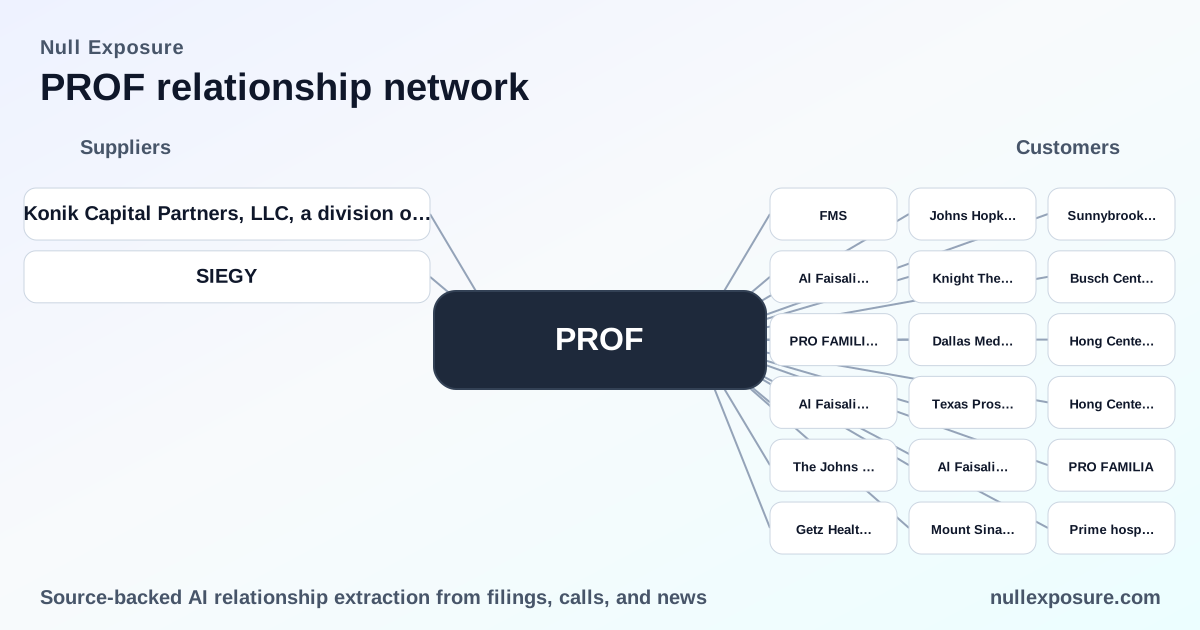
PROF (Profound Medical): supplier relationships that shape a capital‑light device play
Profound Medical develops and commercializes MRI‑guided therapeutic devices and monetizes through equipment sales, recurring service and disposables, licensing of core IP, and strategic OEM/distribution partnerships. Revenue is concentrated at a nascent scale (Revenue TTM: $16.1M) while operating losses persist (EBITDA: –$40.7M), so supplier and partner arrangements materially determine capacity to scale and margin expansion. For a pragmatic diligence trail, evaluate IP licenses, OEM compatibility, distribution coverage, and the scale of third‑party services. Learn more about mapping supplier risk and revenue linkages at https://nullexposure.com/.
Quick map of the named supplier relationships in public coverage
Below I cover every supplier relationship pulled from the public results: a financing placement agent and an OEM partner that impacts product compatibility and distribution strategy.
Konik Capital Partners (T.R. Winston division) — placement agent for capital raise
Konik Capital Partners acted as the exclusive placement agent for Profound’s registered direct offering, supporting a $36 million financing effort tied to a subsequent private placement completed by the company in late 2025. This is a capital markets engagement rather than an operational supplier relationship, but it affects liquidity and the runway necessary to fund supplier commitments and commercialization. According to an InvestingNews report covering the transaction (March 2026), Konik served as the exclusive placement agent for the offering.
Siemens — OEM partner and MR compatibility contributor
Profound is finalizing comparative compatibility with Siemens’ Interventional MR Free.Max and cites OEM partnerships as part of its global commercialization strategy; Siemens is named explicitly as an OEM partner supporting platform interoperability. That relationship signals efforts to broaden clinical access through compatibility with third‑party MR systems and to leverage OEM channels in certain markets. This detail is described in the Q3 2025 earnings call transcript published on InsiderMonkey (first reported March 2026).
What the constraint signals say about how PROF operates and where vendor risk concentrates
The constraint excerpts in filings and disclosures create a composite picture of Profound’s contracting posture, concentration, criticality of specific agreements, and supplier maturity.
-
Licensing is a structural element of the business model. The company holds an exclusive licence with Sunnybrook Health Sciences Centre for core MRI‑guided trans‑urethral ultrasound therapy technology, a non‑reciprocal IP arrangement that underpins product functionality and differentiation. According to the company’s filings in FY2025, Sunnybrook licenses intellectual property and exclusively licensed‑in rights to Profound that enable the core therapy platform.
-
Supplier relationships are critical in practice. The company explicitly warns that failure of key component suppliers or non‑compliance with regulatory or supplier control requirements could interrupt manufacturing and delivery cadence; this elevates counterparty importance beyond routine vendor lists.
-
The firm relies on multiple relationship roles: distributors (to reach EU/other markets and to comply with New EU MDR), licensees (the Sunnybrook IP arrangement), manufacturers (third‑party production fallback is required if facilities are affected), and service providers (annual third‑party cybersecurity and audit engagements). These roles reflect a hybrid operating model: Profound retains IP and platform control while outsourcing manufacturing and professional services.
-
Spend magnitude for professional services is moderate and predictable. Audit and related professional fees are disclosed in the low‑to‑mid six‑figure range (for example, $386k in 2024 and $583k in 2023 in disclosed line items) alongside smaller line items in the sub‑$100k band. Those figures are consistent with a company that outsources audit, legal and specialized technical reviews without large outsourced manufacturing contracts being visible in the same line items.
-
Contracting maturity is mixed. Licensing and OEM compatibility work show strategic, longer‑dated commitments, while manufacturing fallback language and reliance on qualified third parties for cybersecurity indicate adaptive, outsourced execution rather than vertically integrated capacity.
Taken together: IP license dependency + critical supplier warnings + moderate professional services spend create a profile where a few high‑impact agreements (IP license, OEM compatibility, key manufacturers/distributors) account for outsized operational risk and upside.
Explore supplier risk scoring and relationship maps at https://nullexposure.com/ to prioritize diligence steps.
Operational and commercial implications for investors
Profound’s supplier signals translate into several clear investment implications:
-
IP control is strategic and concentrated. The Sunnybrook licence is foundational; loss or limitation of those rights would be existentially material. Investors should prioritize verification of term length, exclusivity scope, and termination triggers.
-
OEM compatibility expands addressable market but creates integration dependency. Compatibility with major MR OEMs such as Siemens accelerates clinical adoption channels but requires ongoing engineering and certification work; that is a continuity and product‑development cost consideration.
-
Manufacturing risk is non‑trivial. Filings explicitly contemplate reliance on third‑party manufacturing in the event of facility disruption; supply continuity, lead times for device components, and quality oversight are primary procurement risks.
-
Regulatory and distribution disciplines matter. Distribution partners for the EU must meet New EU MDR requirements, which may affect go‑to‑market timing and the selection of channel partners.
-
Professional services are visible and bounded. Audit and cybersecurity services are a recurring, moderate expense, indicating that governance and third‑party oversight are budgeted but not a major cost center.
If you are evaluating commercial exposure and counterparty risk, prioritize contractual review of the Sunnybrook licence, OEM compatibility milestones with Siemens, and supplier continuity clauses for manufacturing.
Practical diligence checklist for management meetings
- Produce the Sunnybrook licence schedule, including renewal/termination clauses and territory exclusivity.
- Show the technical status and certification roadmap for Siemens Free.Max compatibility, with milestones and timelines.
- Identify primary manufacturers and ask for inventory of alternative suppliers, lead times, and single‑source components.
- Provide EU distribution agreements and proof of MDR compliance for critical distributors.
- Reconcile professional services spend trends (audit, cybersecurity) and any anticipated increases tied to scaling.
Closing assessment and next steps
Profound’s supplier footprint reflects a strategically licensed IP model augmented by OEM partnerships and outsourced execution. The company’s ability to scale revenue and convert gross margins into positive operating leverage depends on maintaining the Sunnybrook licence, executing OEM compatibility programs, and securing resilient manufacturing and distribution partners. For investors and operators, the primary questions are contractual durability and operational readiness.
For a deeper supplier risk map and tailored due diligence playbooks, visit https://nullexposure.com/. If you want prioritized red‑flag scoring and a checklist aligned to medical‑device regulatory risk, start your review at https://nullexposure.com/ — the right supplier intelligence shortens the path from research to conviction.