ProKidney (PROK): Capitalized developer, asset monetizer, and supplier-dependent early-stage biotech
ProKidney develops cell-based therapeutics for kidney disease and currently monetizes through a combination of equity markets financing, one-off asset transactions, and the long-term commercialization value of its biologics pipeline. The company funds R&D and operations primarily with capital markets activity and selective asset sales while relying on small, specialized suppliers and external service providers for manufacturing and clinical work. For investors evaluating supplier and capital relationships, the relevant signals are capital dependence, real-estate monetization, and a supplier base that combines small vendors and dedicated consulting partners. Visit https://nullexposure.com/ to track relationship exposure and supplier risk across ProKidney’s counterparties.
How the market relationship with Jefferies underpins liquidity
ProKidney has an Open Market Sale Agreement with Jefferies LLC that enables up to $100 million of Class A ordinary share sales; $7.9 million had been sold under that facility as of September 30, 2024. According to a TradingView note summarizing ProKidney’s SEC 10-Q for FY2024, the Jefferies arrangement is explicitly used to provide near-term financing capacity. This relationship demonstrates a deliberate reliance on equity distribution facilities to bridge cash needs rather than operating cash flow.
Implication: the Jefferies arrangement is a financing tool that reduces short-term funding friction, but it also signals recurring equity dilution as the primary monetization mechanism until product revenues materialize. Monitor filings for further utilization of the facility and any changes to the cap.
Real-estate divestiture via CBRE shows non-core asset monetization
A Greensboro property owned by ProKidney has been listed for sale through CBRE, according to a WFMY news report describing a CBRE real estate listing. Asset sales are being used to unlock balance-sheet liquidity in parallel with capital markets financing.
Context from filings shows ProKidney has been an active real-estate investor: the company purchased land and a building in Greensboro for $25.5 million (2023) and purchased two facilities it occupied under leases for $22.5 million (2024). Those purchases and the current CBRE listing underline a strategy of converting fixed assets into cash to support operations and development. Investors should treat property sales as a material financing lever rather than core business revenue generation.
Suppliers and service providers: small vendors plus a named consulting partner
ProKidney’s manufacturing and clinical pathway depends on a mix of small specialized suppliers and engaged service providers. According to company filings, manufacturing rilparencel requires reagents and specialty materials provided by small companies with limited experience supporting commercial biologics production, creating concentration and operational risk around supplier capability.
Separately, ProKidney-KY has a longstanding consulting services agreement with Nefro Health, an Irish partnership controlled by board member Pablo Legorreta; ProKidney-KY paid Nefro $100,000 in each of 2022, 2023, and 2024, and Nefro provides consulting services across R&D, trial conduct, and manufacturing design. That relationship is active and sits in the $100k–$1M annual spend band, according to the company filing excerpts. This is an example of the company outsourcing critical development functions to a named partner while keeping annual spend at modest levels.
Taken together, these signals show a supplier footprint that is service-heavy, R&D-focused, concentrated in specialized vendors, and not yet at commercial scale—a structural feature that drives both operational risk and the choice to preserve capital through externalization.
Operating model constraints and what they mean for partnerships
- Contracting posture: ProKidney relies on consulting agreements and third-party manufacturing/design support rather than building large internal manufacturing capacity. Filings emphasize third-party CDMOs and the need to comply with cGMP and cGTP standards, indicating contractual dependence on regulated service providers.
- Concentration: The supplier base includes small-business vendors for specialty reagents, which increases operational concentration risk relative to diversified supplier networks.
- Criticality: Manufacturing reagents and CDMO relationships are functionally critical—failure or delay in those relationships would directly impede clinical timelines.
- Maturity: Relationships are early-stage and generally service/consulting in nature, with spend bands centered at modest annual levels (e.g., Nefro at ~$100k/year) while larger balance-sheet moves are made through asset purchases and disposals.
These constraints together portray a classic early-stage biotech operating model: high technical dependency on external service providers, limited internal scale, and capital structure that leans on equity issuance and asset sales for liquidity.
(If you want a concise supplier risk scorecard and counterparty map for ProKidney, visit https://nullexposure.com/ for an investor-ready view.)
Every public relationship in the record
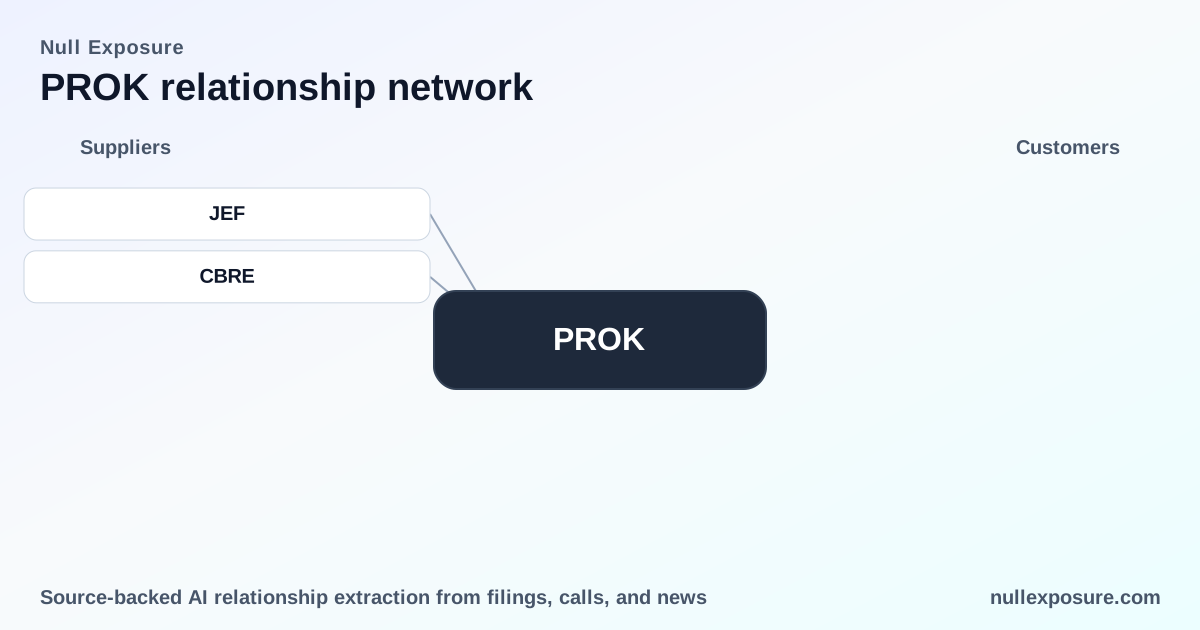
- Jefferies LLC — ProKidney entered an Open Market Sale AgreementSM with Jefferies LLC authorizing up to $100 million in Class A share sales; $7.9 million had been sold as of September 30, 2024, according to reporting of the company’s FY2024 SEC 10-Q in TradingView. This is the company’s active equity distribution channel.
- CBRE — A real-estate listing handled by CBRE shows ProKidney’s Greensboro property is on the market, as reported by WFMY; the listing confirms management’s use of property sales to generate liquidity alongside capital markets activity.
Investor takeaways and short checklist
- Financing reliance is high. Market cap is $646.8M, revenue is $744k TTM, and EBITDA is deeply negative (–$164.6M), which explains reliance on the Jefferies facility and asset sales as primary cash sources.
- Supplier concentration is a material operational risk. Small-business suppliers of reagents and a limited set of CDMOs increase the likelihood of single-point failures affecting timelines.
- Asset monetization is a deliberate strategy. Purchases of real estate in 2023–2024 and the current CBRE listing indicate management will monetize physical assets to sustain the development pathway.
- Named consulting relationships are active but modest in spend. The Nefro Health engagement is ongoing and paid at roughly $100k per year, demonstrating low-to-medium dollar reliance on key advisory partners.
Where to look next and recommended actions
For operators and investors, the immediate monitoring set should include: rate of utilization of the Jefferies sales facility (SEC filings), updates on the CBRE sale and any proceeds disclosed, announcements of CDMO contracts or supply agreements for rilparencel, and clinical/regulatory milestones that could change the capital plan. Track these items monthly against cash runway and quarterly filings to anticipate further dilution or asset sales.
Get continuous updates and counterparty intelligence at https://nullexposure.com/ — the best place to map supplier concentration and financing relationships for ProKidney.
Final note: ProKidney’s model is capital-market-dependent, supplier-concentrated, and asset-augmented—a common profile for therapeutics developers transitioning from R&D to commercialization. Investors should price in dilution risk and operational fragility until clinical proof-of-concept and diversified manufacturing capacity are established.