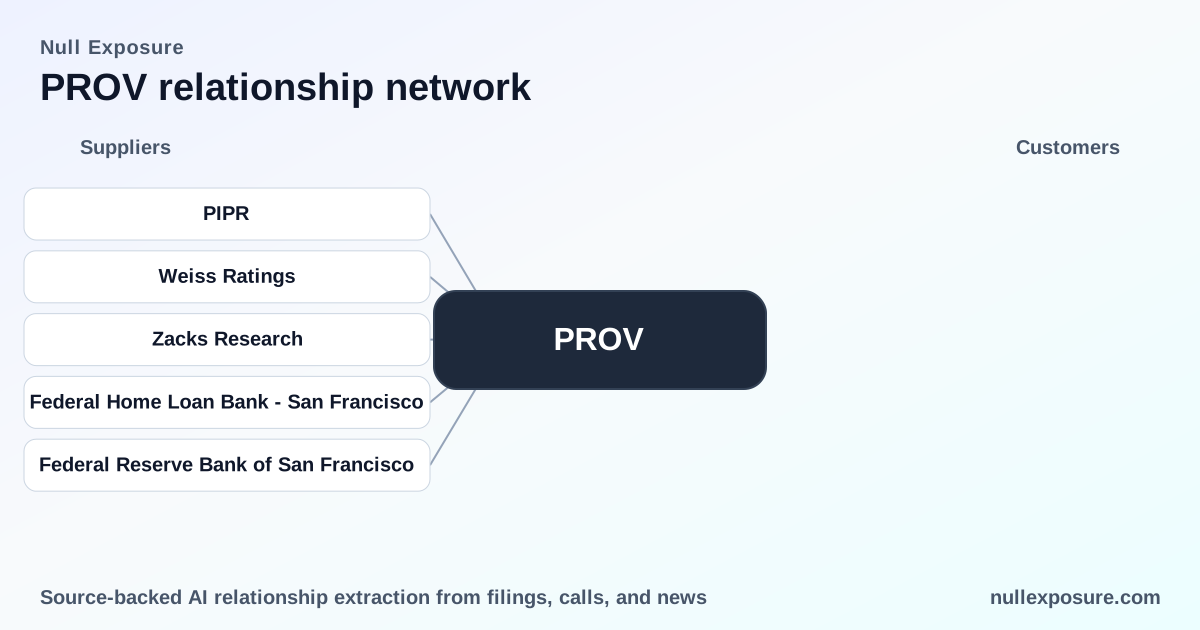
Provident Financial Holdings (PROV): supplier and counterparty map for investors
Provident Financial Holdings operates as a community bank in the Inland Empire of Southern California, monetizing primarily through net interest income on originated and purchased mortgage and commercial loans, deposit gathering, and fee income from consumer and small-business banking services. Its balance sheet and earnings depend on lending spread management and access to wholesale funding lines that support loan growth and liquidity. Investors should view supplier and counterparty relationships through the lens of funding flexibility, third‑party service criticality, and modest scale. For an integrated view of counterparty exposures and supplier posture, visit https://nullexposure.com/.
How Provident runs the business and what that means for suppliers
Provident is a regional bank with a focused footprint, which creates a concentrated operating model: revenue is local, funding needs are discrete, and vendor choices are pragmatic. Company-level disclosures show three clear operational signals: long‑dated lease commitments for retail offices, an originating/buyer role for loan assets, and active engagement of third‑party cybersecurity and managed security service providers. These are not peripheral facts — they define contracting posture and vendor criticality.
- Contracting posture: retail branch leases are multi‑year (maturities range 2026–2029 with extension options), so facilities and facilities‑management vendors operate under long‑term agreements as a default.
- Relationship role: Provident functions principally as a buyer of funding and as an originator/purchaser of loan assets, which concentrates its counterparty needs on funding sources and loan‑servicing providers.
- Service provider reliance: the company proactively engages third‑party cybersecurity experts for assessments, penetration testing, managed security, and incident response — this elevates vendor criticality for operational resilience.
These company-level constraints shape supplier negotiations: long-term service commitments, predictable renewal cycles, and a need for specialized financial-services security vendors rather than ad‑hoc providers.
Supplier and counterparty list: what each relationship means for an investor
Below are the relationships captured in public reporting; each entry is summarized in plain English with the reporting source.
Piper Sandler
Piper Sandler has provided equity research coverage on Provident and recently reduced its price target, signaling a more conservative view from a sell‑side analyst covering the stock (National Today, Feb 11, 2026: https://nationaltoday.com/us/nj/jersey-city/news/2026/02/11/provident-financial-share-price-crosses-above-200-day-moving-average). Investor takeaway: sell‑side sentiment has shifted toward caution, which can compress market liquidity and investor confidence for a small‑cap bank.
Weiss Ratings
Weiss Ratings has maintained a "hold (c)" rating on Provident Financial in public commentary, providing a neutral independent assessment that will matter to retail and some institutional investors (National Today, Feb 11, 2026: https://nationaltoday.com/us/nj/jersey-city/news/2026/02/11/provident-financial-share-price-crosses-above-200-day-moving-average). Investor takeaway: third‑party ratings are not bearish but set a modest bar for performance expectations.
Zacks Research
Zacks Research upgraded Provident from "strong sell" to "hold", reflecting an improvement in their short‑term assessment of earnings or outlook (National Today, Feb 11, 2026: https://nationaltoday.com/us/nj/jersey-city/news/2026/02/11/provident-financial-share-price-crosses-above-200-day-moving-average). Investor takeaway: research upgrades have supported recent positive price action, but the rating remains cautious given the bank’s scale.
Federal Home Loan Bank — San Francisco
Provident reported approximately $213.1 million of remaining borrowing capacity with the FHLB as of Dec 31, 2025, which represents a material wholesale funding lever available for liquidity and loan growth (company reporting summarized on Yahoo Finance, Mar 2026: https://finance.yahoo.com/news/provident-financial-holdings-reports-second-110000084.html). Investor takeaway: the FHLB facility is a primary contingent funding source that materially reduces short‑term liquidity risk.
Federal Reserve Bank of San Francisco
Provident also disclosed an additional $193.3 million available through a borrowing facility with the Federal Reserve Bank of San Francisco, plus an unused unsecured federal funds facility of $50.0 million with a correspondent bank, demonstrating layered access to central and correspondent liquidity (company reporting summarized on Yahoo Finance, Mar 2026: https://finance.yahoo.com/news/provident-financial-holdings-reports-second-110000084.html). Investor takeaway: combined central‑bank and correspondent facilities give Provident a resilient funding profile relative to its asset base.
What these relationships imply for risk, concentration, and maturity
The counterparty map shows funding concentration toward established, highly rated wholesale sources (FHLB and FRB), which is positive for short‑term liquidity but creates a dependence on institutional facilities that require continued compliance with covenants and collateral standards. The balance between these facilities and the bank’s on‑balance liquidity creates a practical runway for the loan portfolio.
- Concentration: funding is concentrated in a few large counterparties rather than diversified across many small lines; this is efficient for a small bank but increases counterparty negotiation leverage.
- Criticality: FHLB and FRB lines are operationally critical; any restriction there would force immediate funding alternatives or balance‑sheet adjustments.
- Maturity profile: branch leases maturing 2026–2029 produce predictable renewal events that act as natural negotiation points with vendors and landlords, allowing management to reprice or rationalize physical footprint.
- Vendor maturity: reliance on third‑party cybersecurity services signals a mature governance posture — the bank treats security providers as indispensable vendors rather than optional contractors.
These characteristics combine to form a conservative contracting stance: long-term commitments where necessary (branches), and centralized, relationship‑based funding where scale favors fewer counterparties.
If you want a structured supplier risk scorecard and counterparty exposure view for due diligence, explore our platform at https://nullexposure.com/ for an investor‑grade summary.
Investment implications and near‑term monitoring items
Provident’s modest market capitalization (~$102.7 million) and current valuation metrics (Price/Book ~0.80; Forward P/E ~10.17) position it as a small regional bank whose upside is tied to local loan growth, margin management, and unfettered access to wholesale funding. Key monitoring items for investors:
- Covenant and collateral terms on the FHLB and FRB facilities — any tightening changes funding economics.
- Branch lease renewals in 2026–2029 — these are levers for cost control or footprint optimization.
- Third‑party security vendor performance and incident history — outages or breaches would be reputationally expensive.
- Sell‑side and independent ratings shifts — analyst downgrades or rating changes have outsized effects on small caps.
Bottom line: actionable takeaways
Provident’s supplier and counterparty landscape is straightforward and concentrated: robust wholesale liquidity lines (FHLB/FRB), long‑term branch lease contracts, and deliberate use of third‑party cybersecurity providers. These give the bank operating resilience but concentrate counterparty risk in a small set of institutional relationships. For investors, the primary questions are funding covenant stability and execution on local loan growth, not vendor diversity.
For a concise, investor‑ready counterparty summary and supplier risk scoring for PROV, visit https://nullexposure.com/. For a tailored diligence package and alerts on covenant or rating changes, see https://nullexposure.com/ and set up monitoring.