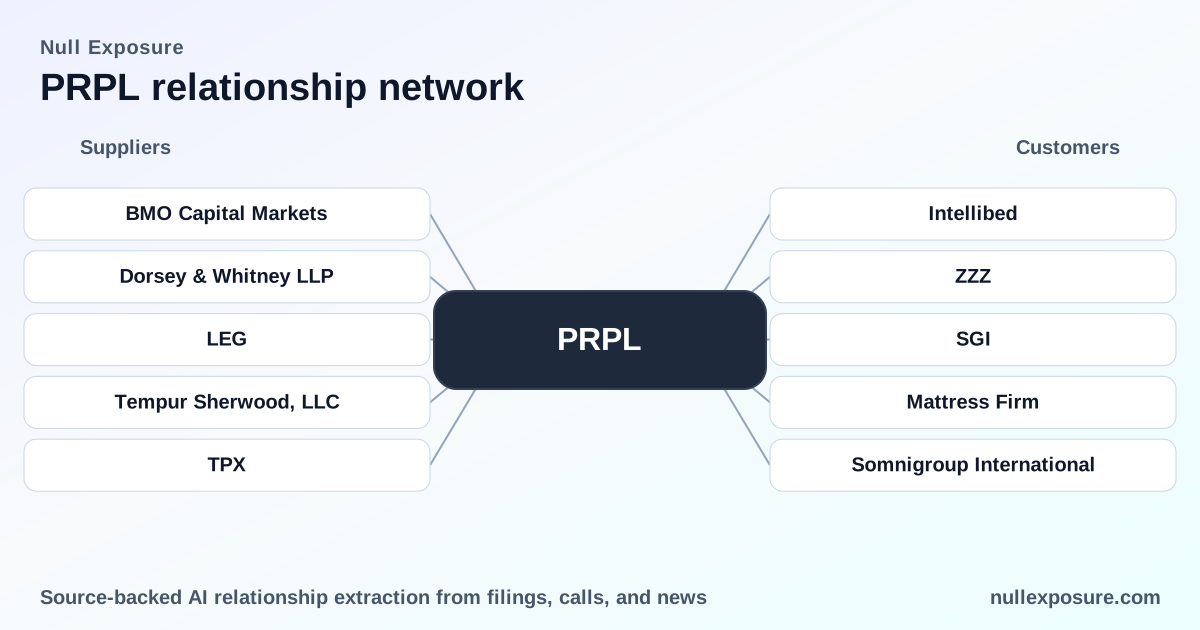
Purple Innovation (PRPL): supplier map and investor implications
Purple Innovation designs and manufactures mattresses, pillows, and cushions and monetizes through direct product sales and wholesale/retail channel partnerships that leverage third‑party assembly and logistics. The company outsources materials and contract assembly while scaling retail distribution through strategic partners, creating a supplier‑dependent operating model where supplier performance directly drives gross margins and order fulfillment.
For a quick refresh on supplier coverage and deeper supplier-intelligence for portfolio or operational due diligence, visit https://nullexposure.com/ for a consolidated view of third‑party relationships and risk signals.
Why suppliers matter to Purple’s business model
Purple runs a manufacturing‑dependent, outsource‑heavy model: raw materials such as polyurethane foam, springs and its Hyper‑Elastic Polymer inputs are procured externally, and final assembly frequently occurs through contract manufacturers and partner assemblers. That posture drives four investment‑relevant constraints:
- Criticality: Suppliers are classified as critical because delayed or degraded inputs can materially disrupt revenue recognition and increase costs; the company’s disclosures explicitly warn that supplier failures could significantly impact operations.
- Concentration exposure: Purple depends on a network of contract manufacturers and, in some cases, sole‑source suppliers for components—this raises substitution costs and operational fragility during supply shocks.
- Operational role mix: Suppliers act both as manufacturers (contract assemblers) and service providers (third‑party logistics), embedding third parties into Purple’s fulfillment and inventory economics.
- Maturity and scalability: Using established external partners supports faster retail expansion but transfers execution risk; the company leverages long‑term manufacturing relationships to scale beyond the U.S.
These constraints are company‑level signals drawn directly from Purple’s supplier disclosures and should be incorporated into any supplier‑risk adjusted valuation or operational playbook.
What the supplier relationships actually are — vendor by vendor
BMO Capital Markets
BMO Capital Markets served as Purple’s financial advisor in the company’s transaction activity related to the acquisition of Intellibed, supporting deal execution and structuring. A PR Newswire announcement covering the Intellibed acquisition names BMO as the financial advisor (PR Newswire, March 2026).
Dorsey & Whitney LLP
Dorsey & Whitney acted as legal advisor on the Intellibed acquisition, handling the legal workstream for the transaction. This role is documented in the same PR Newswire release describing the acquisition (PR Newswire, March 2026).
Leggett & Platt (LEG)
Purple leverages a long‑standing partnership with Leggett & Platt to scale sourcing efficiencies and assembly support as it expanded retail presence into Canada, indicating dependence on legacy bedding supply chains for component sourcing and manufacturing know‑how (PR Newswire release announcing expansion with Sleep Country Canada; first reported in the company’s announcement).
Tempur Sherwood, LLC
Purple executed a strategic supply agreement with Tempur Sherwood, LLC (a Tempur Sealy subsidiary) to align parts of its supply chain with one of the world’s largest bedding manufacturers, an arrangement described as delivering meaningful value to both companies’ stakeholders (PR Newswire, FY2025 announcement).
Tempur Sherwood (TPX)
A separate media report noted that Tempur Sherwood will assemble some Purple product lines sold through Mattress Firm, illustrating a commercialization route that routes specific SKUs into retail via partner assembly at an established mattress manufacturer’s facilities (Yahoo Lifestyle report, FY2025).
Operational reading: what these relationships signal for investors
Collectively, these relationships show Purple is outsourcing both financial/legal transaction work (advisors) and core manufacturing/assembly to established bedding industry players. That structure provides scale advantages—access to established assembly lines and logistics—but concentrates operational risk in third parties, particularly for the Hyper‑Elastic Polymer inputs and other raw materials the company flags as critical. The company’s financial snapshot reinforces the importance of supply stability: revenue is meaningful (approximately $457m TTM) but profitability metrics are negative (EBITDA and EPS losses), so operational disruptions translate quickly into margin pressure and earnings volatility.
A pragmatic investor should treat the advisory relationships (BMO, Dorsey) as execution support for M&A and strategy, and the manufacturing partners (Leggett & Platt, Tempur Sherwood) as second‑order drivers of gross margin, inventory flow, and time‑to‑shelf.
For a consolidated supplier risk score and ongoing monitoring, consider visiting https://nullexposure.com/ to see how supplier dependencies affect operational resilience.
Risks to monitor and catalyst checklist
- Supply continuity for key raw materials: Procurement disruptions for foam, springs or Hyper‑Elastic Polymer inputs are explicitly labeled critical in Purple’s disclosures and would directly impair production and margins.
- Concentration of assembly partners: Reliance on a small set of contract assemblers increases operational leverage and negotiation risk as Purple scales retail penetration.
- Channel execution through third parties: Retail expansion—especially outside the U.S.—relies on partners’ ability to assemble and distribute to local retailers; underperformance by those partners reduces revenue realization speed.
- Margin sensitivity: Given current negative operating metrics, cost inflation or supplier price pressure hits near‑term earnings and requires either price pass‑through or improved operational efficiency.
Watch upcoming quarterly disclosures and press releases for changes to supplier mix, any move toward vertical integration, or additional multi‑year supply contracts that reduce single‑source exposure.
Bottom line and investor action points
Purple’s supplier strategy is pragmatic and scale‑oriented: it leverages recognized bedding manufacturers for assembly and reputable advisors for transactions while accepting material third‑party dependency that is explicitly characterized as critical in company filings. That creates a tradeoff: faster retail growth with higher supplier risk.
If you’re evaluating PRPL exposure for a portfolio or operational partnership, prioritize:
- confirmation of multi‑year supply agreements and single‑source exceptions,
- margin sensitivity analysis under supplier stress scenarios,
- and verification of contingency plans for key raw materials.
For deeper supplier intelligence and to track changes in Purple’s third‑party map in real time, explore the coverage available at https://nullexposure.com/.
If you want a tailored supplier risk brief or monitoring setup focused on Purple’s manufacturing partners, legal advisors, and critical‑material suppliers, visit https://nullexposure.com/ to request a custom report or alerting package.