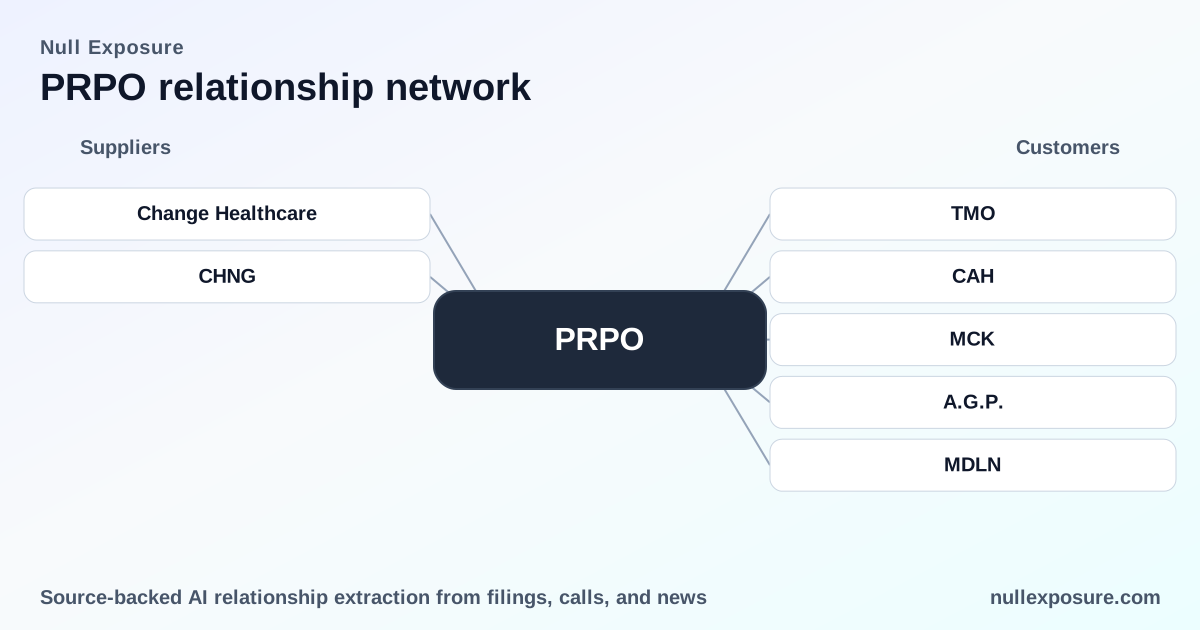
Precipio’s supplier footprint: what Change Healthcare repayments reveal about PRPO’s operating leverage
Precipio (PRPO) is a New Haven–based cancer diagnostics and reagent company that monetizes through laboratory testing services, reagent and media sales, and licensed technologies tied to its IV-Cell platform. The company’s near-term cash profile has been shaped as much by working capital and vendor financing as by topline growth; recent repayments to Change Healthcare reduce short-term leverage and free operating cash flow to remain inside the business. For investors and operators, the supplier story is a lens into contracting posture, vendor criticality, and the maturity of Precipio’s supply and IP arrangements. Learn more at https://nullexposure.com/.
The Change Healthcare relationship, in plain language
-
Precipio repaid a $1.1 million advance from Change Healthcare, the clearinghouse that handles the company’s billing claims processing, which removes a near-term liability on the balance sheet. (Source: GlobeNewswire press release, Jan 15, 2026 — https://www.globenewswire.com/news-release/2026/01/15/3219581/0/en/Precipio-Takes-Major-Steps-Toward-a-Clean-Balance-Sheet.html)
-
Management reported in FY2025 that PRPO was two months away from completing its quarterly repayments to Change Healthcare, after which operating cash flow would remain in the business, improving liquidity flexibility. (Source: TradingView summary of Zacks analysis, FY2025 — https://www.tradingview.com/news/zacks:637559b8a094b:0-precipio-stock-up-following-solid-q3-earnings-and-improved-cash-flow/)
-
In the company’s Q2 FY2025 disclosure, Precipio reiterated that the remaining repayment to Change Healthcare would be completed by year-end and framed the repayment as part of a pathway to a cash-flow-positive, debt-free balance sheet. (Source: Precipio Q2 2025 press release, GlobeNewswire — https://www.globenewswire.com/news-release/2025/08/13/3133061/0/en/Precipio-Announces-its-Q2-2025-Financial-Results.html)
Each of the three notices documents the same counterparty role — Change Healthcare as a billing clearinghouse and short-term creditor — and together they trace a discrete capital flow: short vendor advance → systematic repayment → strengthened operational liquidity.
What the supplier relationship pattern tells investors about how Precipio operates
Precipio’s supplier relationships aggregate into a hybrid operating model that mixes product sales, licensed IP, and outsourced services. The documented interactions reveal a company transitioning from relying on vendor-supplied advances toward self-sustaining operating cash flow. Repayment of the Change Healthcare advance is a tactical deleveraging event with strategic implications: it converts an operational dependency into an improvement in free cash flow available for reinvestment in labs, reagents, or commercialization.
Constraints and company-level signals derived from Precipio’s disclosures add texture to that assessment:
-
Licensing is part of the model. The company states it may enter license agreements for technologies relevant to its products, signaling an IP-driven revenue stream and exposure to licensor/licensing contracts for core capabilities.
-
Precipio can act as a licensor. Statements describing potential license agreements indicate the firm has or intends to grant rights to third parties, which implies revenue channels that scale without proportional increases in manufacturing footprint.
-
Outsourced manufacturing is in use. The IV-Cell technology and media can be produced under direct supply contracts with a manufacturer operating under license and NDAs, which points to a mixed supply chain of in-house know-how and third-party production.
-
Third-party services are material to operations. Precipio engages external cybersecurity and assurance providers for penetration testing and audits, indicating reliance on specialized service providers for enterprise controls.
These are company-level signals about contracting posture, not annotations of a single supplier. Collectively they point to a firm that balances IP licensing, outsourced manufacturing, and service provider relationships rather than vertically integrating every element of its value chain.
Contracting posture and critical vendor exposure
The Change Healthcare relationship demonstrates how a single vendor can play both an operational and a financing role. As a billing clearinghouse, Change Healthcare is operationally critical — claims processing affects revenue realization and cash collections — and the advance facility placed it temporarily in a creditor–vendor role. The repayment reduces counterparty concentration risk and improves Precipio’s cash conversion profile, which investors should view as a reduction in short‑term funding fragility.
Supply, IP and operational maturity
The presence of licensed technologies and manufacturer contracts for IV-Cell media suggests Precipio’s product offerings rely on protectable IP and controlled manufacturing pathways. Engaging external manufacturers under license and NDA is consistent with a growth-stage diagnostics company that outsources scale production while retaining IP control. Similarly, regular third-party security audits indicate an operational maturity in governance and controls that supports enterprise customers and payer interactions.
Investment implications — a concise checklist
-
Balance-sheet improvement: Completion of repayments to Change Healthcare frees operating cash flow; this is a liquidity positive that supports reinvestment without immediate external financing.
-
Vendor criticality remains: Billing clearinghouses are mission‑critical suppliers; even when advances are repaid, operational dependency on a single claims processor is a persistent risk to collections and revenue timing.
-
IP and manufacturing mix reduces capex but raises supplier governance needs: Licensing and third‑party manufacturing lower fixed costs but increase exposure to contract performance and IP protection failures.
-
Service-provider reliance signals enterprise readiness: Ongoing cybersecurity audits and penetration tests support commercialization and payer integrations, improving the firm’s operational credibility.
Actionable items for investors and operators include monitoring receivables days, contract terms with clearinghouses, and the cadence of license agreements that could yield non-linear revenue. For tailored diligence and monitoring, visit https://nullexposure.com/.
What operators should prioritize next
Operators should focus on three concrete workstreams:
-
Tighten contract terms and SLAs with critical service providers (claims processors, manufacturers) to reduce operational single points of failure and accelerate dispute resolution.
-
Translate the improved cash profile from vendor repayment into targeted investments that raise throughput in diagnostic services or expand high-margin reagent sales tied to IV-Cell technology.
-
Maintain or expand third-party assurance and security audits to preserve enterprise customer confidence and insurer integrations.
These steps protect the topline and convert the recent deleveraging progress into sustainable margin gains. For a deeper review of supplier dynamics and contract signals, go to https://nullexposure.com/.
Bottom line
Precipio’s supplier disclosures and the sequence of Change Healthcare repayments represent more than housekeeping: they signal a shift in funding composition and a clearer runway to internally generated cash flow. Repaying the advance lowers short-term funding risk while highlighting the importance of managing vendor concentration, IP licensing terms, and outsourced manufacturing governance. For investors evaluating PRPO, the supplier story is a practical indicator of operational resilience and contract management discipline.