Pursuit Attractions and Hospitality (PRSU): supplier relationships and what they mean for investors
Pursuit Attractions and Hospitality operates, acquires and monetizes a portfolio of destination attractions and hospitality properties across North America and Iceland, generating revenue from admissions, hospitality services, concessions and location-specific experiences. The company’s value is driven by site ownership and long-term land positions, complemented by selective licensed attractions and third-party service arrangements that support operations and technology. For investors evaluating supplier exposure, the key questions are how contractual terms lock in locations, where transient vendor dependencies exist, and what supplier changes could materially affect cash flow and capex requirements.
Explore deeper supplier analytics at https://nullexposure.com/.
How Pursuit makes money and where suppliers fit in
Pursuit’s economics are location-dependent and asset-backed. The company owns a large share of its properties, which supports stable revenue capture from hospitality and attraction operations and increases sensitivity to real-estate economics and local tourism cycles. Where Pursuit does not own sites—most notably its Flyover attractions and certain support offices—it operates under leases or licensing arrangements that compress control and introduce landlord and licensor counterparty risk. Vendor relationships for technology, ride systems, and professional services are transactional but operationally critical: they reduce capital outlay but create service continuity exposures that affect guest experience and revenue realization.
Supplier relationships uncovered (what investors need to know)
T.ark Architects — design partner on Sky Lagoon (Iceland)
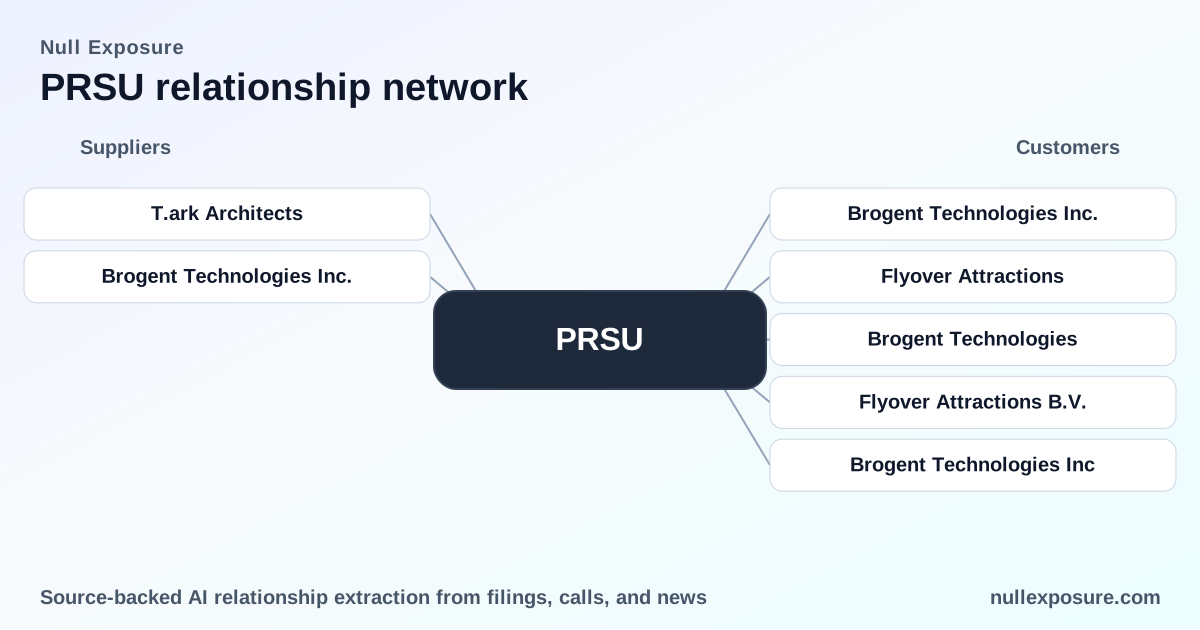
Pursuit’s Sky Lagoon in Reykjavik was designed by Halldór Eiríksson, a partner at T.ark Architects, reflecting the company’s use of specialized architectural firms for flagship developments; this relationship underscores how Pursuit sources design expertise for high-profile, location-specific projects. A CLAD Global article covering Sky Lagoon described the project’s design inspiration and credited T.ark Architects for the destination’s cinematic aesthetic (CLAD Global, published March 10, 2026).
Brogent Technologies Inc. — transfer of Flyover ride systems
A news report noted that Brogent Technologies agreed to acquire Flyover attractions from Pursuit, and the Flyover venues currently feature Brogent’s i-Ride flying theatre systems across locations including Vancouver, Las Vegas, Chicago and Reykjavík. This signals that Pursuit’s Flyover attractions are materially coupled with Brogent’s ride technology and that ownership changes involve the underlying supplier intellectual property and equipment (EAP Magazin, reported March 10, 2026).
What the constraints reveal about operating posture and supplier risk
The contractual and operational excerpts available for Pursuit provide clear signals about supplier exposure and maturity.
-
Long-term land leases are a core structural feature. Pursuit reports land leases in Canada and Iceland with terms up to 46 years, which anchors revenue potential at those sites and reduces tenant turnover risk, while concentrating asset exposure in specific geographies and making capex and maintenance obligations long-lived. This is a company-level characteristic that supports predictable cash flow but increases sensitivity to local demand shocks.
-
Short-term transitional vendor dependence exists. Pursuit entered a transition service agreement (TSA) with GES for post-sale IT infrastructure support for a limited period, indicating a temporary but potentially critical reliance on an external provider during systems migration. This represents short-term operational dependency rather than a permanent outsourcing posture.
-
Mixed ownership and license positions create differentiated counterparty profiles. While Pursuit primarily owns its properties, it explicitly licenses and leases its Flyover attractions and key support offices, which imposes landlord and licensing counterparty risk for those venues and can limit operational flexibility and residual value capture.
-
Third-party professional services support cyber and risk functions. Pursuit uses external cybersecurity and professional services to manage threats and compliance, signaling outsourced specialist reliance for high-skill functions; this reduces internal headcount needs but increases vendor management and third-party risk oversight requirements.
-
Contract terminations and consolidation occur. A facility lease was terminated effective August 6, 2024, showing that Pursuit adjusts its footprint when strategic or financial calculus requires it; investors should treat lease termination events as signs of active portfolio management rather than purely operational failure.
These constraints collectively portray a company with strategically long property commitments, targeted short-term vendor dependencies, and a mixed model of owned vs. leased assets—a profile that supports valuation stability but requires active supplier governance.
Investment implications for operators and procurement teams
- Concentration and site specificity are core risks and strengths. Long land leases protect revenue at marquee locations but concentrate exposure to local tourism cycles and regulatory regimes. Operators should prioritize contingency planning for geographic demand shocks and ensure capex programs preserve property appeal.
- Transition agreements require explicit migration plans. The TSA with GES highlights that short-term vendor arrangements can become operational bottlenecks; procurement and IT teams should demand clear exit and knowledge-transfer milestones in TSAs to avoid service gaps.
- Technology and ride-system relationships can be strategic levers. The Brogent–Flyover linkage shows that ride suppliers are more than contractors; they are technology partners whose equipment and IP shape asset value, and any change in ownership or supplier terms can affect guest experience and recurring revenues.
- Professional services outsourcing is acceptable but demands third-party risk controls. External cyber and advisory suppliers reduce fixed costs but introduce dependency; contracts should include SLAs, audit rights, and incident response commitments.
Learn how to track supplier posture and contractual signals at https://nullexposure.com/.
Quick, actionable takeaways
- Asset-backed model with long lease anchors. Long land leases up to 46 years provide revenue stability but concentrate location risk.
- Selective vendor dependency. Short-term TSAs and outsourced cyber support create temporary but important single points of failure.
- Critical equipment suppliers matter. Ride-system suppliers like Brogent materially influence attraction economics and transfer dynamics when assets are sold.
- Active portfolio management is ongoing. Lease terminations and licensing usages indicate a company that adapts its footprint.
Bottom line and next steps for investors
Pursuit’s supplier landscape is a hybrid of durable, owned assets and targeted leased/licensed venues, with a small number of strategically critical suppliers for technology and transitional services. For investors and operators, the priority is to assess counterparty credit, contract maturities, and migration plans for any short-term vendor agreements—these factors will determine near-term operational continuity and the firm's capacity to monetize assets through tourism cycles. To monitor supplier shifts and contract signals over time, visit https://nullexposure.com/ for supplier-focused intelligence and alerts.