Prothena’s outsourced manufacturing footprint: what investors need to know
Prothena Corporation plc (PRTA) is an advanced‑stage clinical biotech that commercializes value primarily through progressing therapeutic candidates through clinical development and out‑licensing or eventual product launches. The company does not operate manufacturing plants; instead, it monetizes pipelines by relying on third‑party manufacturers, clinical partners and licensing economics while retaining clinical and regulatory control. For investors, the practical exposure is straightforward: supply‑chain continuity, contractual commitments, and third‑party quality control drive execution risk and timeline certainty. Learn more about supplier exposures at https://nullexposure.com/.
Understanding this dynamic is essential to modeling development timelines, the probability of successful launches, and downside scenarios tied to manufacturing interruptions.
How Prothena outsources critical functions and why it matters
Prothena has a deliberate contracting posture: it does not own or operate manufacturing, packaging, labeling, storage, testing or distribution facilities for its drug candidates and instead contracts out those activities. That operating model intentionally reduces capital intensity but concentrates operational risk with a handful of contract development and manufacturing organizations (CDMOs) and service providers.
Company disclosures identify manufacturing and service relationships as material to operations, and Prothena reports non‑cancelable purchase commitments totaling $12.7 million as of December 31, 2024, indicating mid‑single‑digit to low‑double‑digit millions in committed near‑term spend. These commitments, together with explicit reliance on external consultants and CROs to manage trials and manufacturing strategy, mean supply continuity and counterparty performance are critical drivers of near‑term execution. For further context and supplier tracking, visit https://nullexposure.com/.
Supplier relationships disclosed in the 2024 Form 10‑K
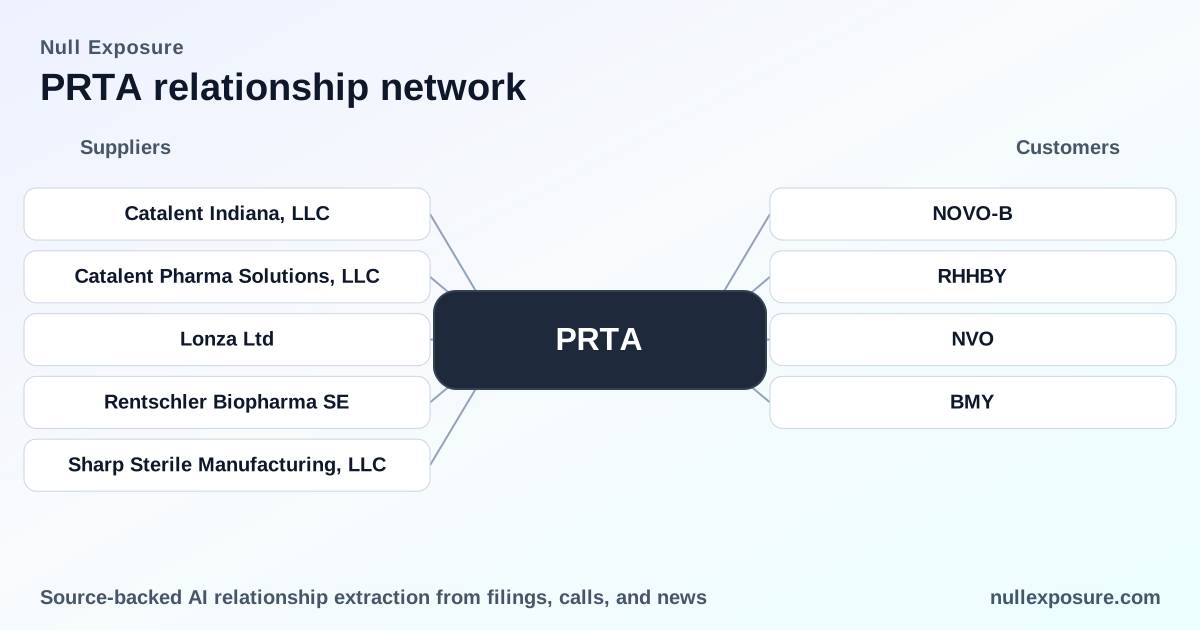
Prothena lists a short roster of named CDMO partners in its FY2024 filing; each relationship is in active support of clinical supplies for specific programs.
Catalent Indiana, LLC
Catalent Indiana is named as one of Prothena’s third‑party manufacturers for clinical supplies of birtamimab, the company’s Alzheimer’s‑related therapeutic candidate. According to Prothena’s 2024 Form 10‑K (FY2024), Catalent Indiana is contracted to produce clinical material for that program.
Rentschler Biopharma SE
Rentschler Biopharma is also identified as a third‑party manufacturer for birtamimab, sharing manufacturing responsibilities with Catalent Indiana for that program. This dual‑vendor naming suggests Prothena has at least some redundancy for biologic production of birtamimab, as recorded in the FY2024 10‑K.
Catalent Pharma Solutions, LLC
Catalent Pharma Solutions is listed as a third‑party manufacturer for clinical supplies of PRX012, Prothena’s other clinical candidate. The FY2024 Form 10‑K indicates Catalent Pharma is a named CDMO partner for PRX012 along with a secondary supplier.
Sharp Sterile Manufacturing, LLC
Sharp Sterile Manufacturing is disclosed alongside Catalent Pharma as a third‑party manufacturer providing clinical supplies for PRX012, according to the company’s FY2024 10‑K, indicating Prothena uses both firms to support that candidate’s clinical production needs.
Lonza Ltd
Lonza Ltd is identified as the third‑party manufacturer of clinical supplies for PRX019, per Prothena’s FY2024 Form 10‑K, placing an established global CDMO in support of that development program.
Operational constraints and what they signal about risk
Prothena’s public disclosures include several company‑level constraints that should be reflected in investor diligence and models:
- Contracting posture — outsourced manufacturing and services. Prothena explicitly states it contracts with third parties for all preclinical and clinical manufacturing, testing and distribution; that is its default operating model and will remain so in the foreseeable future. This reduces capital requirements but increases dependency on vendor execution.
- Materiality of supplier risk. The company warns that interruptions in raw materials or third‑party supply could materially impair manufacturing until alternate sources are qualified, a strong statement about the operational sensitivity of its programs.
- Role concentration — manufacturers and service providers. Filings identify both CDMOs and third‑party consultants/CROs as core to running trials and manufacturing strategy; these are not peripheral vendors but execution partners.
- Active contractual commitments and spend scale. Non‑cancelable purchase commitments of $12.7 million as of year‑end 2024 place near‑term spend in the $10m–$100m band; this is meaningful for a company with limited revenue and negative operating margins.
- Relationship maturity and stage. These are active, clinical‑stage manufacturing relationships supporting current trials, not speculative vendor relationships that could be deferred.
These signals collectively imply counterparty performance, inventory coverage, and contract terms are key levers investors should monitor. Filings identify the constraint — they do not allocate it to a single supplier — so treat the list of vendors as the operational ecosystem driving that risk.
What investors and operators should do next
For valuation modeling and partnership diligence, translate the supplier profile into four practical actions:
- Stress‑test timelines: model production delays of 3–12 months for late‑stage clinical supplies and their impact on peak sales and discount rates.
- Quantify runway and contingent spend: track non‑cancelable commitments and likely incremental CDMO spend to the next clinical inflection.
- Demand contract diligence: obtain suppliers’ contingency plans, capacity commitments, quality inspection histories and inventory cover for critical lots.
- Monitor counterparties’ reputations: prioritize operational due diligence on Catalent, Lonza, Rentschler and Sharp for inspection records and capacity constraints.
For a consolidated supplier intelligence view tailored to investor workflows, visit https://nullexposure.com/ to see how supplier exposures map to financial models.
Bottom line: what this means for PRTA risk and value
Prothena’s business model deliberately outsources manufacturing to reduce capital intensity, which is consistent with biotech peers. However, that outsourcing concentrates execution risk with a small set of CDMOs and translates into material contractual commitments that investors should incorporate into probability‑weighted valuations. The named relationships — Catalent Indiana, Rentschler, Catalent Pharma Solutions, Sharp Sterile, and Lonza — represent both operational leverage (established partners) and single‑point execution risk for the company’s clinical programs.
For further supplier mapping and to convert these relationship disclosures into investable signals, consult https://nullexposure.com/ and incorporate supplier continuity scenarios into your PRTA models.