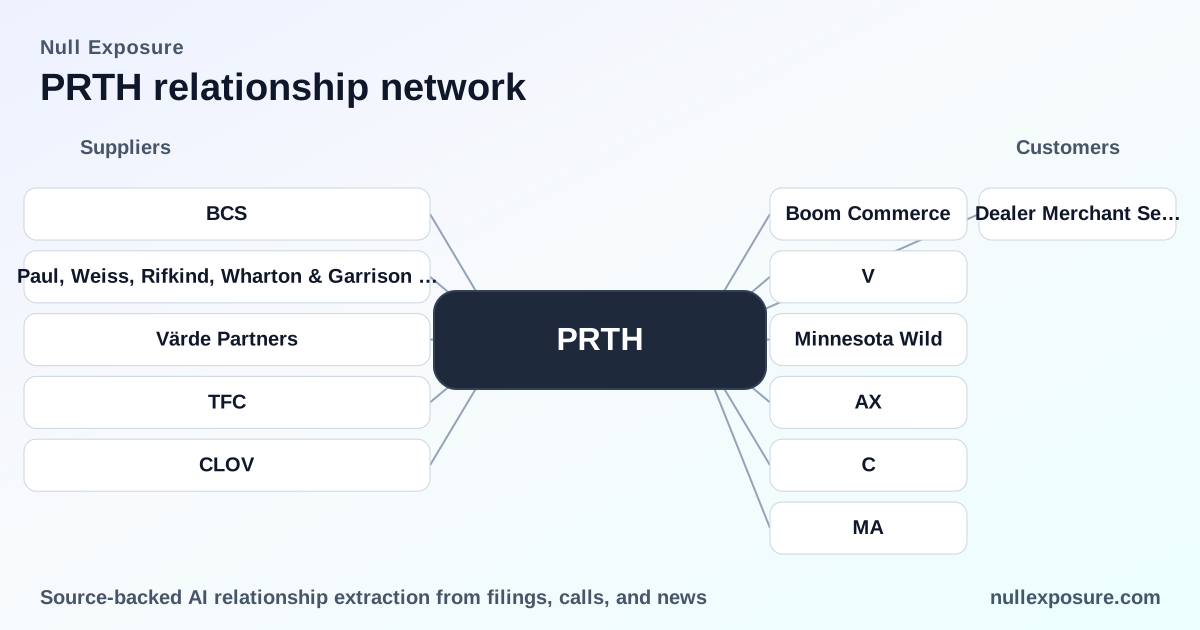
Priority Technology Holdings (PRTH): supplier relationships that drive capital and distribution
Priority Technology Holdings operates as a merchant acquirer and integrated payments software provider that monetizes through transaction economics, recurring software and service fees, and financing arrangements that support its ISO/ISV reseller network. The company generates scale from payment volume, locks in margin through software and residual flows, and leverages financing to deepen partner economics—a model that combines operating leverage with capital-structure dependencies. For investors evaluating supplier exposure, the active roster of financial and legal advisors, a residual financing partner, and reseller ties to major POS vendors are the primary relationship signals to monitor.
Learn more about the platform and relationship analytics at https://nullexposure.com/.
Why the current relationships matter to investors
Priority’s public disclosures and market coverage show an operating model that blends payments operations with capital facilitation for resellers. Contracts with processors, sponsor banks and financing partners are operationally critical because they sit between Priority and card networks, affect authorization/settlement flows, and determine the firm’s ability to advance capital to ISOs and ISVs. The relationships documented below provide a clear view into strategic finance activity (advisor hires and residual financing) and channel concentration (reseller ties to Clover).
Barclays — financial advisor to the Special Committee
Priority’s Special Committee retained Barclays as financial advisor, signaling a formal strategic review or transaction process under board oversight. According to TradingView coverage on March 10, 2026, Barclays was explicitly hired to advise the Special Committee on strategic options. (TradingView, March 10, 2026: https://www.tradingview.com/news/tradingview:ce9aeea00b35d:0-priority-technology-holdings-inc-special-committee-retains-advisors/)
Paul, Weiss — legal counsel for the Special Committee
The Special Committee engaged Paul, Weiss, Rifkind, Wharton & Garrison LLP as legal counsel to support the same strategic review, providing high-caliber legal capacity for complex transaction or governance work. TradingView reported this legal appointment on March 10, 2026. (TradingView, March 10, 2026: https://www.tradingview.com/news/tradingview:ce9aeea00b35d:0-priority-technology-holdings-inc-special-committee-retains-advisors/)
Värde Partners — residual financing facility partner
Priority secured a $50 million residual financing facility with Värde Partners to provide working capital for its ISO and ISV reseller base and to optimize capital structure. The company’s CFO framed the facility as a lever to help resellers accelerate growth and increase the value of their portfolios within Priority. (Financial IT, March 2026: https://financialit.net/news/fundraising-news/priority-secures-50-million-financing-facility)
Truist Securities — prior financing relationship and executive experience
Tim O’Leary, Priority’s CFO, has a background at Truist Securities where he led leveraged financings for payments companies, which connects Priority’s leadership to capital markets and leveraged finance expertise useful in arranging facilities and structuring residual finance products. Citybiz’s profile of O’Leary cites his recent role at Truist and deal experience relevant to payments financings. (CityBiz, 2026: https://www.citybiz.co/article/317118/priority-technology-holdings-appoints-tim-oleary-cfo/)
Clover — material reseller/partner on POS distribution
Priority continues to resell Clover point-of-sale solutions and reports being one of Clover’s larger resellers, indicating channel concentration in certain POS ecosystems that feed merchant volume and recurring services. This reseller relationship shows up in Priority’s earnings commentary and investor transcripts. (InsiderMonkey earnings call transcript, Q3 2025: https://www.insidermonkey.com/blog/priority-technology-holdings-inc-nasdaqprth-q3-2025-earnings-call-transcript-1641887/)
Contracting posture, concentration and criticality — what the constraints reveal
Priority’s relationship constraints flag a company-level operating posture where third-party service providers are central to core payment delivery. The available evidence states that Priority “enters into agreements with payment processors which in turn, have agreements with multiple card associations,” and that the company “partners with various vendors in the payments value chain, most notably processors and sponsor banks which sit between us (the merchant acquirer) and the card networks, to assist us in providing payment processing services to merchant clients.” These excerpts indicate a service-provider dependency that is operationally critical and structurally embedded.
Implications:
- Contracting posture is vendor-dependent and structured around standard processing and sponsorship agreements, not vertically integrated merchant acquiring alone. That increases legal and operational complexity in negotiations and contingency planning.
- Counterparty concentration risk is real because sponsor banks and processors act as gatekeepers to network access; any deterioration in those relationships could materially affect authorization and settlement.
- Maturity profile is mixed: Priority demonstrates typical payments maturity through recurring revenue and financing sophistication, but the need for external financing and advisory hires signals active capital management rather than a fully self-contained model.
Explore a deeper supplier analysis and scenario planning at https://nullexposure.com/.
Deal-level takeaways and risk implications for investors
- Special Committee hires (Barclays and Paul, Weiss) are strong signal events: they indicate Priority is pursuing or preparing for a material corporate action—strategic sale, recapitalization, or significant restructuring. That elevates near-term event risk but also creates an optionality pathway for value crystallization.
- The Värde $50M residual facility reduces short-term liquidity stress and supports reseller economics, but it also increases the importance of asset-quality diligence on residual streams. Credit and covenant structures in that facility will be consequential to free-cash-flow dynamics.
- Leadership with leveraged finance pedigree (CFO from Truist) aligns capital strategy with execution capability; investors should watch how that experience translates into debt sizing, tenor, and covenant design.
- Clover reseller concentration accelerates go-to-market for volume and recurring revenue, but it concentrates channel risk: disruptions at a major POS partner could compress volume and margin rapidly.
Key risk checklist:
- Contract and counterparty concentration with processors/sponsor banks.
- Financing cost and covenant exposure tied to residual facilities.
- Execution risk around any Special Committee-directed transaction.
Final read: what investors should watch now
Priority sits at the intersection of payments operations and capital intermediation for resellers. The current relationship set—advisors for a Special Committee, a structured residual financing partner, financing-savvy management, and concentrated POS reseller ties—creates both upside optionality from a strategic process and tail risk from counterparty and financing exposure. Monitor transaction announcements from the Special Committee, covenant language on the Värde facility, and any public changes in processor or sponsor bank arrangements.
For a focused view of supplier exposure and to track material relationship changes, visit https://nullexposure.com/ for ongoing coverage and alerts.