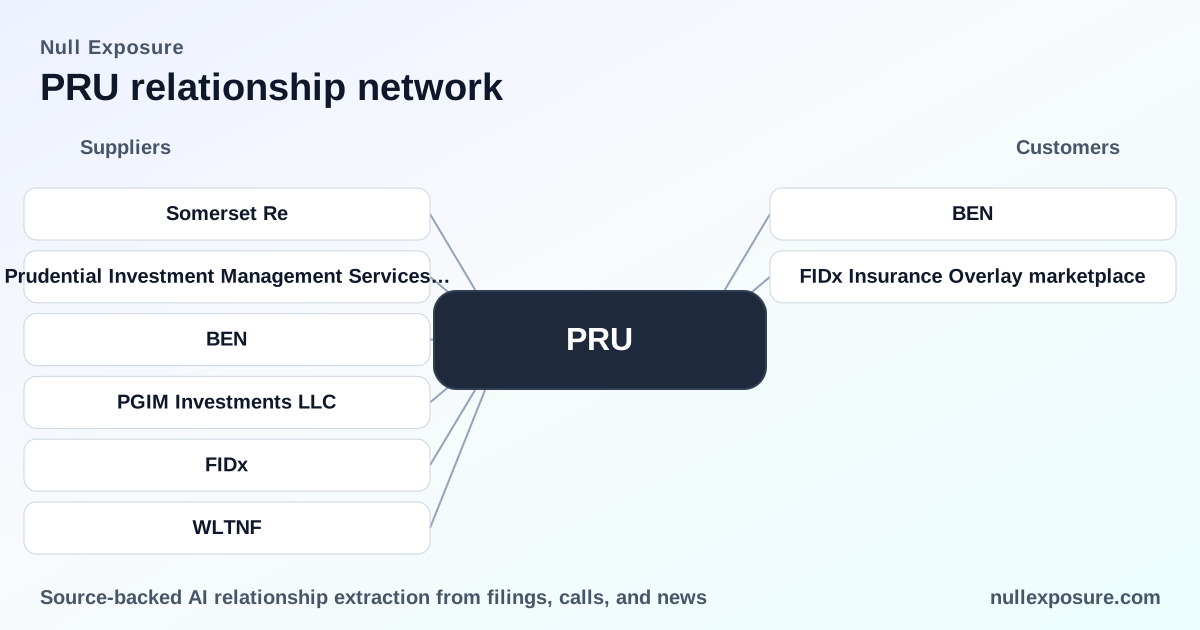
Prudential Financial (PRU): how supplier and reinsurance relationships drive capital management and product distribution
Prudential Financial operates as a diversified insurer and asset manager that monetizes through premiums, fee income from investment management, and strategic capital management using reinsurance and third‑party distribution. Reinsurance counterparties and platform partners are core to Prudential’s balance‑sheet efficiency and market access—they reduce capital strain on long‑duration blocks and extend retail distribution for insurance overlays and managed account solutions. For underwriting and treasury investors, these supplier links are both operational levers and material risk vectors.
Discover more supplier intelligence at https://nullexposure.com/.
Why counterparties matter to Prudential’s business model
Prudential runs large blocks of long‑duration life insurance and annuity contracts while operating global investment management businesses. That combination creates a dual need: capital efficiency through reinsurance and broad distribution through asset management partners. From the 2025 disclosures, Prudential recognizes multi‑hundred‑million dollar accounting impacts from reinsurance transactions and holds tens of billions in reinsurance recoverables—concrete evidence that these relationships are not peripheral. The firm’s operating model therefore shows a contracting posture that leans on long‑term, high‑value agreements with large counterparties to shift risk and to scale product distribution.
Key company‑level signals drawn from regulatory and public sources:
- Long‑term contracting posture: Prudential recognizes deferred reinsurance losses amortized over policy lives and records reinsurance transactions as long‑duration arrangements, indicating multi‑year commitments and accounting sensitivity.
- Large‑enterprise counterparties: Prudential selects highly rated major financial institutions and large broker‑dealers as its primary counterparty set, supporting predictable credit‑risk management.
- Global footprint and services role: Reinsurance and service relationships operate across international businesses, with vendors treated as service providers that introduce operational and security considerations.
- Materiality and spend: Reinsurance recoverables and deposit receivables totaled $44,077 million in 2025, and Prudential recorded a $980 million deferred reinsurance loss at inception on a transaction disclosed in the 2025 Form 10‑K—evidence of scale and material balance‑sheet implications.
- Active, mature relationships: Reinsurance receivables and ongoing market partnerships indicate active counterparties and persistent exposure rather than one‑off arrangements.
Counterparties and platform partners to know
Below I cover every relationship cited in the public results set, with a plain‑English summary and source note for each.
Somerset Re
Prudential used reinsurance transactions with Somerset Re to eliminate credit‑linked note structures supporting certain guideline reserves, reflecting a balance‑sheet cleanup through reinsurer arrangements. According to Prudential’s 2025 Form 10‑K filing, the company executed reinsurance transactions with Somerset Re as part of this effort (FY2025 Form 10‑K, filed 2026).
Wilton Re
Wilton Re participated in the same reinsurance transactions as Somerset Re, enabling Prudential to remove credit‑linked note structures for remaining business and reallocate liabilities off the balance sheet. This action is disclosed in Prudential’s 2025 Form 10‑K (FY2025 Form 10‑K, filed 2026).
Prudential Investment Management Services LLC
Prudential Investment Management Services LLC is identified as a distributor for issuer products where PGIM Investments LLC acts as primary advisor, signaling Prudential’s vertically integrated distribution channels within its investment‑management ecosystem. This distribution role is noted in a market news listing summarizing fund issuer and advisor roles (TradingView news, March 2026).
PGIM Investments LLC
PGIM Investments LLC functions as a primary advisor on certain Prudential‑issued funds, reflecting Prudential’s in‑house advisory capabilities and cross‑company asset management links that feed product shelf and fee income. Market coverage lists PGIM as primary advisor in fund documentation summarized by TradingView (TradingView news, March 2026).
Franklin Templeton
Franklin Templeton hosts Prudential’s ActiveIncome insurance overlay on its Canvas platform, providing a direct channel for Prudential to integrate protected lifetime income into advisor workflows and expand retail managed‑account reach. MarketScreener and other press reports covered the March 2026 launch of the ActiveIncome overlay on Franklin Templeton’s Canvas (MarketScreener, March 10, 2026; cited in broader market commentary).
FIDx
FIDx appears as the marketplace channel on Canvas where Prudential’s ActiveIncome insurance overlay is made available, enabling third‑party RIAs to access Prudential’s protected‑income product through a marketplace experience. This placement was described in MarketScreener’s report on the Canvas offering (MarketScreener, March 10, 2026).
What these relationships mean for investors: concentration, criticality and risk
Prudential’s supplier posture is strategic and concentrated. Reinsurance partnerships are large, long‑dated and balance‑sheet critical, materially affecting reported liabilities and deferred losses. The company’s reliance on large, highly rated institutions reduces counterparty credit dispersion but creates concentration risk if a key reinsurer or collateral arrangement weakens. Distribution partnerships with Franklin Templeton and the Canvas marketplace drive product reach and fee momentum, but they also tie Prudential to third‑party platform governance and marketplace economics.
Operationally, Prudential treats vendors as service providers with explicit vendor‑risk controls, but the 10‑K flags vendor security and performance as potential exposure points—an operational risk vector separate from counterparty credit risk. The reinsurance recoverable balance of $44,077 million in 2025 underlines that supplier and reinsurer performance are quantitatively material to capital and liquidity.
If you are evaluating PRU as a supplier counterparty or as an investor assessing counterparties, prioritize:
- counterparty credit strength and collateral arrangements on reinsurance;
- contract tenor and amortization schedules for deferred reinsurance accounting;
- distribution economics and platform governance for managed‑account overlays.
Explore detailed supplier signals and monitoring options at https://nullexposure.com/ to incorporate these factors into diligence workflows.
Actionable next steps for operators and investors
- For investors: require quarterly disclosure checks on reinsurance recoverables, collateral schedules, and any changes to deferred reinsurance amortization that affect operating earnings.
- For operators/partners: negotiate explicit counterparty protections (collateral, rating triggers, master netting) in long‑term reinsurance agreements and clarify responsibilities with platform partners on distribution, compliance and security.
- For both: monitor platform partnerships for concentration in distribution channels and run scenario analysis on counterparty stress to quantify potential capital and liquidity impacts.
For ongoing monitoring and supplier intelligence on Prudential and its counterparties, visit https://nullexposure.com/.
Prudential’s capital and product strategy is intertwined with a relatively small set of high‑value reinsurance and platform partners; that integration creates both scalable economics and concentrated operational risk that investors and operators must price into decision frameworks.