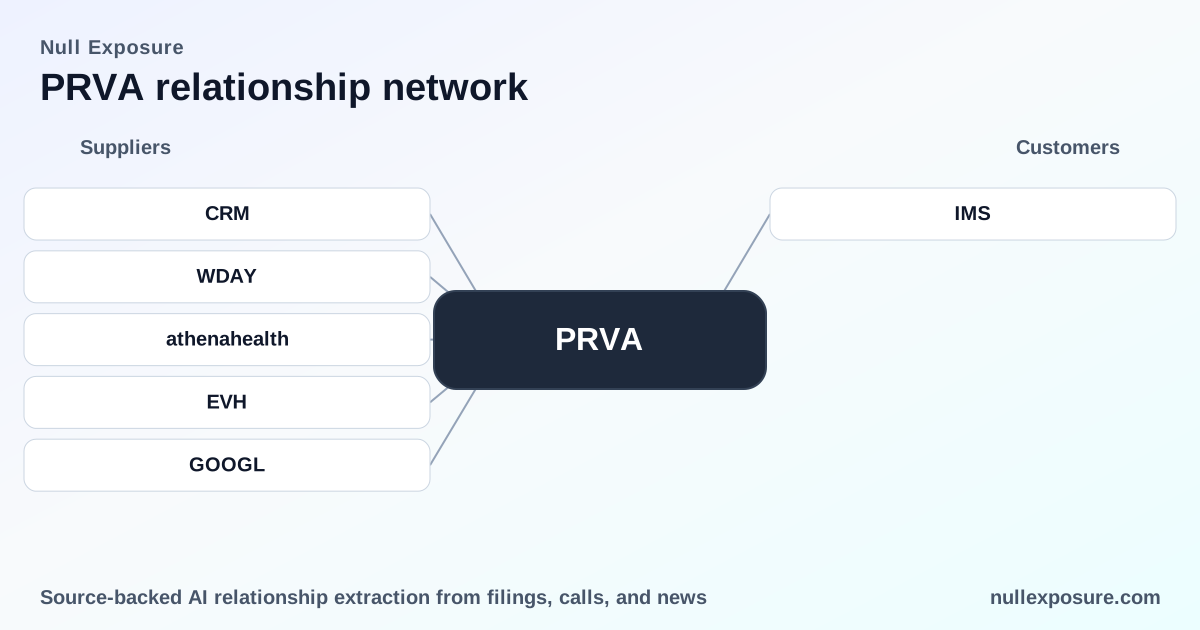
Privia Health (PRVA) — Supplier Relationships, Operational Constraints, and What Investors Should Know
Privia Health runs a population-health and practice-management business that monetizes by selling platform services and managed-care arrangements to physician groups, collecting fees tied to care management, shared savings and practice support. Its operating model embeds third‑party technology and cloud suppliers into the delivery stack, which converts fixed IT and admin work into variable, usage‑linked costs that scale with implemented physicians and patient volumes. For investors assessing counterparty and operational risk, the relevance is clear: vendor costs are a flow-through that affect margins and cash conversion, and announced inorganic moves—like the acquisition of an ACO business—change supplier demand profiles. Learn more about supplier risk mapping at https://nullexposure.com/.
What the supplier posture means for the business
Privia’s financials show large revenue scale (roughly $2.12B trailing) but narrow operating margins, indicating that vendors and platform costs materially influence profitability. Company disclosures describe third‑party EMR and practice‑management expenses as paid on a percentage‑of‑revenue basis, which makes these relationships usage‑based contracts and aligns costs with revenue but also exposes operating margin to volumes and rate changes. The company also signals that it both licenses technology from third parties and relies on third‑party service providers to run its platform, placing vendor selection, contracting and oversight at the center of execution risk.
- Contracting posture: Predominantly usage‑based and variable, reducing fixed overhead but increasing exposure to third‑party pricing and renegotiation.
- Concentration and criticality: Core clinical systems and cloud infrastructure are critical to operations; disruptions would have immediate operational impact.
- Maturity: Partners cited are established enterprise vendors, suggesting robust product maturity but also bargaining power asymmetries in pricing and licensing.
- Oversight risk: The company acknowledges its vendor-monitoring controls could be inadequate, which elevates execution risk as Privia scales.
Supplier-by-supplier review (clear, investor‑facing)
Salesforce (CRM)
Privia cited Salesforce among its existing technology partners during the Q4 2025 earnings call transcript, indicating Salesforce is used in the corporate/CRM stack or provider engagement workflows. Source: InsiderMonkey transcript of the Q4 2025 earnings call (first seen Mar 10, 2026).
Workday (WDAY)
Workday was named alongside Salesforce and athenahealth as an existing technology partner on the same Q4 2025 earnings call; this suggests Workday is used for HR/payroll or financial systems supporting the platform. Source: InsiderMonkey transcript of the Q4 2025 earnings call (Mar 10, 2026).
athenahealth
Management explicitly referenced athenahealth as a technology partner during the Q4 2025 earnings commentary, signaling integration with electronic medical record or practice‑management capabilities that feed Privia’s clinical and billing workflows. Source: Motley Fool/Globe and Mail transcript of Q4 2025 earnings remarks (Mar 10, 2026).
Evolent (EVH)
Market commentary noted Privia’s plan to acquire Evolent’s ACO business to expand value‑based care scale, an action that will increase managed‑care revenue and change the supplier/customer dynamics for care management services. The move was discussed in filings and market alerts in early March 2026. Source: MarketBeat reporting on filings and transaction context (Mar 3–10, 2026).
Google Cloud (GOOGL)
Management said the corporate side runs on Google Cloud and Google Workspace and that Privia is implementing Gemini across operations in a HIPAA‑compliant manner, indicating reliance on Google’s cloud infrastructure and generative AI tooling for clinical and administrative workflows. Source: Motley Fool/Globe and Mail transcript of Q4 2025 earnings remarks (Mar 10, 2026).
Operational constraints and what they imply for valuation and diligence
Privia’s supplier evidence produces a set of company-level signals that are material to investors:
- Usage‑based contracts are a structural feature. The company’s platform costs—specifically third‑party EMR and practice management software—are often paid as a percentage of revenue, which reduces fixed cost risk but introduces margin volatility tied to pricing and physician volume. (Evidence referenced in company cost disclosures.)
- Multiple relationship roles exist simultaneously. Privia acts as a seller of services while simultaneously depending on third‑party service providers and licensed technologies to deliver those services; this duality increases contractual complexity and dependency vectors.
- Active oversight requirement. Contracts are classified as active; management explicitly notes vendor performance monitoring is part of governance, but also concedes oversight controls could be inadequate, making vendor governance a priority for operational due diligence.
- No single relationship is singled out by constraint excerpts. The constraints describe company‑level characteristics rather than assigning them to a specific supplier, which is itself a signal that risks are embedded across the vendor base.
If you are modeling Privia, incorporate variable platform cost assumptions that scale with revenue, stress test margins for vendor fee increases, and quantify the integration cost and synergy timing from the Evolent acquisition.
Investment implications — short checklist for analysts
- Margin sensitivity: Run scenarios where third‑party EMR or cloud fees increase by 5–10% and measure operating margin impact given the usage‑based contract posture.
- Execution risk: Evaluate vendor governance controls and integration capability; the company’s admission about oversight adequacy is a red flag for rapid scaling or large acquisitions.
- Concentration exposure: Although multiple vendors are cited, confirm contract terms, termination rights, and migration complexity (especially for EMR and cloud).
- Technology leverage: The Google Cloud/Gemini implementation is an operational upside if it reduces labor or improves care management outcomes, but it also adds dependency on cloud SLAs and HIPAA compliance attestations.
If you need a supplier risk scorecard or a quick comparative framework for similar healthcare platform companies, see our analytical tools at https://nullexposure.com/—they’re built for this exact diligence workflow.
Bottom line and next steps
Privia’s supplier ecosystem is composed of well‑known enterprise vendors and a target ACO acquisition that together shape both near‑term margin dynamics and long‑term scalability. The usage‑based nature of key contracts reduces fixed cost but increases margin cyclicality, and management’s public acknowledgment of vendor oversight limitations elevates execution risk during growth and integration phases. For investors, the priority is to quantify vendor cost pass‑through, validate integration timelines for Evolent assets, and confirm contractual protections around EMR and cloud relationships.
To review Privia’s supplier map alongside peers and get a tailored diligence checklist, visit https://nullexposure.com/. For a deeper supplier risk assessment and scenario modeling for PRVA, start your analysis at https://nullexposure.com/ — we provide frameworks aimed at investor and operator needs.