Public Storage (PSA): How a Welltower Data Tie and Material Capital Commitments Reframe Supplier Risk
Public Storage is a REIT that owns and operates an extensive network of self‑storage facilities and monetizes through rental income, ancillary tenant fees, and disciplined property acquisitions and dispositions, returning cash to shareholders via a large dividend yield. With a market capitalization around $50.9 billion, trailing revenue of $4.83 billion and a 4.07% dividend yield, the company balances steady cash flows with ongoing capital deployment and an increasing reliance on external data and analytics to sharpen acquisition decisions. For investors evaluating supplier exposure, the combination of a new analytics partnership and sizeable contractual commitments changes both strategic sourcing and counterparty concentration considerations. Explore how these signals affect supplier diligence at https://nullexposure.com/.
What the Welltower partnership is — and why it matters to procurement
Public Storage has signed a data science licensing partnership with Welltower to leverage Welltower’s analytics platform to accelerate and refine granular acquisition decisions. According to Senior Housing News (March 2, 2026), the deal licenses Welltower’s platform to improve capital deployment “with greater velocity and precision on granular acquisitions.” Simply Wall St also reported in March 2026 that Public Storage has advanced a data science partnership with Welltower to support capital allocation and operational analytics.
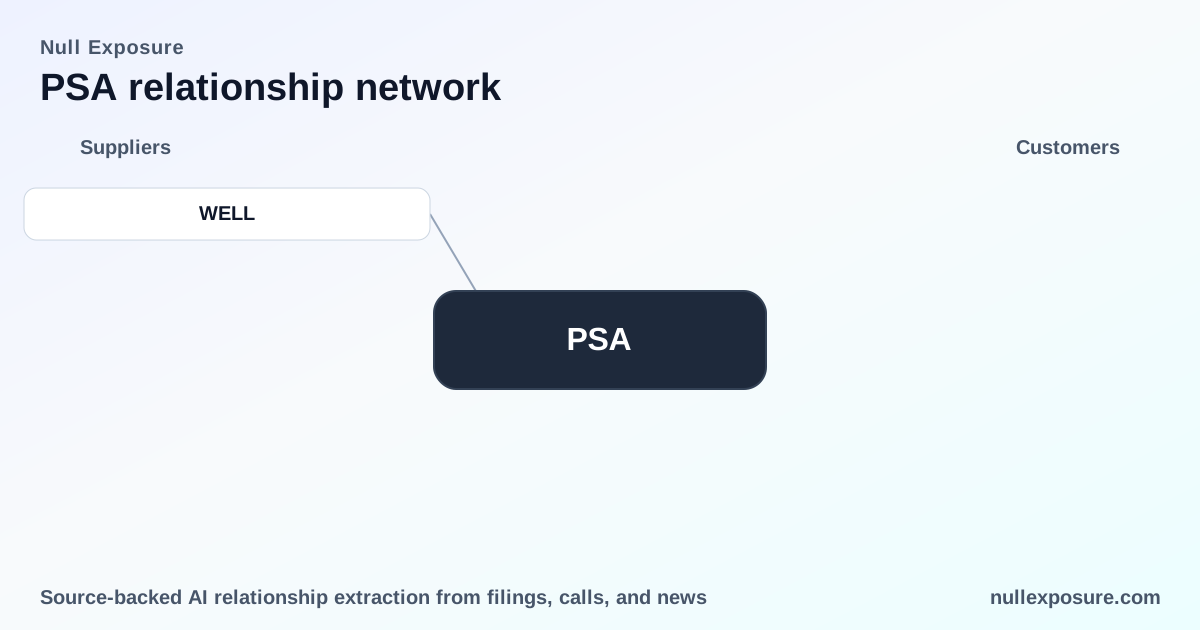
- Welltower — Public Storage licensed Welltower’s data science platform to support faster, more precise capital allocation and acquisition decisions, positioning analytics as a supplier of strategic insight rather than a narrow back‑office service (Senior Housing News, March 2026; Simply Wall St, March 2026).
Key takeaway: the Welltower relationship elevates analytics to a supplier of differentiating capability; supplier terms, SLAs and IP rights will therefore be strategically important for value capture.
Every supplier relationship surfaced in the records
Welltower — Public Storage entered a data science partnership to support capital allocation and operational analytics; the agreement is presented as a licensing arrangement to accelerate and improve site-level acquisition precision (Senior Housing News, March 2, 2026; Simply Wall St coverage, March 2026).
The balance sheet constraints that govern supplier posture
Public Storage’s public disclosures around December 31, 2025 show material, varied contractual commitments that define procurement scale and contracting posture:
- Construction commitments — $169.4 million (100m_plus band): this indicates large, project‑based procurement exposures tied to development and redevelopment programs.
- Lease and capital commitments — $65.5 million (10m_100m band): future contractual payments related to land, equipment and office space point to recurring vendor engagement for property operations and corporate infrastructure.
- Unfunded loan commitments — $43.9 million (10m_100m band) and unfunded private equity commitments — $48.2 million (10m_100m band): these items create contingent counterparty credit and capital provisioning relationships.
- Corporate transformation costs — ~$4.9 million (1m_10m band): one‑time transformation initiatives impose professional services and systems integration spend.
These are company‑level signals drawn from Public Storage’s December 31, 2025 disclosures and shape how procurement should approach vendor selection, contract length, collateral requirements and performance metrics.
How those constraints translate into vendor risk and opportunity
Public Storage’s supplier profile is shaped by three forcing functions:
- Contracting posture: mix of large, discrete construction contracts and medium‑sized, recurring operational commitments implies dual sourcing strategies — rigorous RFPs and fixed‑price construction contracts for development work, and negotiated master service agreements for ongoing supply and maintenance.
- Concentration and criticality: the $169.4 million construction pipeline is critical to growth and therefore concentrates risk with construction, engineering and development partners; analytics partnerships such as Welltower’s are strategic rather than tactical and thus command tighter IP and performance governance.
- Maturity of relationships: the presence of unfunded loan and private equity commitments suggests multi‑year vendor/counterparty lifecycles, requiring long‑term credit assessment and covenant monitoring.
Operational implication: procurement must treat analytics (Welltower), construction contractors and financing counterparties as high‑priority suppliers with contract terms that protect cash flow and preserve competitive advantage.
What investors should watch next
Be alert to three monitorable items that flow directly from the relationship and commitments:
- Execution of the Welltower licensing program — watch how analytics outputs change acquisition cadence and capex utilization; improved precision should show up in acquisition metrics and ROIC over time (quarterly disclosures).
- Construction and capital spend cadence — the $169.4 million construction commitment and the 10–100m band obligations are the largest levers on free cash flow and counterparty exposure; trending higher or delayed execution changes funding needs.
- Corporate transformation costs and integration risk — the ~$4.9 million transformation spend is modest in isolation but signals organizational change that can temporarily increase vendor management overhead.
Major risk factors: vendor concentration in construction and analytics, counterparty credit on unfunded commitments, and the execution risk of integrating licensed analytics into investment decision‑making.
Practical actions for investors and operators
- For due diligence teams: require clear contract disclosure and key performance indicators for the Welltower license — IP ownership, model governance, and escape clauses are material to valuation.
- For procurement and ops: structure construction contracts with milestone payments and performance bonds to mitigate the concentrated $169.4 million exposure.
- For investor relations and strategy teams: quantify any near‑term cash flow variability from the 10–100m commitments and communicate how analytics licensing alters acquisition returns.
Midway recommendation: if you need a consolidated view of supplier exposures and contractual commitments for portfolio companies, review the supplier intelligence available at https://nullexposure.com/.
Bottom line
Public Storage is simultaneously a capital‑intensive operator and a cash‑return vehicle for investors. The Welltower analytics partnership converts a supplier into a strategic lever for acquisition precision, while meaningful construction and capital commitments define where vendor risk concentrates. For investors and operator teams, the priority is to ensure tight contract governance on analytics, disciplined contracting on construction spend, and ongoing transparency on how these relationships affect acquisition returns and free cash flow.
For a deeper supplier map and contract‑level insights, visit https://nullexposure.com/. For teams building investor‑grade supplier diligence, start with Public Storage’s commitments and the Welltower agreement as your modeling assumptions and governance checkpoints — then benchmark contract language across peers at https://nullexposure.com/.