Public Storage (PSA-P-G): Portfolio buying as the operational rhythm — what investors and operators should read next
Public Storage runs a large self-storage REIT and converts scale into cash flow through leasing, ancillary fee income, and strategic acquisitions and dispositions of facility portfolios; the PSA‑P‑G instrument sits in the capital structure as a preferred equity exposure for yield-focused investors. The company’s recent activity shows acquisition-led growth, market concentration in high-demand U.S. metros and continued reliance on third‑party deal origination and banking relationships to execute large transactions. For investors and operators evaluating supplier and counterparty exposure, these patterns define where opportunities and risks cluster.
Explore more on portfolio-level exposures and counterparty tracing at https://nullexposure.com/.
Acquisition-driven growth: the operating playbook in plain English
Public Storage’s operational model is straightforward: own and operate storage facilities as a REIT, collect recurring rental and ancillary income, and increase portfolio scale through selective buys. Acquisitions convert developer inventories and smaller operators into owned cash flows, integrating already-leased assets rather than relying solely on organic development. That approach reduces time-to-cash and allows the company to redeploy capital rapidly across markets it values.
- Contracting posture: acquisitive and market-driven—Public Storage buys ready portfolios from developers and operators rather than building exclusively from ground up.
- Concentration: recent deals emphasize large U.S. metros (notably Dallas–Fort Worth), signaling market concentration where demand and pricing power are robust.
- Criticality: acquisitions are a core growth lever — portfolio purchases materially move asset base and revenue run-rate.
- Maturity: behavior is consistent with a mature REIT that mixes cash-flow stability with opportunistic deployment into secondary purchases.
Relationship rundown: the counterparties and what they mean
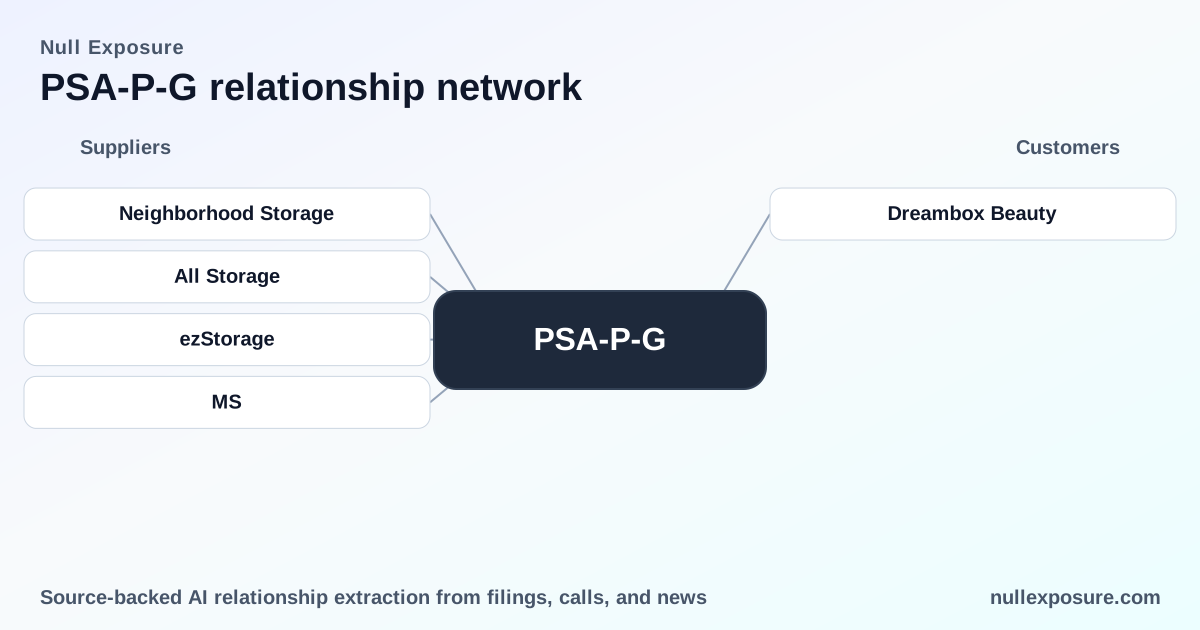
Below are every relationship flagged in the recent supplier-focused results, summarized in plain English with source context.
Neighborhood Storage — Public Storage acquired 26 facilities from Neighborhood Storage in a deal announced in early 2026; this is a classic roll-up of smaller operator assets into a national platform, reinforcing scale in markets where Neighborhood Storage operated. (Source: Ocala Gazette, March 2026 — https://www.ocalagazette.com/neighborhood-storage-sale-to-public-storage/)
All Storage — Public Storage paid roughly $1.5 billion for a portfolio sold by developer All Storage, with holdings concentrated in the Dallas–Fort Worth market; this underscores strategic concentration in fast-growing Sun Belt demand corridors. (Source: SpareFoot, March 2026 — https://www.sparefoot.com/blog/public-storage-snaps-up-dallas-portfolio-for-1-5-billion/)
ezStorage — The company’s FY2026 activity also includes the $1.8 billion purchase of 48 ezStorage facilities in April, counted alongside the All Storage consideration; this deal demonstrates scale-of-deal execution and willingness to transact at large, multi-hundred-million-dollar portfolio sizes. (Source: SpareFoot, March/April 2026 coverage — https://www.sparefoot.com/blog/public-storage-snaps-up-dallas-portfolio-for-1-5-billion/)
Morgan Stanley — Public Storage’s senior management has an enduring advisory relationship with Morgan Stanley, exemplified by Tom Boyle, a former Morgan Stanley banker who has worked on transactions for the last decade; this signifies deep investment-banking ties that underpin capital raises and large M&A execution. (Source: SpareFoot coverage of leadership and transactions, 2024–2026 commentary — https://www.sparefoot.com/blog/ron-havner-begins-last-year-public-storage-ceo/)
What operators, lenders and preferred holders should focus on
Public Storage’s pattern of buying operating portfolios, rather than exclusively developing, creates a predictable playbook for counterparties and investors.
- Operational integration is the control point. Acquiring operating facilities transfers tenant mixes, local pricing strategies and staffing — integration execution determines near-term cash-flow accretion.
- Market concentration is both strength and risk. Dallas–Fort Worth and similar Sun Belt corridors deliver demand tailwinds, yet concentration increases exposure to regional downturns or regulatory shifts.
- Deal origination and banking partners matter. Continued advisory relationships with major banks like Morgan Stanley smooth large transactions and debt/capital placement; this is a strategic asset for closing multi-billion-dollar portfolios.
- Preferred investors should watch liquidity and call features. PSA‑P‑G sits in the capital stack as a yield instrument; with limited public dividend detail in the available record, preferred holders must evaluate callable provisions, trading liquidity and how acquisition funding stresses the balance sheet.
If you’re tracking counterparty risk or need portfolio-level exposure insight, visit https://nullexposure.com/ for a consolidated view.
Valuation and capital-structure signals that matter for PSA‑P‑G holders
Public data in the filing summary here is sparse on explicit preferred dividend metrics, but market price history is available: the asset traded in a narrow band with a 52‑week high of 22.45 and a 52‑week low of 19.49. For preferred investors the primary actionable variables are dividend stability (driven by underlying cash flow from owned facilities), balance‑sheet flexibility after large acquisitions, and secondary-market liquidity for depositary share instruments. Monitor transaction cadence and any disclosure around financing packages for recent buys, since aggressive leverage to fund portfolios could compress preferred credit protection.
Quick take: risk-return checklist for the next 12 months
- Positive: acquisition scale improves cash-flow predictability and market share; repeatable banker relationships accelerate deal flow.
- Watch: geographic concentration and integration execution risks; limited public disclosure on preferred-series specifics increases the importance of monitoring filings and transaction press releases.
- Actionable: prioritize portfolio-level tenant roll-forward, financing terms of recent acquisitions, and any changes to preferred share call or dividend language in SEC filings and investor releases.
Learn how these relationship signals map to supplier exposure frameworks at https://nullexposure.com/.
Bottom line for investors and operators
Public Storage’s supplier relationships and recent portfolio purchases reveal an acquisitive REIT executing through large, off-market or developer-sourced transactions and supported by long-standing investment-banking ties. For investors in PSA‑P‑G and counterparties, the principal focus should be on how acquisitions are financed, how quickly purchased assets contribute to cash flow, and whether market concentration amplifies cyclical risk. Operators should assess their vulnerability to consolidation and potential sale offers; investors should emphasize preferred‑instrument documentation and liquidity.
For deeper counterparty mapping and portfolio exposure intelligence, visit https://nullexposure.com/ — the faster you connect these dots, the better you can position capital or operational strategy around Public Storage’s clear M&A-led playbook.