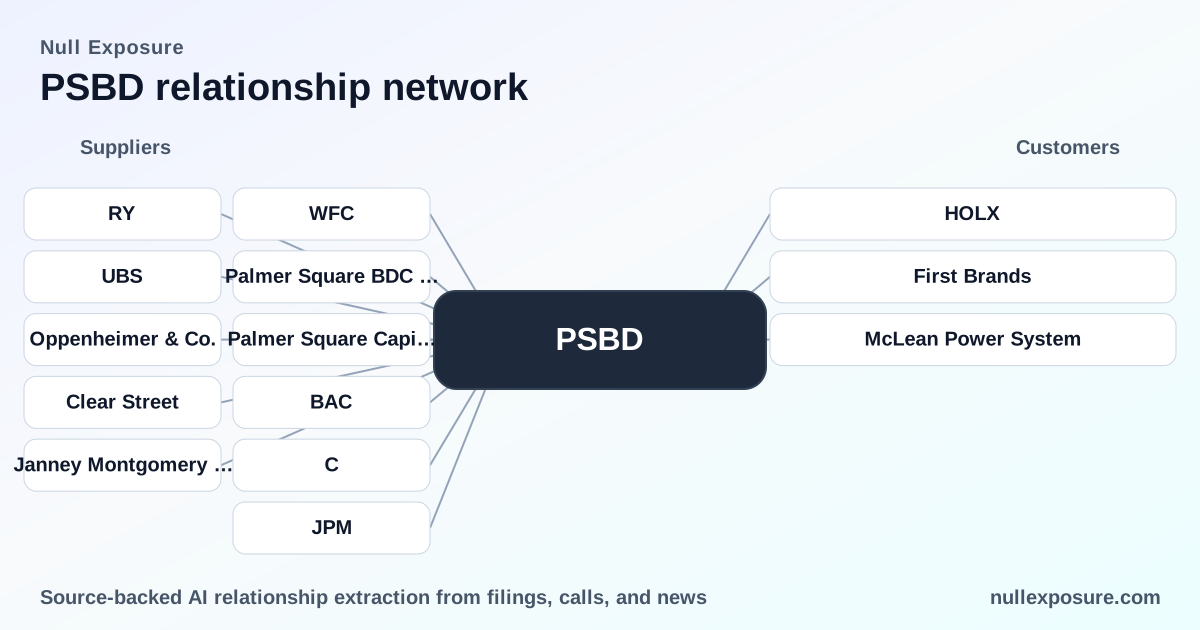
Palmer Square Capital BDC (PSBD): who they pay, who they rely on, and why it matters for investors
Palmer Square Capital BDC Inc. is a publicly traded business development company that monetizes through private credit and equity investments in middle‑market companies, capturing interest income, fees and capital appreciation while outsourcing day‑to‑day portfolio management to an affiliated investment adviser. Its core operating model combines externally managed investment operations with bank credit facilities and capital‑markets relationships that supply leverage and public distribution. For investors evaluating supplier risk, the key questions are counterparty concentration, contract tenor, and advisor dependence — all of which influence liquidity, expense flexibility and governance. For a concise hub of supplier intelligence on PSBD, visit https://nullexposure.com/.
How PSBD operates and where suppliers fit in the P&L
PSBD is an externally managed BDC. An affiliate investment adviser runs sourcing, underwriting and portfolio management, while PSBD uses bank facilities to provide leverage and investment banks to access markets. The adviser relationship controls most day‑to‑day economics and is therefore operationally critical, while banks and underwriters supply funding and capital markets distribution that determine cost of capital and balance‑sheet flexibility.
- Revenue drivers: interest and fee income from middle‑market debt plus realized gains on equity investments.
- Cost structure: external advisory and administration fees plus interest expense on credit facilities.
- Funding mix: revolvers/credit facilities and public offerings arranged by major investment banks.
If you want ongoing supplier tracking and relationship mapping for PSBD, see https://nullexposure.com/.
Supplier relationships and what each one means to PSBD
-
Wells Fargo (WFC) — PSBD refinanced a private credit facility with Wells Fargo in Q4, reducing spreads by ~55 basis points while increasing capacity, which improves funding cost and liquidity flexibility. Source: PSBD earnings call transcript reported on The Globe and Mail (FY2026) — https://www.theglobeandmail.com/investing/markets/stocks/WFC/pressreleases/450128/palmer-square-bdc-psbd-earnings-call-transcript/
-
Wells Fargo Bank (WFC) — PSBD executed multiple credit facility amendments with Wells Fargo Bank (including an Amendment No. 5 disclosed in November), indicating an ongoing lender relationship supporting term and revolver capacity. Source: MarketScreener coverage of company filings (FY2026) — https://www.marketscreener.com/news/palmer-square-capital-bdc-inc-announces-fourth-quarter-and-full-year-2025-earnings-release-and-conf-ce7e5bd8d18cf326
-
Palmer Square BDC Advisor LLC — The investment adviser to PSBD is Palmer Square BDC Advisor LLC, a majority‑owned subsidiary of Palmer Square Capital Management, and it manages PSBD’s investment activities and administrative services. This adviser is central to PSBD’s operations and governance. Source: MarketScreener company announcement and Q4 investor materials (FY2026) — https://www.marketscreener.com/news/palmer-square-capital-bdc-inc-announces-fourth-quarter-and-full-year-2025-earnings-release-and-conf-ce7e5bd8d18cf326 and https://nationaltoday.com/us/mo/kansas-city/news/2026/02/26/palmer-square-capital-bdc-releases-q4-2025-investor-fact-sheet/
-
Palmer Square Capital Management LLC — PSBD’s adviser relationship is managed through affiliates of Palmer Square Capital Management LLC, which supplies personnel and investment resources to the Adviser under a resource sharing arrangement. This affiliate structure concentrates operational control within the Palmer Square organization. Source: MarketScreener company announcement (FY2026) — https://www.marketscreener.com/news/palmer-square-capital-bdc-inc-announces-fourth-quarter-and-full-year-2025-earnings-release-and-conf-ce7e5bd8d18cf326
-
BofA Securities (BAC) — BofA acted as a joint book‑running manager on PSBD’s initial public offering, indicating an underwriting and capital‑markets relationship established at IPO. Source: PR Newswire IPO closing (FY2024) — https://www.prnewswire.com/news-releases/palmer-square-capital-bdc-inc-announces-closing-of-initial-public-offering-302041265.html
-
Citigroup (C) — Citigroup was a joint book‑running manager for PSBD’s IPO, positioning it as a distribution partner during the company’s capital raise. Source: PR Newswire IPO closing (FY2024) — https://www.prnewswire.com/news-releases/palmer-square-capital-bdc-inc-announces-closing-of-initial-public-offering-302041265.html
-
J.P. Morgan (JPM) — J.P. Morgan served as a joint book‑running manager at IPO, establishing a relationship that supports public equity distribution and potential future capital‑markets access. Source: PR Newswire IPO closing (FY2024) — https://www.prnewswire.com/news-releases/palmer-square-capital-bdc-inc-announces-closing-of-initial-public-offering-302041265.html
-
RBC Capital Markets (RY) — RBC Capital Markets participated as a joint book‑runner for PSBD’s initial public offering, contributing to syndicate distribution breadth at IPO. Source: PR Newswire IPO closing (FY2024) — https://www.prnewswire.com/news-releases/palmer-square-capital-bdc-inc-announces-closing-of-initial-public-offering-302041265.html
-
UBS Investment Bank (UBS) — UBS was a joint book‑running manager at IPO and subsequently factored into analyst coverage and price‑target adjustments, making it part of PSBD’s capital markets and research footprint. Source: PR Newswire IPO closing (FY2024) and MarketScreener analyst coverage (FY2025) — https://www.prnewswire.com/news-releases/palmer-square-capital-bdc-inc-announces-closing-of-initial-public-offering-302041265.html and https://www.marketscreener.com/news/ubs-trims-price-target-on-palmer-square-capital-bdc-to-13-50-from-14-50-maintains-neutral-rating-ce7d5ad9d18cff2d
-
Oppenheimer & Co. — Listed as a co‑manager on PSBD’s IPO, Oppenheimer contributes to distribution and middle‑market investor reach at the offering stage. Source: PR Newswire IPO closing (FY2024) — https://www.prnewswire.com/news-releases/palmer-square-capital-bdc-inc-announces-closing-of-initial-public-offering-302041265.html
-
Clear Street — Clear Street acted as a co‑manager on the IPO, indicating involvement in trade execution or distribution at the capital‑raising event. Source: PR Newswire IPO closing (FY2024) — https://www.prnewswire.com/news-releases/palmer-square-capital-bdc-inc-announces-closing-of-initial-public-offering-302041265.html
-
Janney Montgomery Scott — Janney served as a co‑manager on the IPO syndicate, extending the distribution network for PSBD’s initial equity issuance. Source: PR Newswire IPO closing (FY2024) — https://www.prnewswire.com/news-releases/palmer-square-capital-bdc-inc-announces-closing-of-initial-public-offering-302041265.html
Operational constraints and what they signal to investors
PSBD’s public disclosures surface a mixture of contractual tenors and structural dependencies that shape supplier risk:
-
Contracting posture is mixed: PSBD runs short‑term administrative and advisory approvals that are reviewed annually or terminable on short notice (e.g., Administration Agreement renewal and Advisory Agreement approvals), while funding instruments include longer‑dated facilities and notes (bank facility draws that expire in 2028 and notes maturing to 2037). These mixed tenors create both operational flexibility and refinancing exposure.
-
Advisor dependence is material: Filings explicitly state dependence on the Investment Advisor and Palmer Square Capital Management for investment decision‑making and staffing, which is a critical operational concentration that centralizes execution risk.
-
Contract renewals are routine: The Advisory/Administration arrangements are on multi‑year cycles with regular reapproval; governance processes show active board oversight and periodic renewal events, implying manageable but recurring governance risk.
-
Spend and capital policy signal: A share repurchase program authorization up to $15–$20 million places supplier spend and capital allocation in a mid‑range band consistent with a $10m–$100m spend profile for operational programs and shareholder return initiatives.
These constraints are company‑level signals for capital‑markets and counterparty diligence, not specific to a single supplier unless explicitly stated.
If you want a deeper supplier map and continuous monitoring for PSBD, check https://nullexposure.com/.
Investment implications — what to watch
- Funding cost and capacity matter: The Wells Fargo refinancing that cut spreads by ~55 bps is an immediate positive for net interest margin and debt servicing ability. Monitor future amendments and maturity cliffs (2028 facility expiry, long‑dated notes) for refinancing risk.
- Advisor concentration: Because the adviser controls sourcing and portfolio decisions, governance and key‑person continuity at Palmer Square entities are direct drivers of performance.
- Capital markets relationships are broad: Multiple global bank relationships at IPO provide distribution breadth but do not substitute for stable bilateral funding lines.
- Contract tenor mix creates managed risk: Annual renewals for advisory services grant the Board leverage; long‑dated funding requires active liability management.
Bottom line and next steps
Palmer Square BDC combines an externally managed investment model with diversified capital‑markets partners and a core lending relationship with Wells Fargo that materially affects cost of capital. Investors should treat the adviser as a single operational nexus and watch funding maturities and bank facility economics closely.
Ready to map supplier concentration and track changes automatically? Explore more supplier intelligence at https://nullexposure.com/.
For a supplier‑level alerting feed and tailored counterparty dashboards on PSBD, visit https://nullexposure.com/ and sign up for updates.