Prospect Capital (PSEC-P-A): Counterparties, Contracts and What Investors Should Price
Prospect Capital’s PSEC-P-A is a preferred equity issuance of Prospect Capital Corporation that monetizes by delivering contracted dividend streams to holders while Prospect generates cash flow through its private credit and middle‑market equity investments. The security’s economics are tightly coupled to Prospect’s capital‑formation activities — deal origination, capital markets distribution and the investment management arrangement with its adviser — which together drive dividend coverage and long‑term return potential. For a concise map of the supplier-side relationships that underpin that engine, read on. If you want a quick company supplier summary, start here: https://nullexposure.com/.
How Prospect organizes the revenue engine and earns investor returns
Prospect Capital operates as an investment firm focused on middle‑market debt and private equity across multiple sectors. Revenue is generated through interest, fees and equity appreciation on portfolio companies; a portion of that cash is allocated to preferred holders like PSEC-P-A as contractual dividends. The firm outsources critical distribution and advisory roles: it relies on a dealer manager for capital raising, an external adviser for investment origination and monitoring, and law firms for transactional and regulatory support. These relationships are operationally critical to maintaining liquidity and executing new preferred offerings.
If you want to cross‑check counterparties or benchmark supplier risk, visit https://nullexposure.com/.
The counterparties you need to know — plain English, with sources
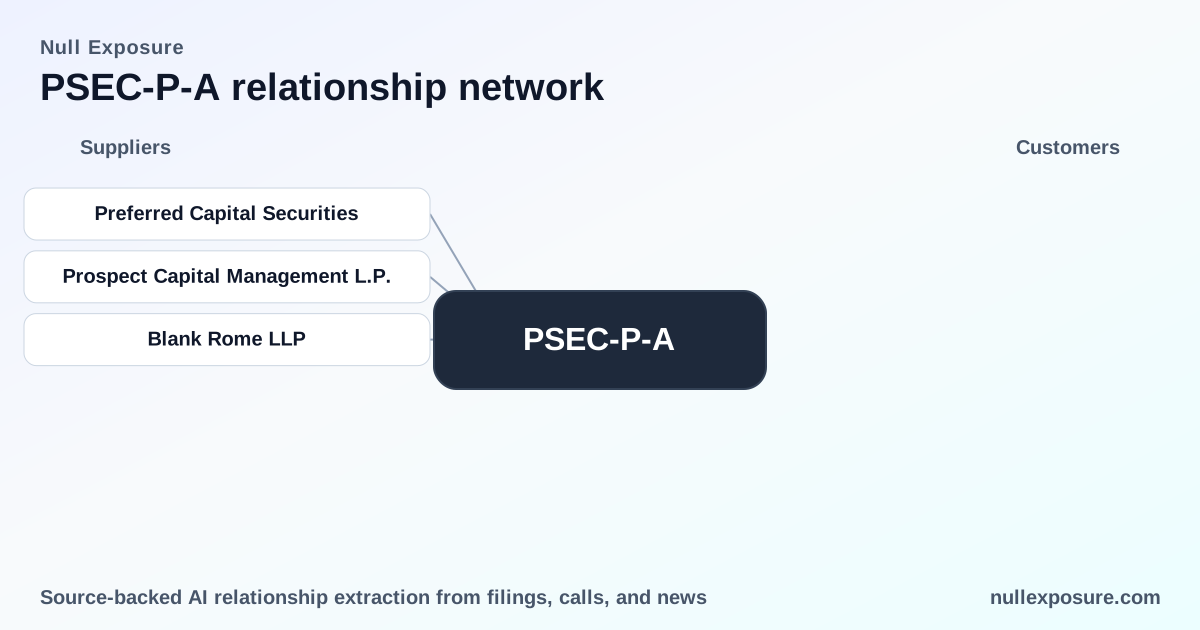
Below are every supplier relationship surfaced in the records, each summarized in plain English with its source.
-
Preferred Capital Securities — Dealer manager amendment (FY2026). Prospect executed an amendment to its Dealer Manager Agreement with Preferred Capital Securities to support an ongoing preferred stock offering, indicating active distribution management for PSEC‑P‑A issuance. Source: TradingView article dated March 10, 2026 discussing the Dealer Manager Agreement amendment.
-
Prospect Capital Management L.P. — Investment adviser (FY2025 & FY2026). The firm’s investments are managed by Prospect Capital Management L.P., which handles origination, transaction development and ongoing monitoring of portfolio holdings — effectively running the engine that funds preferred dividends. Source: Prospect’s SEC Form 10‑K commentary reported via TradingView (FY2025) and MarketScreener coverage referencing FY2026.
-
Blank Rome LLP — Legal advisor (FY2025). Blank Rome LLP served as legal counsel to Prospect, providing transactional and regulatory legal services that support securities offerings and corporate actions. Source: a Yahoo Finance item reporting on Prospect’s transactions and noting Blank Rome’s advisory role (reported March 2026).
-
Prospect Capital Management L.P. — (additional mention for offering size context, FY2026). MarketScreener coverage reiterated that Prospect Capital Management L.P. is the investment adviser in connection with an increased offering size for the preferred issuance, reinforcing the adviser’s ongoing role in capital formation. Source: MarketScreener, March 2026.
What these relationships reveal about operating posture and supplier strategy
These counterparties collectively reveal a distribution‑centric, externally coordinated operating model:
- Contracting posture: Prospect actively negotiates and amends dealer manager agreements to support capital raises, which signals an assertive approach to market distribution rather than passive shelf placements.
- Concentration: The supplier ecosystem is concentrated among a small set of specialist service providers — investment adviser, dealer manager and outside counsel — which centralizes execution risk but simplifies vendor management.
- Criticality: The investment adviser relationship is mission‑critical because adviser performance directly affects portfolio cash flow and therefore dividend coverage for preferred holders.
- Maturity: Use of established legal counsel and a dedicated dealer manager suggests institutionalized, recurring capital‑markets activity rather than a one‑off issuance.
These are company‑level signals drawn from the relationship set; no supplier constraint documents were surfaced that modify those interpretations.
Risks and investor implications you should price
- Operational concentration risk: Relying on a small set of external partners concentrates execution risk — any disruption with the adviser or dealer manager could delay offerings or impact dividend funding.
- Capital‑raising dependency: The dealer manager amendment indicates active issuance behavior; investors must price in the potential for future issuance, coupon resets, or restructuring that could dilute economic outcomes for existing holders.
- Legal and regulatory exposure: Ongoing use of external counsel like Blank Rome reflects complex transactional activity; legal outcomes can alter prospectus terms or distribution timelines.
- Alignment and incentive structure: Because Prospect’s adviser runs origination and monitoring, alignment between the adviser’s fee structure and preferred‑holder interests is a core credit consideration.
Key takeaway: the core operational levers that support PSEC‑P‑A are distribution capability and adviser performance — both should be central to underwriting.
Practical next steps for investors and counterparties
- Review recent dealer manager amendments and the offering prospectus to quantify issuance terms and termination provisions tied to Preferred Capital Securities. For a supplier‑centered due diligence checklist and counterparty mapping, visit https://nullexposure.com/.
- Engage targeted diligence on Prospect Capital Management L.P.’s track record for portfolio cash‑flow stability and fee alignment; strong historical coverage trends reduce preferred credit risk.
- Monitor legal filings and counsel notifications from Blank Rome for any transactional disclosures or risk events that could affect the preferred series.
Bottom line: where to focus capital allocation decisions
Prospect Capital’s PSEC‑P‑A is supported by a compact but critical set of supplier relationships: an active dealer manager for distribution, an in‑house adviser (Prospect Capital Management L.P.) that executes the investment strategy, and established legal counsel. Investors should prioritize counterparty stability and the dynamics of ongoing capital raises when valuing yield versus credit exposure. For a deeper supplier risk profile and ongoing updates, see https://nullexposure.com/.
Final recommendation: treat PSEC‑P‑A as a preferred instrument whose credit and liquidity profile is a direct function of Prospect’s adviser performance and capital‑markets execution; price returns accordingly and monitor counterparties continuously.