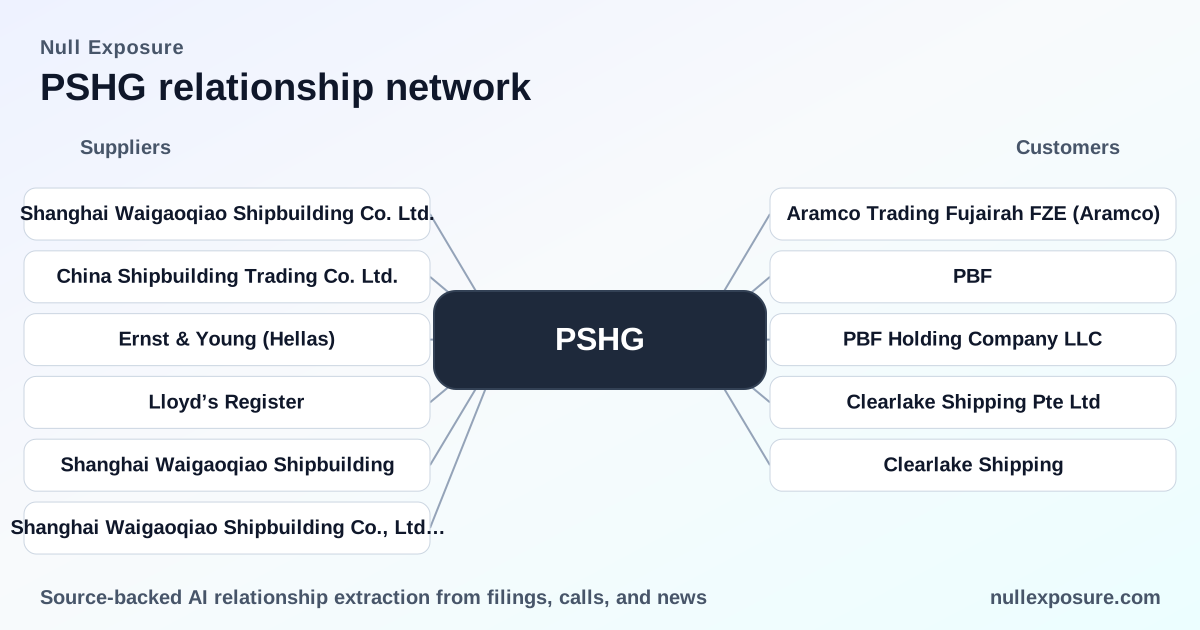
Performance Shipping (PSHG): Supplier relationships that drive growth and capital intensity
Performance Shipping operates as a small but profitable Greek tanker owner that monetizes its fleet through freight contracts, time-charters and selective newbuilding investments. The company expands capacity by contracting with Chinese shipyards for LNG-ready Aframax and Suezmax tankers, leverages third-party classification and audit firms for regulatory compliance, and finances growth from a compact public equity base (Market Cap ~$26.6M). Investors should treat PSHG as a capital-intensive operator where supplier selection (shipyards, class societies, auditors) directly controls delivery schedules, technical compliance and vessel operating economics.
For deeper supplier analytics and monitoring, visit https://nullexposure.com/.
How PSHG makes money and why suppliers matter
Performance Shipping owns and operates tankers and captures revenue through charter hire and freight services; the company’s financials show high gross profitability and strong operating margins relative to its market capitalization, underscoring that vessel economics—not large equity capital—drive returns. Fleet renewal and expansion are financed through contractual relationships with shipbuilders and underpinned by external certification and audit services; these suppliers therefore determine both capital expenditure timing and the vessels’ regulatory readiness for higher-margin employment (e.g., LNG-ready capability).
PSHG’s small public float and low institutional ownership amplify the economic impact of supplier outcomes: a delayed newbuilding or classification issue will have outsized earnings and valuation effects. For supplier diligence, review yard reputations, class history and audit continuity alongside charter contracts. Learn more about supplier risk scoring at https://nullexposure.com/.
The supplier relationships you need to know now
Below I cover every supplier relationship found in recent reporting. Each entry is a concise, plain-English takeaway with the cited source.
Shanghai Waigaoqiao Shipbuilding Co. Ltd.
Performance Shipping signed shipbuilding contracts with Shanghai Waigaoqiao Shipbuilding for the construction of new Suezmax and Aframax tankers, demonstrating a continued procurement relationship with a major Chinese yard for LNG-ready designs. Source: GlobeNewswire release carried by The Manila Times, March 3, 2026.
China Shipbuilding Trading Co. Ltd.
Performance Shipping entered contracts with China Shipbuilding Trading Co. Ltd. (CSTC) for two 158,000 DWT Suezmax newbuilds, signaling centralized contracting within China’s state-aligned shipbuilding ecosystem. Source: GlobeNewswire release carried by The Manila Times, March 3, 2026.
Ernst & Young (Hellas)
Shareholders ratified Ernst & Young (Hellas) as Performance Shipping’s independent auditors for the fiscal year ending December 31, 2025, confirming continuity with a Big Four auditor that supports financial transparency for public investors. Source: Annual general meeting coverage in The Globe and Mail / TipRanks, FY2025 reporting.
Lloyd’s Register
Performance Shipping’s vessels are classed by Lloyd’s Register, and the company emphasizes design features that reduce fuel consumption and carbon intensity, indicating that classification choices align with an emissions and fuel-efficiency strategy. Source: PortNews coverage on technical classification and design, FY2025.
Shanghai Waigaoqiao Shipbuilding (offshore-energy.biz report)
The company received delivery of its first LNG-ready LR2 Aframax newbuild constructed at Shanghai Waigaoqiao Shipbuilding, underlining that PSHG is executing on its fleet modernization program with LNG-capable tonnage. Source: Offshore-Energy.biz article on vessel delivery, FY2025.
Shanghai Waigaoqiao Shipbuilding Co., Ltd. (SWS) — christening of P. Massport
PSHG christened P. Massport, a 114,000 DWT Aframax product tanker built by Shanghai Waigaoqiao Shipbuilding Co., Ltd. (SWS), marking a fleet milestone and reinforcing the company’s reliance on SWS-built tonnage for product and LR2 trades. Source: PortNews fleet milestone report, July 31, FY2025.
Shanghai Waigaoqiao Shipbuilding Co. Ltd. (QuiverQuant mention)
Multiple outlets reference construction at Shanghai Waigaoqiao Shipbuilding for PSHG’s LNG-ready vessel projects, further corroborating the shipyard as a primary partner in the company’s newbuilding pipeline. Source: Company naming and delivery notice circulated via QuiverQuant, FY2026.
What those relationships imply for investors and operators
- Concentrated shipyard exposure. PSHG repeatedly contracts with Shanghai Waigaoqiao and links into CSTC procurement channels; that concentration reduces supplier diversification but accelerates fleet standardization and scale benefits in maintenance, crewing and spare parts.
- Capital-intensity and scheduling risk. Newbuilding contracts create significant near-term capex commitments; delivery timing from Chinese yards will dictate vessel availability for revenue generation and therefore affect quarterly earnings volatility.
- Regulatory and ESG signaling. Classification by Lloyd’s Register and the adoption of LNG-ready designs position the fleet for lower carbon intensity and better charterer access in regulated trades.
- Governance and audit continuity. The ratification of Ernst & Young (Hellas) supports reliable financial reporting—important for a small-cap company where disclosure miscues have amplified market consequences.
These signals collectively describe an operator with high supplier dependency, targeted yard concentration, and clear technical modernization objectives.
For a focused supplier risk score and real-time alerts on yard activity, visit https://nullexposure.com/.
Operational constraints and business-model characteristics to watch
With no formal constraint excerpts published in the sourced material, present company-level operating signals are the appropriate frame:
- Contracting posture: PSHG executes formal newbuilding contracts with established Chinese yards and trading houses, indicating a supplier-facing posture that favors fixed-scope newbuild agreements rather than opportunistic spot purchases.
- Concentration: The procurement pattern shows concentration to a small set of shipbuilding partners, increasing counterparty importance and country exposure to Chinese yards.
- Criticality: Shipyards and class societies are critical suppliers—deliveries and class certificates directly enable revenue-generating operations.
- Maturity: The use of established global players (SWS/CSTC, Lloyd’s Register, Ernst & Young) signals a mature procurement and compliance approach suitable for public-company governance despite the firm’s small market cap.
Monitor yard delivery schedules, class audits, and auditor continuity as leading indicators of operational health.
Risk considerations and recommended monitoring
- Delivery slippage will compress near-term utilization and earnings; with PSHG’s compact equity base, operational delays translate quickly into valuation pressure.
- Counterparty concentration in Chinese yards creates exposure to geopolitical, FX, and shipping-cycle disruptions.
- Regulatory compliance through Lloyd’s Register reduces technical risk but requires continuous validation, particularly for LNG-ready systems.
Operators and investors should prioritize contract-level review (payments, warranty terms, delivery dates), class certificates, and audit reports at each reporting cycle.
Bottom line — actionable investor takeaways
Performance Shipping’s supplier network shows strategic alignment toward modern, LNG-ready tonnage and reliance on a small set of high-capacity Chinese shipyards, supported by reputable classification and audit partners. That configuration provides potential for improved vessel economics but concentrates delivery and counterparty risk. For ongoing monitoring of PSHG supplier exposures and to integrate supplier intelligence into investment models, visit https://nullexposure.com/ for structured tracking and analysis.
For immediate next steps: validate upcoming delivery dates against charter backlog, confirm class certificates for each newbuild, and review payment milestones in shipbuilding contracts to quantify capex timing.