PS International Group Ltd. (PSIG): A supplier-focused view for investors
Thesis: PS International Group Ltd. is a small-cap, diversified investment and logistics operator that monetizes through strategic equity investments and operating activities in technology and sustainable solutions, while being a publicly traded vehicle whose principal market relationships are with listed exchanges that provide liquidity and market access. For investors evaluating supplier exposure and counterparty risk, the practical relationships to assess are exchange listings and the company’s own financial footprint; learn more at https://nullexposure.com/.
How PSIG operates and where cash flow comes from
PS International Group describes itself as a diversified investment firm concentrated on innovative technology and sustainable solutions across several industries, with an emphasis on value creation through strategic stakes and operating initiatives. The company reports trailing revenue of roughly $70.99 million and a gross profit of about $2.52 million for the most recent trailing twelve months, but carries negative operating and net margins and a diluted EPS of -2.65, reflecting an early-stage or restructuring financial profile (latest quarter 2024-06). According to its public profile and filings, PSIG trades on U.S. exchanges and relies on public markets for capital liquidity and valuation discovery.
Key financial signals:
- Small market capitalization (~$46.8 million) and low institutional ownership (0.42%), which concentrate shareholder control and limit deep market liquidity.
- Negative EBITDA and margins, indicating the firm is not currently self-sustaining from operating cash flow and is dependent on financing, asset sales, or investment gains to support operations.
- Public listing characteristics (Nasdaq/others) provide tradability but also expose the company to exchange-driven costs and liquidity dynamics.
If you want a supplier-risk perspective wired into investment decisions, start here: https://nullexposure.com/.
The corporate relationships investors will see in public sources
Below are the supplier/market relationships reported in public mentions and sentiment sources; each relationship is summarized in plain English with a source note.
-
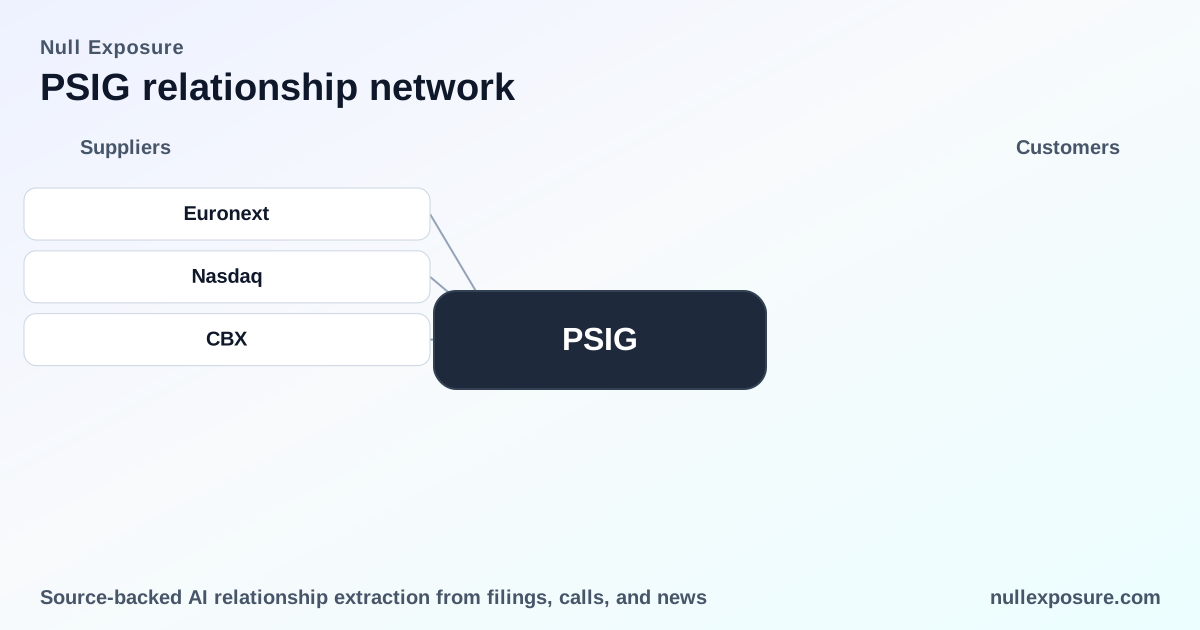
Euronext: TradingView notes that PSIG shares are traded on multiple exchanges including Euronext, which indicates cross-listing or trading venue mentions that expand where liquidity can be found. (TradingView symbol page, March 2026: https://www.tradingview.com/symbols/NASDAQ-PSIG/)
-
Nasdaq: TradingView explicitly lists Nasdaq as a trading venue for PSIG, confirming that the company is accessible to U.S. retail and institutional brokers that route orders to Nasdaq. (TradingView symbol page, March 2026: https://www.tradingview.com/symbols/NASDAQ-PSIG/)
-
Nyse: TradingView also references Nyse among exchanges where PSIG is traded, suggesting either historical or cross-market exposure that can affect quoting and execution. (TradingView symbol page, March 2026: https://www.tradingview.com/symbols/NASDAQ-PSIG/)
These mentions are concise market-structure signals rather than supplier contracts, and they matter because exchanges are the primary counterparties for trading, settlement, and visibility.
Why exchange relationships matter to supplier-risk analysis
Exchanges are not traditional “suppliers” of goods, but they are strategic service providers whose terms and performance affect an issuer’s market functioning. For PSIG, the relationship with public trading venues informs four operational constraints that shape investor risk and supplier posture:
-
Contracting posture — market access over vendor dependency. PSIG operates as a listed issuer; its exposure to exchanges is contractual in the sense of listing standards, fees, and disclosure obligations rather than a procurement-style supplier agreement. Exchange terms determine ongoing compliance costs and the thresholds that could threaten listing status.
-
Concentration — liquidity is concentrated and shallow. With a market capitalization under $50 million and just over 3 million shares floated, liquidity is thin and order flow is concentrated, making execution and share-price stability sensitive to a small number of participants.
-
Criticality — exchanges are mission-critical for exit and valuation. Public exchanges are mission-critical service providers for PSIG because they deliver the only practical mechanism for shareholders to realize value and for the company to access equity capital.
-
Maturity — company is financially immature. Negative profitability metrics and declining quarterly revenue growth indicate that PSIG remains at an early-to-mid maturity stage where market relations (listings, broker coverage, and investor relations) play an outsized role in capital access and perceived credibility.
These company-level signals frame how investors should think about supplier risk: the most consequential “suppliers” are market infrastructure and capital providers rather than large procurement vendors.
Explore supplier and market relationship analytics tailored for investors at https://nullexposure.com/.
Risks that flow from these supplier and capital relationships
Several practical investor risk considerations flow from the relationship map and financial profile:
- Liquidity and execution risk. Low float and small market cap mean trades can move the stock materially; investors should model slippage and partial fills into position sizing.
- Disclosure and compliance risk. As a listed company, PSIG is vulnerable to listing-standard enforcement that could impose remediation costs or delisting risk if governance or reporting thresholds are not met.
- Capital dependence. Negative operating cash flow and limited institutional backing mean the company is likely to rely on new equity issuance or asset monetization; those capital-raising events interact directly with market conditions on exchanges.
- Concentration of counterparties. With few institutional holders, single large investors or block trades could produce outsized price moves or negotiating leverage over corporate actions.
Practical takeaways and what to do next
- Treat exchange access as a strategic supplier relationship. For a small-cap issuer like PSIG, listing venues are the de facto infrastructure providers that govern visibility, cost of capital, and trading quality.
- Stress-test liquidity and capital-raising scenarios. Model the impact of a small number of buyers or a forced equity raise on dilution and execution.
- Monitor filings and exchange notices closely. Quarterly filings through the latest quarter (2024-06) show negative profitability and declining revenue trends, so investors must watch governance and compliance signals for early warning of market-impacting events.
If you are managing exposure or conducting diligence, review the public market relationships and risk signals at https://nullexposure.com/. For teams building counterparty risk profiles, prioritize exchanges and capital counterparties as primary suppliers when sizing PSIG exposure.
Bottom line: PS International Group is a publicly traded, diversified investment and logistics operator whose most consequential supplier relationships for investors are with capital markets infrastructure rather than traditional vendors. Liquidity, exchange rules, and the company’s negative operating profile are the dominant risk levers investors must price into any exposure.