Power Solutions International (PSIX): Supplier Relationships That Drive Margin and Risk
Power Solutions International designs, engineers, manufactures and sells diesel and gas engines and power systems, monetizing through product sales and integrated power-system solutions to industrial, commercial and infrastructure customers. Revenue is driven by OEM and aftermarket sales, supported by a global supply partnership strategy and selective acquisitions that expand product scope into adjacent electrical enclosures and fuel systems. For an at-a-glance supplier risk view, visit https://nullexposure.com/.
What the business model looks like to an investor
PSIX operates as a mid‑market specialty industrial machinery manufacturer with vertical production concentrated in the U.S., supplemented by strategic global supplier relationships that give international parts access and capacity. The company reports roughly $722 million in trailing revenue and healthy margins (gross profit and operating margins reported in filings), and management monetizes both new system builds and recurring aftermarket parts and service. Capital allocation signals include facility expansion and bolt‑on M&A to broaden product sets for higher‑margin end markets like data centers.
The supplier and M&A relationships you need to know
Below are the explicit supplier and transaction relationships disclosed in company filings and public reports. Each relationship is summarized in plain English with the original source noted.
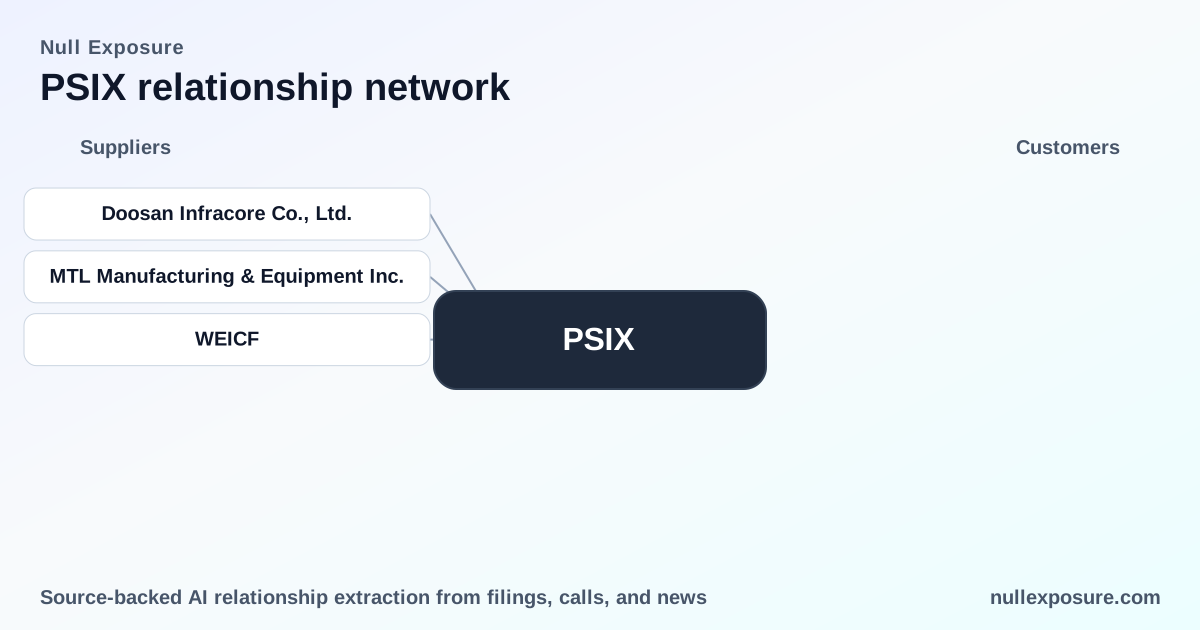
Doosan Infracore Co., Ltd.
Power Solutions maintains a longstanding supply relationship with Doosan, formalized by a Supply Agreement originally dated December 11, 2007 and amended with Addendum #12 on June 8, 2023, reflecting continued contractual ties for components or engines. According to the company’s 2024 10‑K, the addendum updates that multi‑year arrangement and confirms Doosan is a contractual supplier partner (10‑K, FY2024).
MTL Manufacturing & Equipment Inc.
Power Solutions announced in March 2026 the acquisition of MTL Manufacturing & Equipment Inc., a maker of switchgear subbases, electrical enclosures and fuel tanks — assets intended to let PSIX deliver a more complete power solution for the data center market. The transaction was disclosed in a press release reported by The Globe and Mail (Mar 2026); consideration was not publicly disclosed (press release, Mar 2026).
Weichai (WEICF)
Weichai supplies inventory and acts as a strategic partner that supports global supply‑chain access and capacity. The 2024 10‑K states Power Solutions purchased $21.5 million of inventory from Weichai in 2024 (and $6.2 million in 2023), and public commentary highlights the partnership as part of the company’s global manufacturing strategy and capacity expansion plans (10‑K, FY2024; market commentary, 2026).
How these relationships shape risk and opportunity
These three relationships collectively outline PSIX’s supplier posture and near‑term growth levers:
- Long tenure with legacy suppliers. The Doosan supply agreement dates to 2007 with recent addenda, signaling durable contracting relationships and a preference for formal long‑term supply contracts rather than spot purchases (10‑K, FY2024).
- Material supplier spend with Weichai. The quantified inventory purchases from Weichai—$21.5 million in 2024—make this supplier economically significant and operationally critical for parts and inventory flow (10‑K, FY2024). This creates both supply‑chain dependency and sourcing leverage for PSIX.
- Acquisition to expand product scope and reduce single‑market exposure. The MTL acquisition brings switchgear and enclosure capabilities that broaden PSIX’s addressable market into data centers, improving product completeness and aftermarket opportunities (press release, Mar 2026).
Collectively, these signals imply a contracting posture that favors multi‑year agreements and strategic partnerships, with supplier concentration around a few material partners and active efforts to reduce customer and product concentration through targeted M&A. For a deeper supplier map and monitoring playbook, visit https://nullexposure.com/.
Operational constraints and what they reveal
One explicit constraint found in filings is that PSIX functions in a manufacturer role with respect to at least one identified supplier relationship:
- The company’s 10‑K discloses purchases from Weichai of $21.5M in 2024 and $6.2M in 2023, which underpins a high‑confidence classification of Weichai as a material inventory supplier and positions PSIX as a manufacturing buyer in that relationship (10‑K, FY2024).
Company‑level operating signals derived from public disclosures include:
- Concentration: Manufacturing and engineering are concentrated in seven U.S. facilities totaling roughly 1 million square feet, which concentrates operational risk geographically even as a Wisconsin expansion is underway to add capacity (market commentary, 2026).
- Criticality: Inventory purchases from Weichai and the longevity of the Doosan supply agreement indicate suppliers that are operationally critical, not interchangeable spot vendors.
- Maturity: The Doosan agreement (origin 2007) and multi‑year supplier spend demonstrate mature contractual relationships with formal amendments rather than ad hoc buying.
- Strategic diversification: The MTL deal is an explicit effort to de‑risk product concentration and capture integrated system economics in attractive end markets (press release, Mar 2026).
These constraints and signals should be used as a lens to evaluate procurement resilience, inventory risk, and margin sustainability.
Key investor takeaways and monitoring checklist
- Supplier dependency is real and measurable. Weichai represents material inventory spend, and Doosan is a legacy supply partner under long‑dated contracts — both factors are central to production continuity (10‑K, FY2024).
- Acquisition strategy is additive to product breadth. MTL adds components required for data‑center power systems and should increase addressable aftermarket revenue (press release, Mar 2026).
- Concentration risk exists but is managed through partnerships and expansion. A concentrated U.S. manufacturing footprint and strategic foreign suppliers give PSIX operational leverage but also expose it to localized disruptions and supplier performance risk (market commentary, 2026).
Watch these items closely in the next two quarters: integration progress for MTL, any revisions to Doosan contractual terms, quarterly supplier‑spend disclosures (particularly with Weichai), and production ramp in the Wisconsin expansion. For an investor‑grade supplier risk dashboard, explore https://nullexposure.com/.
Final assessment
Power Solutions combines manufacturing scale, strategic supplier partnerships and targeted M&A to monetize both systems and aftermarket parts; this structure supports margin expansion but carries concentrated supplier exposure that must be managed through contracting and inventory strategy. Investors should weigh durable contractual links and M&A upside against supplier concentration and single‑facility risk when assessing PSIX’s operational resilience.