Paramount Skydance (PSKY) — Supplier relationships under the lens of a transformational financing
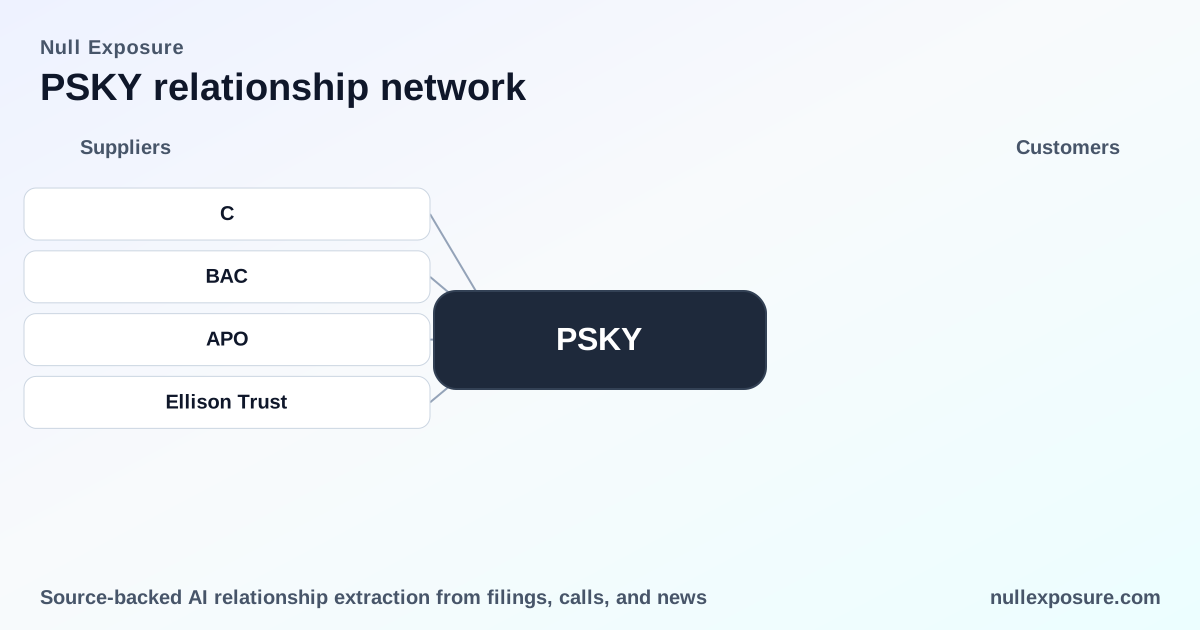
Paramount Skydance Corporation operates as a global media and entertainment company that monetizes content through theatrical distribution, streaming/licensing, advertising, and library exploitation, while running capital-intensive studio operations that rely on large-scale external financing for transformational deals. The supplier footprint exposed in recent news is overwhelmingly financial — banks, private capital and a controlling trust — reflecting an operating model that outsources balance-sheet capacity rather than funding major transactions from internal cash flow. For more supplier intelligence, visit Null Exposure.
Financial posture that drives supplier dependence
Paramount Skydance has the scale and margins of a major studio: Revenue TTM $28.76B, Gross Profit $9.137B, EBITDA $2.576B, Market Cap ~$8.55B. Those figures coexist with a low trailing EPS and a very high trailing P/E (449x) driven by near-term earnings variability and a materially different forward multiple (Forward P/E ~9.9x), signaling investor expectations tied to strategic execution rather than steady-state cash generation. This capital intensity and episodic profitability make large counterparty financings essential for any outsized M&A or balance-sheet expansion, which is exactly what the relationship records reflect.
How the relationships cluster around a single corporate event
The relationships surfaced in the records are concentrated on one strategic transaction: the proposed acquisition of Warner Bros. Discovery in FY2026. That event compressed supplier activity into a short window and created high counterparty concentration — banks and private capital providing the lion’s share of debt and equity backing, with a controlling trust (Ellison Trust) filling the equity anchor role. This is an operating model characteristic: transactional, concentrated, highly critical to strategic outcomes, and short-dated in maturity. If you evaluate PSKY as a supplier consumer, treat these counterparties as single-event suppliers whose importance is outsized for the company’s strategic trajectory.
For deeper relationship mapping and supplier risk scoring, see Null Exposure.
The relationships recorded — every entry accounted for
-
Citigroup Global Markets: TradingView flagged Citigroup Global Markets as a financing counterparty on March 10, 2026, listing it alongside Bank of America and Apollo Capital Management in coverage of the proposed Warner Bros. Discovery acquisition financing. Source: TradingView report (2026-03-10) — https://www.tradingview.com/news/tradingview:c67f0bfe8c85f:0-paramount-skydance-to-acquire-warner-bros-discovery-for-31-per-share-in-cash/.
-
Bank of America Merrill Lynch: SahmCapital’s refile update (Feb 27, 2026) identified Bank of America Merrill Lynch as a lender in a $57.5 billion debt package supporting the transaction, up from an earlier $54 billion commitment. Source: SahmCapital refile update (2026-02-27) — https://www.sahmcapital.com/news/content/refile-update-9-paramount-skydance-wins-warner-bros-netflix-walks-away-and-its-shares-jump-2026-02-27.
-
Citi: SahmCapital’s refile update (Feb 27, 2026) listed Citi among the banks participating in the $57.5 billion financing package for the acquisition. Source: SahmCapital refile update (2026-02-27) — https://www.sahmcapital.com/news/content/refile-update-9-paramount-skydance-wins-warner-bros-netflix-walks-away-and-its-shares-jump-2026-02-27.
-
Citi (duplicate entry, update-8): An earlier SahmCapital update (labeled update-8) repeated Citi’s role in the financing commitment, underscoring multiple press mentions of the same counterparty relationships during the FY2026 process. Source: SahmCapital update-8 (2026-02-27) — https://www.sahmcapital.com/news/content/update-8-paramount-skydance-wins-warner-bros-netflix-walks-away-and-its-shares-jump-2026-02-27.
-
Bank of America (TradingView entry): TradingView’s March 10, 2026 item identified Bank of America as a counterparty in the financing syndicate for the proposed deal, aligning with other contemporaneous reports. Source: TradingView (2026-03-10) — https://www.tradingview.com/news/tradingview:c67f0bfe8c85f:0-paramount-skydance-to-acquire-warner-bros-discovery-for-31-per-share-in-cash/.
-
Apollo (SahmCapital refile update 9): SahmCapital’s refile update (Feb 27, 2026) named Apollo as a debt provider in the $57.5 billion financing package. Source: SahmCapital refile update (2026-02-27) — https://www.sahmcapital.com/news/content/refile-update-9-paramount-skydance-wins-warner-bros-netflix-walks-away-and-its-shares-jump-2026-02-27.
-
Apollo (SahmCapital update-8): The update-8 report from SahmCapital reiterated Apollo’s participation in the financing syndicate, reflecting repeated market coverage of the same group of counterparties. Source: SahmCapital update-8 (2026-02-27) — https://www.sahmcapital.com/news/content/update-8-paramount-skydance-wins-warner-bros-netflix-walks-away-and-its-shares-jump-2026-02-27.
-
Apollo Capital Management (TradingView): TradingView’s piece on March 10, 2026 explicitly named Apollo Capital Management among the counterparties backing the transaction. Source: TradingView (2026-03-10) — https://www.tradingview.com/news/tradingview:c67f0bfe8c85f:0-paramount-skydance-to-acquire-warner-bros-discovery-for-31-per-share-in-cash/.
-
Ellison Trust (SahmCapital update-8): SahmCapital’s update-8 (Feb 27, 2026) reported the Ellison Trust committing $45.7 billion in equity to the transaction, up from $43.6 billion previously, backed by Larry Ellison’s agreed additional funding to satisfy bank solvency checks. Source: SahmCapital update-8 (2026-02-27) — https://www.sahmcapital.com/news/content/update-8-paramount-skydance-wins-warner-bros-netflix-walks-away-and-its-shares-jump-2026-02-27.
-
Ellison Trust (SahmCapital refile update 9): The refile update reiterated the Ellison Trust’s increased equity commitment of $45.7 billion and its role in satisfying solvency requirements for the banks in the financing package. Source: SahmCapital refile update (2026-02-27) — https://www.sahmcapital.com/news/content/refile-update-9-paramount-skydance-wins-warner-bros-netflix-walks-away-and-its-shares-jump-2026-02-27.
What these relationships mean for supplier risk and contract posture
-
Concentration risk is high. The coverage shows a compact syndicate — Bank of America, Citi, Apollo and the Ellison Trust — shouldering almost all transactional financing risk for a single transformational deal. That creates an acute supplier concentration that is strategic and short-term rather than diversified across many long-term providers.
-
Contracting posture is opportunistic and event-driven. PSKY’s supplier posture is to assemble bespoke financing packages when required, rather than maintain ongoing long-term lending relationships that are visible in procurement records; this is consistent with studio economics that deliver episodic capital needs tied to M&A and large content spends.
-
Criticality is elevated for strategic outcomes. These counterparties are mission-critical for the proposed acquisition; their withdrawal or repricing would directly alter PSKY’s strategic calculus and valuation.
-
Maturity horizon is short and transaction-specific. The listed relationships are tied to FY2026 financing commitments and therefore carry short-dated operational importance, not perennial supply commitments.
For a structured supplier risk analysis of media-sector counterparties and their levered role in M&A, explore Null Exposure.
Constraints and company-level signals
No supplier-level constraints are recorded in the available relationship records for PSKY. At the company level, the absence of explicit long-term supplier constraints in the feeds signals that Paramount Skydance’s supplier exposure is dominated by episodic financial counterparties rather than entrenched operational vendors, which is an important interpretive point for investors evaluating continuity risk versus transaction risk.
Final takeaways and recommended next steps
-
Primary risk vector for PSKY is financing concentration tied to transformational M&A. Investors and operators should treat the bank/private-capital syndicate and the Ellison Trust as strategically critical counterparties whose behavior will directly affect deal execution and near-term valuation.
-
Operational supplier risk is low relative to financing risk, but strategic dependency is high. That profile favors monitoring of credit commitments and solvency covenants as part of any investment or counterparty assessment.
-
Actionable workstream: validate the binding nature of financing commitments, track covenant conditions, and stress-test scenarios where parts of the syndicate withdraw or demand material repricing.
For a deeper, ongoing view of PSKY’s counterparty exposures and supplier-risk scoring, visit Null Exposure.