PriceSmart (PSMT): Supplier Relationships and Operational Constraints that Drive Stability and Risk
PriceSmart operates membership warehouse clubs across Central America, the Caribbean and Colombia, monetizing through membership fees and bulk retailing while controlling costs via centralized sourcing and long-lived leased locations. The company’s model blends steady recurring revenue from memberships with capital-intensive, long-term real estate and logistics commitments that shape supplier and technology vendor relationships. If you evaluate supplier risk or partnership opportunities, start with this supplier map and operating posture. For more supplier-focused intelligence visit https://nullexposure.com/.
What investors need to know up front
PriceSmart generates retail gross margins through merchandise sales and memberships; the balance sheet and cash flow are affected materially by long-term property leases and third-party logistics. Recent FY2026 disclosures show active IT and trade-platform implementations and a strategic move into co-branded consumer credit in selected markets—actions that shift operational dependence from legacy IT and local partners to a mix of enterprise software vendors and regional financial institutions. These relationships are operationally critical because they touch payments, replenishment and cross-border trade controls.
How PriceSmart contracts, sources and scales its supply chain
PriceSmart’s procurement and footprint exhibit clear structural traits that matter to suppliers and counterparties:
- Long-term real estate commitments: leases for warehouse clubs typically run 20–30 years with renewal options, creating multi-decade occupancy and capex obligations tied to store openings and relocations. These are company-level, binding commitments that anchor location economics.
- Usage-sensitive lease mechanics: some leases include rent linked to future sales volumes or indexed adjustments, introducing a partial variable cost element to otherwise fixed-site commitments.
- Geographic sourcing split: roughly half of merchandise is sourced within Latin America and the Caribbean, with the remainder procured globally—this local sourcing concentration increases regional supplier importance while preserving global procurement flexibility.
- Third-party distribution and origin consolidation: the company uses third-party distribution centers in most markets and is pursuing origin consolidation to reduce freight, shorten transit and improve working capital conversion.
These characteristics produce a contracting posture that is capital-intensive, concentrated regionally but globally sourced, and operationally dependent on third-party logistics and enterprise software platforms.
The relationships that matter (what the public record shows)
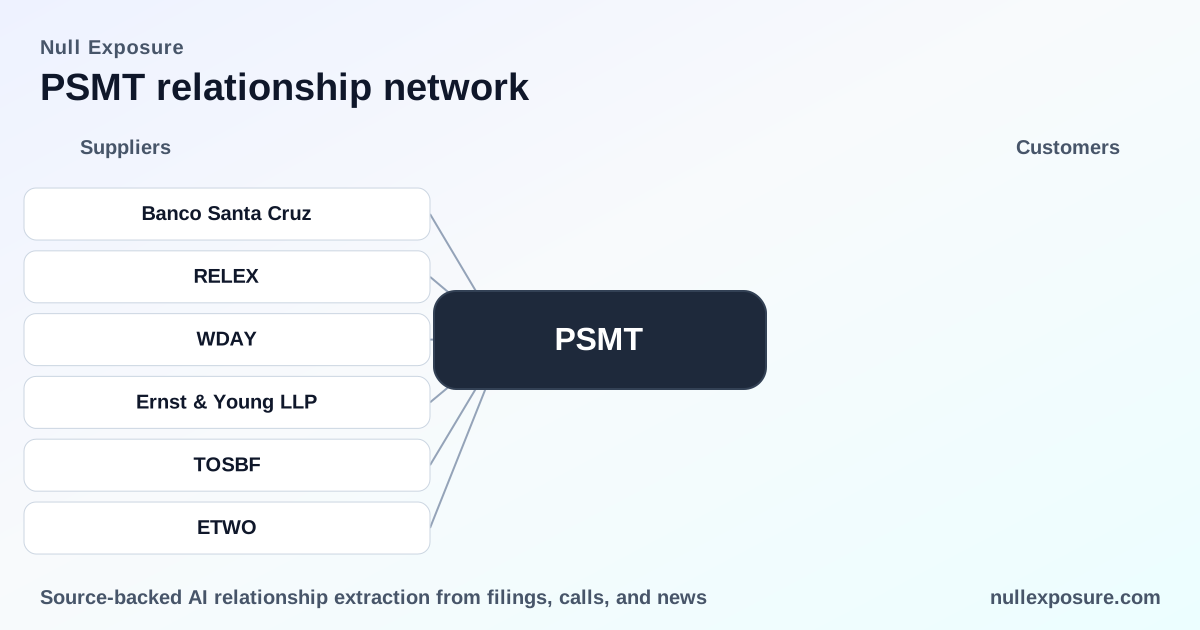
Below are the supplier and supplier-adjacent relationships disclosed in FY2026 communications, each with a concise plain-English description and source reference.
-
Banco Santa Cruz — PriceSmart launched an enhanced co-branded consumer credit card with Banco Santa Cruz in the Dominican Republic in November 2025, expanding point-of-sale financing and loyalty capabilities in that market. According to the Q1 FY2026 earnings call transcript (InsiderMonkey, March 10, 2026), this partnership supports local card acceptance and member financing.
-
RELEX — PriceSmart is migrating to the RELEX forecasting and replenishment platform and expects full implementation in FY2026, a move designed to tighten inventory planning and reduce stockouts. This implementation was disclosed on the Q1 FY2026 earnings call transcript (InsiderMonkey, March 10, 2026).
-
Workday (WDAY) — The company began implementing Workday’s human capital management system in Q1 FY2026 to replace legacy HR applications, standardizing workforce data and payroll processes across jurisdictions. Management discussed this transition on the Q1 FY2026 earnings call transcript (InsiderMonkey, March 10, 2026).
-
Ernst & Young LLP — Stockholders ratified Ernst & Young LLP as PriceSmart’s independent registered public accounting firm for the fiscal year ending August 31, 2026, formalizing EY’s role in the company’s external financial reporting and controls oversight. This was disclosed in the company’s PR news release covering the 2026 annual meeting (PR Newswire, March 10, 2026).
-
Toshiba (TOSBF) — PriceSmart completed implementation of a Toshiba point-of-sale product, ELERA, across English-speaking Caribbean markets in Q1 FY2026, modernizing in-store checkout systems and payment processing hardware. Management referenced this completion in the Q1 FY2026 earnings call transcript (InsiderMonkey, March 10, 2026).
-
e2open (ETWO) — The company advanced a multi-phase implementation of the e2open global trade management platform during Q1 FY2026 to strengthen automation, compliance and controls for import/export activity. This program was described on the Q1 FY2026 earnings call transcript (InsiderMonkey, March 10, 2026).
What these relationships imply about operational exposure
Collectively, the vendor map shows PriceSmart pursuing enterprise-grade software and local financial partners while locking in long-term physical footprints. Key implications:
- Operational criticality: RELEX, Workday, Toshiba and e2open touch replenishment, workforce, front-line sales and trade compliance—systems that materially influence same-store sales conversion and cross-border flow. Failure or delay in these implementations would have immediate operational impact.
- Concentration and regional risk: sourcing half of merchandise regionally increases dependence on Latin American and Caribbean suppliers and logistics nodes; distribution partners therefore carry outsized importance for continuity.
- Contract maturity and tenor: multi-decade leases reduce the company’s flexibility to exit poor locations quickly but stabilize unit economics for landlords and anchor long-term supplier planning.
For analysts and procurement leads, these characteristics indicate a supplier risk profile that is highly contractual (long tenor), operationally critical for a small set of vendors, and regionally concentrated—a combination that favors disciplined vendor management and robust contingency plans. If you want deeper supplier exposure analysis, visit https://nullexposure.com/ for tailored reports.
Investment implications and what to watch next
- Execution of software rollouts (RELEX, Workday, e2open) will determine near-term improvements in inventory turns, labor efficiency and compliance; monitor implementation milestones and realized savings versus guidance.
- Co-branded credit expansion (Banco Santa Cruz) is a strategic lever for membership penetration and higher basket sizes; monitor uptake, credit performance, and payment fees or revenue share terms disclosed in future filings.
- Distribution and lease economics are long-duration exposures—any material shift in freight costs, currency volatility in Latin America, or island logistics disruptions will directly affect margins because of fixed store occupancy costs.
Key takeaway: PriceSmart’s supplier relationships are not peripheral add-ons; they are core to the company’s ability to convert membership revenue into predictable retail cash flow.
For practitioners evaluating PSMT supplier relationships, NullExposure provides a focused supplier-risk perspective and real-time relationship tracking—start your review at https://nullexposure.com/.
Final read: risk-reward in one line
PriceSmart pairs resilient membership-driven revenue with long-term, capital intensive supplier and property commitments; the stock reflects that trade-off—stable, but dependent on flawless execution of vendor implementations and disciplined logistics management.