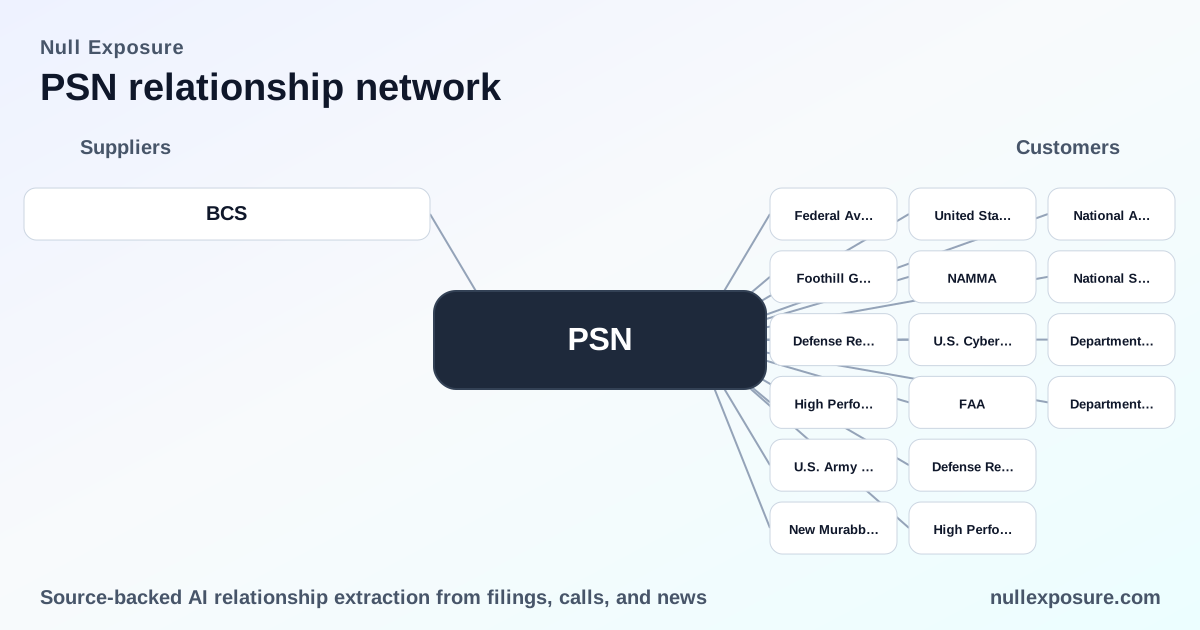
Parsons (PSN) supplier relationships: what Barclays’ advisory role signals for investors and operators
Parsons Corporation operates as a defense, intelligence and critical-infrastructure technology contractor, monetizing through long-term government and commercial contracts, systems integration, and selective M&A to fill capability gaps. Its revenue mix is contract-driven and services-heavy, with margin expansion dependent on program capture, integration of acquisitions, and cost control across a distributed supplier and advisor base. Acquisitions such as Altamira—financed and structured with external advisers—are integral to Parsons’ growth playbook and influence supplier and advisory relationships. For more detailed relationship mapping and ongoing tracking, visit https://nullexposure.com/.
What happened: Barclays was the exclusive financial adviser on Altamira
Multiple January 2026 reports show Barclays acted as Parsons’ exclusive financial adviser in the Altamira Technologies acquisition. WashingtonExec described Barclays as “exclusive financial adviser to Parsons” in coverage of the deal; QuiverQuant’s headline likewise states Barclays served as Parsons’ exclusive financial advisor in the up-to-$375 million transaction; Washington Technology’s reporting repeats Barclays’ exclusive adviser role while noting deal terms. These contemporaneous press reports confirm Barclays’ advisory role on a material strategic acquisition for Parsons in FY2026. (Sources: WashingtonExec, Jan 2026; QuiverQuant, Jan 2026; Washington Technology, Jan 2026.)
The relationships in the record — concise, plain-English summaries
- Barclays — Barclays served as Parsons’ exclusive financial adviser for the Altamira acquisition announced in January 2026; multiple outlets record Barclays in that role while also noting Baird advised the seller. (Sources: WashingtonExec Jan 2026; QuiverQuant Jan 2026; Washington Technology Jan 2026.)
These sources converge on the same point: Barclays occupied the lead advisory slot for Parsons on a strategic, value-accretive acquisition.
Why the Barclays relationship matters for investors
Barclays’ role as exclusive adviser on the Altamira transaction is more than a transactional footnote. Using a major global bank as the exclusive adviser signals that Parsons treated the Altamira purchase as strategically significant, requiring capital-markets and deal-structuring expertise. For investors, that has three practical implications:
- It elevates transaction governance: Parsons allocated deal oversight to a top-tier adviser rather than handling the process solely in-house, indicating emphasis on price discovery and financing flexibility.
- It increases confidence in deal execution mechanics: a major adviser reduces execution risk around valuation, regulatory navigation, and buyer financing resilience.
- It signals appetite for continued M&A: using external advisers for bolt-on capabilities suggests Parsons will continue to use the market to accelerate capability buildouts.
For more context on Parsons’ supplier and adviser relationships and how they impact enterprise risk, review the relationship hub at https://nullexposure.com/.
Company-level constraint that shapes supplier posture
Parsons’ public materials include an explicit reference to using external cybersecurity service providers “to assess, test or otherwise assist with aspects of our security processes.” That mention is a company-level signal describing operating practice rather than an isolated vendor name. From a business-model perspective:
- Contracting posture: Parsons outsources specialized security functions to third-party providers rather than relying solely on internal teams, reflecting a hybrid security operating model.
- Concentration and criticality: Cybersecurity is a critical, non-negotiable control for a defense- and intelligence-focused contractor; reliance on external specialists introduces vendor concentration and control risks that must be managed contractually.
- Maturity: The explicit use of third-party cybersecurity services indicates a mature security program that engages external expertise for validation and testing rather than ad-hoc remediation.
- Procurement behavior: Expect formal vendor selection, recurring service agreements, and periodic reassessments—practical characteristics that shape supplier negotiation leverage and renewal dynamics.
These characteristics drive both operational resilience and an element of third-party risk that investors and operators must price into valuations and contract oversight.
Operational and financial risks that follow from these relationships
Barclays’ advisory role and Parsons’ reliance on external security providers highlight cross-cutting risk themes:
- Execution risk on integration: Acquisitions advised by large banks tend to close with detailed terms, but integration execution—especially in cyber and security-sensitive work—remains a material operational risk that affects near-term margins.
- Counterparty concentration risk: Outsourcing cybersecurity and using high-profile advisers reduce internal load but create dependency points where vendor failures or disputes could disrupt contract performance.
- Contracting complexity: Working with government and intelligence customers means supplier requirements are stringent; Parsons’ choice to use external specialists and advisers indicates both the complexity of compliance and the need to de-risk through experienced third parties.
Investors should treat these relationships as meaningful operational levers rather than neutral line items.
Practical guidance for asset owners and operators
- For investors performing diligence: verify the depth and duration of advisory relationships on material M&A and the contract terms with critical external service providers, especially cybersecurity vendors.
- For operators and procurement teams: codify vendor SLAs and escalation routes for security providers and require integration milestones when acquiring boutique capabilities.
- For governance and risk committees: track third-party concentration metrics and ensure waterfall plans exist if an adviser or specialist fails to deliver during an integration window.
A short checklist for investor diligence:
- Confirm adviser engagement letters and fee structure for material transactions.
- Review cybersecurity vendor contractual terms, including audit rights and SOC/assurance evidence.
- Validate integration milestones and holdback structures that align seller incentives post-close.
Final read and next steps
Barclays’ exclusive advisory role in the Altamira deal underscores Parsons’ strategic use of external advisers for material M&A and reflects a broader operating model that leverages third-party specialists for critical functions like cybersecurity. That combination supports disciplined growth while introducing vendor concentration and integration risks that must be actively managed.
For a deeper dive into Parsons’ external relationships, tracking history and implications for valuation, visit https://nullexposure.com/. If you want tailored briefings or continuous monitoring of supplier and adviser linkages across defense contractors, explore subscription options at https://nullexposure.com/ to see how relationship intelligence can refine your investment and operational decisions.