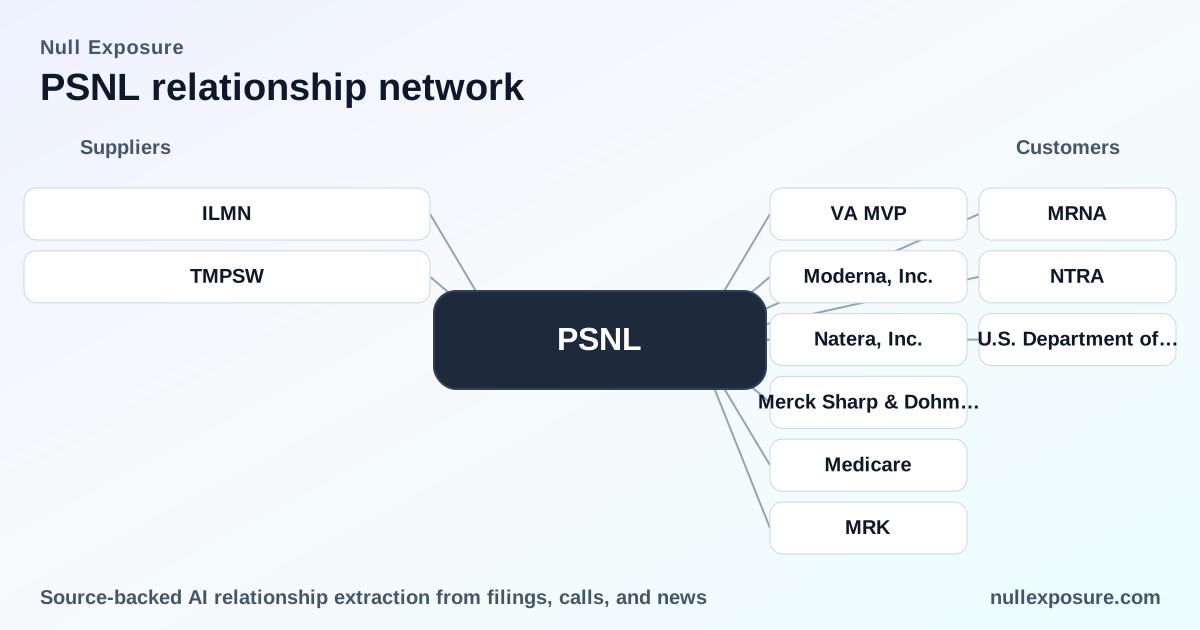
Personalis (PSNL) supplier relationships: who matters, why it matters to investors
Personalis operates a cancer genomics business that sequences and interprets tumor and germline DNA for clinical and research customers, monetizing through testing services and related data products sold to biopharma and clinical partners. Revenue depends on lab throughput, distribution partnerships for commercial reach, and continued access to sequencing platforms and reagents. For a concise supplier-risk lens and ongoing monitoring tools, visit https://nullexposure.com/.
The immediate investor thesis: concentrated input exposure, amplified by strategic distribution
Personalis runs a capital- and supply-intensive wet lab operation that buys sequencers, reagents and commercial distribution to scale adoption. That model creates two primary supplier vectors for investors to track: (1) technology/platform suppliers that are critical to test delivery and (2) commercial partners that scale demand quickly. Both vectors materially affect near-term revenue growth and operational continuity.
What Personalis buys and how that shapes supplier leverage
Personalis discloses that much of its laboratory throughput sits on third‑party sequencing platforms and reagents, procured under largely short-term purchasing arrangements. This contracting posture means purchase commitments are typically short-term, leaving the company exposed to spot availability and price volatility for critical inputs. At the same time, the company relies on third parties for operational systems and maintenance, introducing concentration risk in both hardware and services. These are company-level signals: short contract horizons create procurement risk and cost variability, while reliance on external operational systems increases third-party dependency across multiple corporate functions.
Illumina — platform dependency and single‑source consequences
Personalis relies on Illumina sequencers and associated reagents as a core part of its testing workflow; those products are labeled Research Use Only in the U.S. and are, for now, integral to lab operations. If regulators required clearance for Illumina RUO products and Illumina did not obtain it, Personalis would need to validate an alternative sequencing platform quickly, a transition that would materially impair revenue and operations, because the company has not validated a commercially viable alternative platform. According to Personalis’s FY2024 Form 10‑K, Illumina provides non‑exclusive license rights and supplies key sequencers and reagents used to run their tests (PSNL 2024 10‑K). This creates a high-impact supplier relationship: Illumina is both a manufacturer of hardware/reagents and a critical node whose regulatory or supply disruption would be material.
Source: According to Personalis’s FY2024 10‑K filing, PSNL discloses reliance on Illumina-supplied sequencers and associated reagents (FY2024 10‑K, psnl-2024-12-31).
Tempus — the commercial accelerator
Personalis has an exclusive distribution partnership with Tempus that embeds NeXT Personal ordering into hospital workflows and reaches a large share of U.S. oncologists and hospital systems. The partnership supplies commercial infrastructure and integrates ordering across more than 2,000 hospitals, effectively lowering friction for clinician adoption and speeding route-to-market for NeXT Personal tests. Financial media coverage and the company’s Q4‑2025 commentary both highlight Tempus as the principal commercial scale partner accelerating uptake (Finviz coverage, Mar 2026; Q4‑2025 earnings call transcript coverage, Mar 2026). Tempus shifts the primary risk from sales execution to execution of the integration and throughput on Personalis's lab platform.
Source: A March 2026 Finviz report described Tempus’s distribution reach and integration; the Q4‑2025 earnings call transcript (InsiderMonkey) reiterated Tempus provides the commercial infrastructure for rapid adoption (FY2026 commentary).
How the constraints map to the operating model and investment risk
- Contracting posture (short-term vendor commitments): Personalis generally does not hold long-term, binding purchase orders for consumables and sequencing inputs. That creates variability in input costs and exposure to supply shortages, constraining visibility into gross margin and capacity planning. This is a company-level constraint drawn from the firm’s procurement disclosures.
- Concentration and criticality (Illumina‑named constraints): Illumina is explicitly identified in regulatory‑risk language and product-supply excerpts, establishing Illumina as a critical manufacturer whose regulatory or commercial changes would have outsized effects on Personalis. The disclosure that Personalis has not validated an alternative sequencing platform elevates this to a single‑source risk for lab operations.
- Role diversity (manufacturer vs service provider): The evidence classifies certain suppliers as hardware manufacturers (sequencers/reagents) and also points to reliance on external service providers for maintenance, cloud/IT, financial systems and regulatory compliance workflows. Operational continuity depends on both physical hardware supply and third‑party service stability, which are separate risk vectors.
- Maturity and mitigants: The company’s exclusive distribution deal with Tempus signals a scaled commercialization strategy rather than an organic, slow sales build — a positive for demand-side growth. However, the supply-side maturity is weaker: short-term procurement and lack of platform redundancy are structural vulnerabilities until alternative validation occurs.
Practical implications for investors and operators
- Revenue upside is leveraged to Tempus execution: If Tempus integration continues to drive clinician adoption, volume can scale quickly given Tempus’s hospital reach; monitor realized order conversion and average revenue per test.
- Downside is concentrated on Illumina exposure: A regulatory or supply interruption at Illumina would directly interrupt Personalis’s throughput; investors should track regulatory signals around RUO labeling and Illumina product approvals.
- Margin volatility is likely while procurement remains short-term: The absence of long-term committed supply contracts increases input price and availability risk, pressuring gross margins if volumes spike or supply tightness raises prices.
For a structured supplier-risk monitoring playbook and to model these relationships into scenario analysis, see the resources at https://nullexposure.com/.
Monitoring checklist for next 12 months
- Track public regulatory developments and clearance activity for Illumina RUO products and any company announcements about validating alternate sequencing platforms.
- Monitor Tempus‑sourced order flow and monthly test volume disclosures in PSNL press releases and earnings calls.
- Watch procurement language and any shift toward multi‑year supply contracts in subsequent SEC filings; a move to longer-term commitments would materially reduce input volatility.
Closing view and action
Personalis is a growth story with a two-sided supplier exposure: a commercial accelerator in Tempus and a single-point production dependency on Illumina. That combination offers asymmetric upside if Tempus drives volume and Personalis diversifies its platform risk; it also concentrates downside if supply or regulatory shocks impair the Illumina relationship. For investors focused on supplier risk and third‑party concentration, this is a company to monitor closely.
Explore deeper supplier-mapping and risk signals at https://nullexposure.com/ to incorporate these relationships into your investment due diligence.