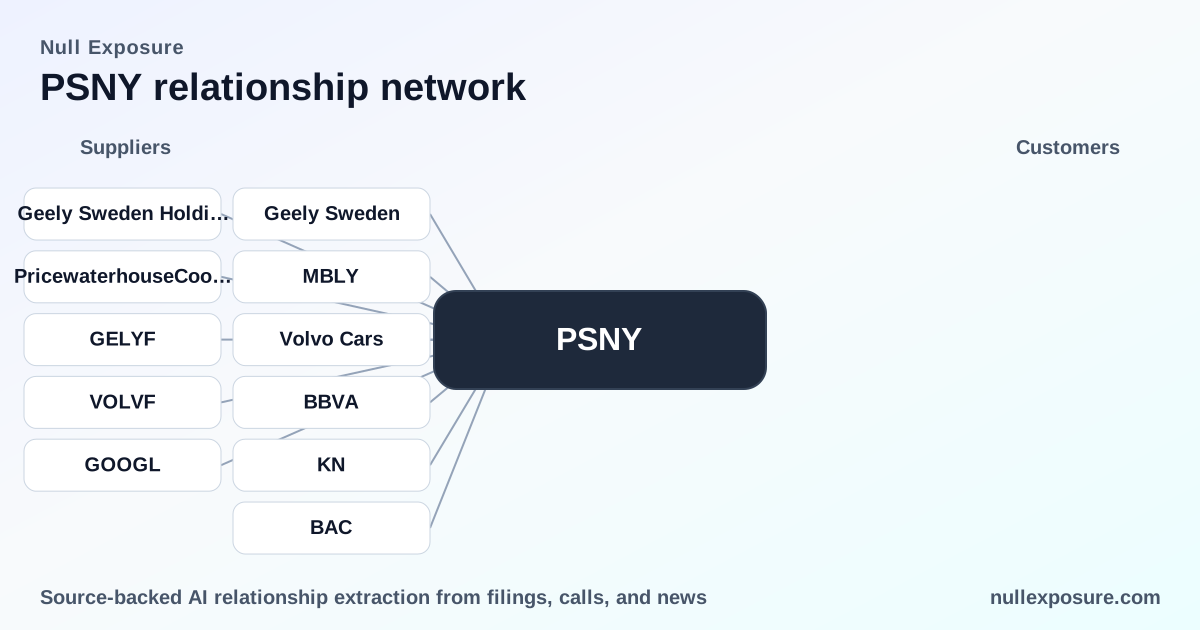
Polestar (PSNY) supplier relationships: capital backstops, technology partners, and service networks that drive the business
Polestar builds and monetizes a premium electric-vehicle franchise by selling performance EVs, recurring service and software subscriptions, and using targeted financing to extend runway for product expansion. The company converts upstream support—capital from strategic shareholders and loan facilities—plus technology alliances for software and autonomous features, into higher vehicle sales and broader service coverage that drive near-term revenue and optionality for scale. For investors, supplier and partner relationships are material to liquidity, time-to-market, and the margin profile of Polestar’s growth strategy. Visit the Nillexposure homepage for deeper supplier intelligence: https://nullexposure.com/
Why supplier ties are a strategic asset for Polestar
Polestar’s commercial model depends on three relationship vectors: capital providers that underwrite development and liquidity, technology partners that accelerate product differentiation, and service networks that protect the customer experience. The balance across these vectors determines whether Polestar converts rising European demand into sustainable margins or remains structurally capital-hungry. The company’s financials show negative EBITDA and persistent losses, so partner funding and service/tech alliances are not optional—they are decisive.
Mid-read: examine the full supplier register and context at https://nullexposure.com/ to assess counterparty risk and concentration.
Catalog of material supplier relationships (what investors need to know)
Geely Sweden
Polestar’s financing narrative includes large credit support from Geely Sweden, notably a prior US$600 million loan facility referenced alongside a December 2025 private placement; these facilities are core to short-term liquidity and strategic alignment. Source: Sahm Capital coverage, December 2025.
Mobileye (MBLY)
Polestar is cooperating with Mobileye on autonomous-driving elements for the Polestar 4, signaling Polestar’s strategy to outsource complex ADAS capability to an established supplier rather than build wholly in-house. Source: MarketBeat reporting on Polestar product strategy, February 2026.
Volvo Cars
Polestar leverages the Volvo Cars service network to broaden its service footprint; Polestar customers access more than 1,200 Volvo service points, which materially reduces Polestar’s own capital outlay for service infrastructure while improving coverage for buyers. Source: MarketBeat product-offensive coverage, February 2026.
Banco Bilbao Vizcaya Argentaria (BBVA)
BBVA committed to a portion of Polestar’s December 2025 equity financing, contributing $150 million to the announced $300 million placement, representing important third-party institutional backing for the company’s stated growth runway. Source: Sahm Capital reporting on the December 2025 financing.
Natixis (KN)
Natixis joined BBVA in committing $150 million to Polestar’s $300 million equity financing, adding diversified banking participation to the placement and improving the company’s liquidity profile for FY2026. Source: Sahm Capital coverage of the December 2025 financing.
BofA Securities (BAC)
BofA Securities is serving as Polestar’s exclusive financial advisor on a USD 400 million equity financing announced in FY2026, which places a recognized investment bank at the center of capital markets execution and strategic funding negotiations. Source: Polestar press release shared via Seeking Alpha, FY2026.
Geely Sweden Holdings AB
As part of balance-sheet remedies, Geely Sweden Holdings agreed to convert approximately $300 million of outstanding principal and interest owed by Polestar into equity, a restructuring action that materially affects leverage and shareholder composition. Source: Sahm Capital recap, FY2025.
Geely (GELYF)
Polestar continues to lean on capital and engineering support from Geely’s broader group, using parent-group resources to prioritize refreshed models and conserve cash while pushing European sales, a practical choice that trades faster commercialization for some dependence on parent support. Source: IBTimes Australia analysis of FY2026 sales and model strategy.
PricewaterhouseCoopers (PwC)
Polestar announced a change in independent auditors to PricewaterhouseCoopers effective after approval at the 2026 annual general meeting, a governance action that investors should view as a signal on financial reporting oversight and auditor confidence. Source: IBTimes Australia coverage, FY2026.
Volvo (VOLVF)
Beyond service points, Volvo as a technology and brand partner underpins Polestar’s premium positioning and sustainability messaging; Polestar emphasizes advanced technology sourced from the Volvo-Geely ecosystem as a competitive differentiator. Source: IBTimes Australia product and strategy review, FY2026.
Google (GOOGL)
Polestar highlights the Polestar 2 as the original “car with Google built in,” reflecting a software-and-cloud partnership that embeds Google services and enhances user experience—an important software-driven revenue and retention lever as Polestar moves more features into connected offerings. Source: MarketBeat reporting, February 2026.
Operating-model constraints and company-level signals
The relationship record did not include formal constraint excerpts; company-level signals are therefore the best available indicators of Polestar’s operational posture:
- Contracting posture: Polestar relies on a mix of equity placements and convertible loan conversions rather than long-term unilateral cash generation, indicating a financing-dependent growth posture. This is visible in December 2025 placement activity and loan-to-equity conversions reported in FY2025–FY2026.
- Concentration and control: Insider ownership is extremely high (82.7%) while institutional ownership is low (3.0%), producing concentrated control that reduces free-float liquidity and can amplify the effect of strategic decisions driven by controlling shareholders.
- Criticality of partners: Technology and service partners—Google, Mobileye, Volvo/Volvo Cars—are operationally critical, enabling capabilities (software, autonomy, and service coverage) that Polestar does not fully own.
- Maturity and governance signals: Transitioning auditors to PwC and retaining an exclusive financial advisor for large financings point to active governance and market-facing capital strategy adjustments as the company scales.
Investment implications: what operators and investors should watch
Polestar’s supplier map shows a company managing growth by outsourcing complexity and leaning on parent-group capital. For investors and operators, the decisive items are:
- Liquidity pathway: Monitor the execution of announced financings and any future conversions of related-party debt into equity; these determine solvency and flexibility.
- Tech partnership execution: Mobileye and Google relationships accelerate product differentiation but require tight program management to translate into sellable features on schedule.
- Service-capacity leverage: Access to Volvo Cars’ service points reduces capital expenditure but creates dependency on another entity’s operational performance.
Key risks in one line: capital dependency, concentrated insider control, and execution risk on tech partnerships.
Final call to action: for a deeper supplier-risk profile and counterparty scoring on PSNY, consult the full analysis at https://nullexposure.com/
Polestar has assembled the right mix of capital and technology partners to scale sales; the next six to twelve months will determine whether those relationships convert growth into sustained profitability or simply extend a capital-intensive growth arc. Revisit our supplier intelligence hub for updated relationship monitoring: https://nullexposure.com/