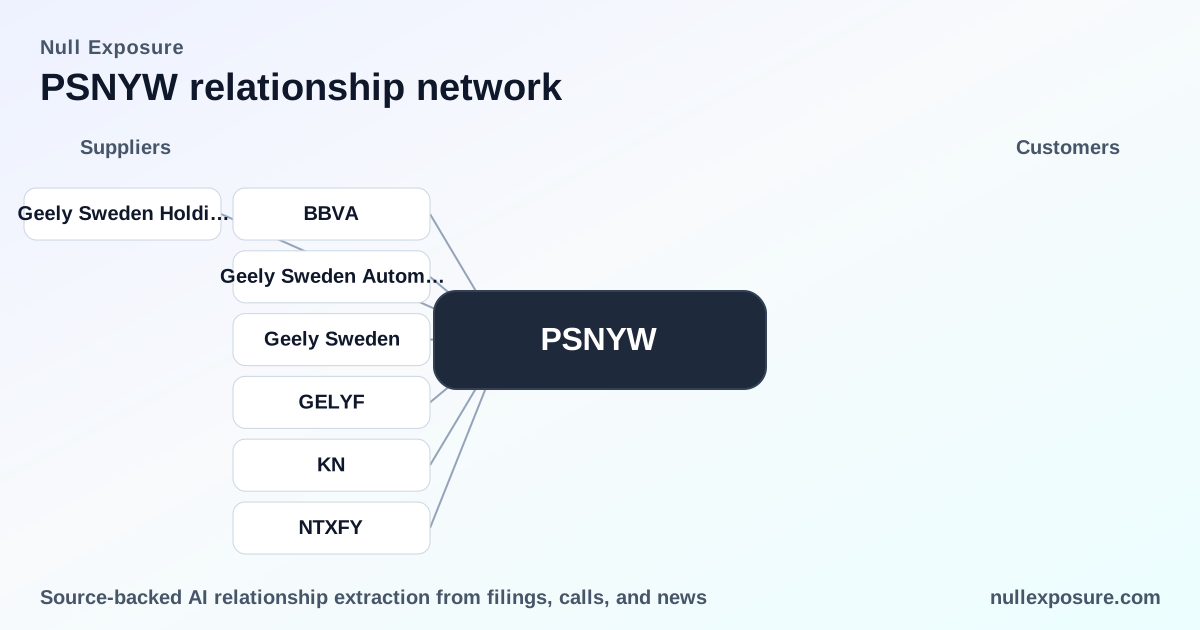
Polestar (PSNYW) supplier map: capital partners, guarantees and what they mean for counterparties
Polestar monetizes through the sale of premium electric vehicles and related connectivity services, leveraging Volvo/Geely engineering and scale while positioning as a distinct performance brand. Revenue is generated primarily from vehicle sales (Revenue TTM: $2.548 billion) and the balance sheet is actively managed through a mix of equity injections and linked financing from strategic partners to bridge scaling losses and inventory build-up. For suppliers and contract counterparties, the practical story is liquidity support from related parties and financial institutions that directly affect payment certainty and procurement runway.
If you want a concise counterparty risk brief on suppliers and counterparties, start here: https://nullexposure.com/
What the counterparty map looks like and why each relationship matters
Below are the counterparties identified in public reporting and news coverage around Polestar’s capital moves in FY2026, each with a short plain-English takeaway and the source.
-
Banco Bilbao Vizcaya Argentaria S.A. (BBVA) — BBVA participated in a $300 million private placement alongside Natixis and also filed a Schedule 13G showing an 8.4% holding in Class A ADSs, indicating both capital support and a material equity stake. According to a TS2 Tech report (FY2026), BBVA is a $150 million investor in the December equity financing and later disclosed a 7,755,946-ADS stake in a 13G filing (Dec. 2025 / FY2026).
-
Natixis — Natixis matched BBVA’s commitment with a $150 million investment in the same $300 million private placement, forming a bilateral bank-backed equity tranche that strengthens liquidity in the short term. TS2 Tech and related coverage note Natixis’s $150 million contribution to the December 2025 financing (FY2026).
-
Geely Sweden Automotive Investment AB — Geely Sweden Automotive Investment provided a $600 million term loan facility that includes a $300 million committed tranche and a second $300 million uncommitted tranche requiring lender consent; the loan documentation also contains a put option tied to ADS resale mechanics. News coverage in TS2 Tech and SimplyWall.St (FY2026) describes the $600 million facility and the put-option mechanics (Dec. 2025 / FY2026).
-
Geely Sweden (group reference in filings) — Public summaries of the December capital structure reference a $600 million loan facility and a $300 million private placement that are “highly relevant” to liquidity and runway, tying Polestar’s financing to Geely Sweden entities. SimplyWall.St summarized these capital injections as central to the December 2025 recapitalization (FY2026).
-
Geely Sweden Holdings AB — A wholly owned subsidiary of Geely Sweden Holdings AB is named in disclosure language as party to put-option arrangements that backstop the equity tranche, creating a structured exit mechanism for bank investors. TS2 Tech reporting (FY2026) references the put option arrangements involving the Geely Sweden Holdings AB subsidiary (Dec. 2025 / FY2026).
-
Geely (Geely Automobile Holdings Ltd / Geely group) — Polestar continues to depend on majority owner Geely for capital and supply-chain scale; commentators highlight a broader $900 million package and ongoing strategic support that preserve manufacturing and component sourcing continuity. FinancialContent and other market coverage cite Geely’s role in financing and supply-chain leverage (FY2026).
Operating posture and business-model signals suppliers need to know
Polestar’s operating model combines growth-stage margin pressure with strategic, high-criticality relationships to Geely and a small set of financial partners:
-
Contracting posture: Polestar uses a mix of committed and uncommitted facilities. The $600 million loan from Geely Sweden Automotive Investment AB has a committed $300 million tranche and an uncommitted $300 million tranche, implying conditional access to the additional capital and the need for continued covenant compliance or lender consent.
-
Concentration: Funding concentration is high — a small number of strategic players (Geely and affiliated entities, plus two banking investors) account for the bulk of the recent liquidity support. That concentration elevates counterparty importance for suppliers: changes in Geely’s posture or bank sentiment will materially shift Polestar’s liquidity.
-
Criticality: The relationships are mission-critical. Geely’s operational support not only supplies capital but underpins procurement and engineering scale; the presence of put-option mechanics with Geely-affiliates also affects shareholder and creditor incentives.
-
Maturity/sophistication: The financing package includes hybrid structures (equity private placement combined with lender consent tranches and put-option guarantees), signaling an advanced, sponsor-backed liquidity strategy rather than simple vanilla bank lending.
These are company-level signals: no external constraint warnings are recorded in the public constraints set, leaving these relationship dynamics as the primary operational levers visible to suppliers and partners.
If you’re mapping counterparty exposure across your supplier book, get the full brief at https://nullexposure.com/
Deal mechanics to watch — practical implications for suppliers and ops
-
Put options and exit routes: The put option granted to BBVA (and mirrored mechanics for equity investors) gives those banks the right to sell ADSs back to a Geely-affiliated entity at a pre-set price after a multi-year term. That creates a structured liquidity backstop for the banks but also a potential transfer of economic control depending on execution — TS2 Tech coverage describes the put option terms and the three-year window (FY2026).
-
Uncommitted tranche risk: Because half of the Geely loan facility is uncommitted, suppliers should model scenarios where that tranche is withheld. This is not hypothetical; SimplyWall.St and other coverage highlight the split between committed and consent-driven capital (FY2026), which directly affects Polestar’s near-term procurement capacity.
-
Equity stake disclosures influence market pricing: BBVA’s Schedule 13G disclosure (8.4% of Class A ADSs) can change market dynamics and investor behavior; Polestar’s share liquidity and cost of capital are sensitive to these block holdings, per TS2 Tech reporting (Dec. 31, FY2026).
Bottom line for investors and procurement officers
Polestar’s short-term liquidity is materially supported by Geely and two European banks (BBVA, Natixis), but the structure includes conditional tranches and put-option mechanics that concentrate downside and strategic control in sponsor hands. For suppliers, the operative conclusion is straightforward: maintain tight receivables governance and prioritize direct confirmation of payment terms tied to committed funding tranches.
For a tactical supplier risk playbook and counterparty monitoring tools, see our portal: https://nullexposure.com/
Key takeaway: Polestar has secured lifeline capital that stabilizes operations, but the mix of committed and uncommitted financing plus sponsor-backed exit options creates a dual reality — operational continuity so long as sponsor alignment holds, and material risk if that alignment changes.
If you want a tailored counterparty brief for your exposure to Polestar or similar OEMs, return to the home page and request a supplier risk scan at https://nullexposure.com/