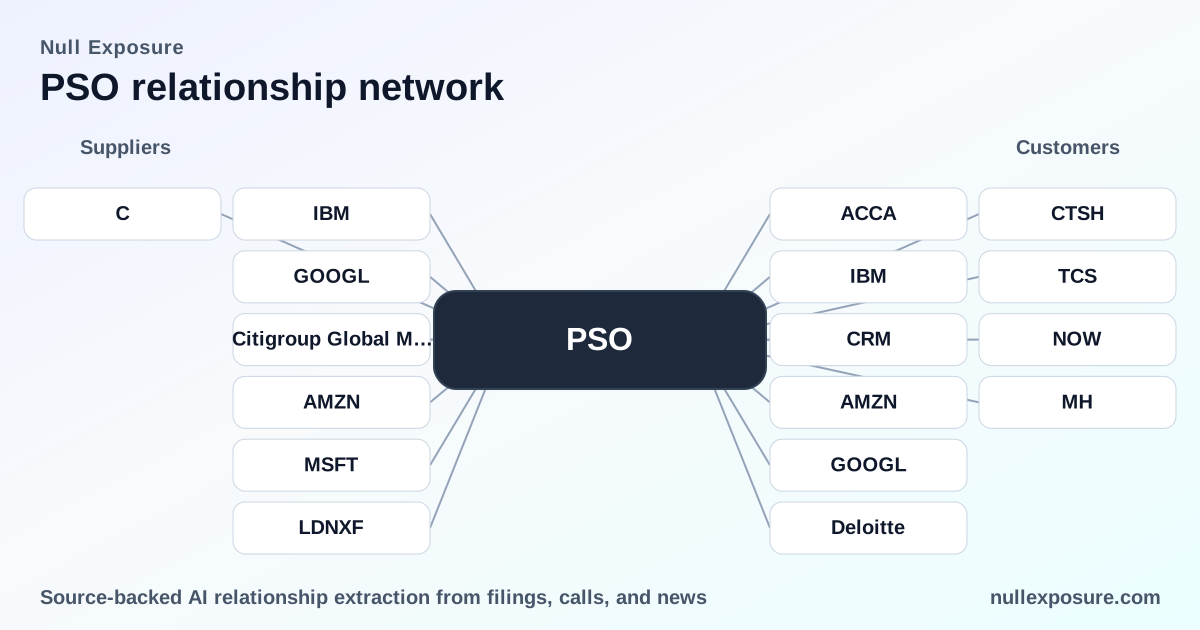
Pearson (PSO) — Supplier mapping and what counterparty relationships mean for investors
Pearson is a global provider of educational content, assessment services and learning technologies that monetizes through recurring assessment contracts, subscription and licensing revenue for digital learning products, and professional testing services. Revenue is driven by scale in assessments and platform delivery, while margins are supported by digital mix and third‑party cloud/technology partnerships that underwrite product functionality. For investor and operator teams, understanding Pearson’s supplier posture is essential because its execution depends on a handful of technology and capital‑markets counterparties that enable AI capabilities, cloud hosting, test delivery and liquidity for share‑buyback execution. Learn more at https://nullexposure.com/.
Quick financial context for counterparty risk
Pearson’s FY metrics show £3.577bn (USD equivalent) in trailing revenue and an operating margin around 15%, with a market capitalization near $8.3bn and a forward P/E in the mid‑teens—numbers that position the company as a mid‑cap, tech‑enabled publishing and assessment operator. These financials indicate sufficient scale to contract with global cloud and consulting firms, while profit margins create room for technology spend. Use this supplier map to translate those financial characteristics into operational exposure.
Supplier map: the counterparties that appear in recent disclosures and news
Below are the relationships surfaced in public filings and press reports. Each relationship is summarized in plain English with a concise source citation.
-
IBM — Pearson has engaged IBM to build a custom AI learning platform that blends human expertise and AI assistants to increase productivity and workflow automation; the initiative is framed as an IBM Consulting‑style engagement reported in December 2025. Source: Sahm Capital news coverage, December 11, 2025 (https://www.sahmcapital.com/news/content/ibm-and-pearson-aim-to-help-workers-keep-up-as-ai-redefines-jobs-2025-12-11).
-
Google Cloud — Pearson Professional Assessments (formerly Pearson VUE) was selected as the test delivery provider for Google Cloud certification exams, positioning Pearson as a delivery partner for one of the largest cloud vendor certification programs. Source: Finviz trading update, FY2026 (https://finviz.com/news/275656/pearson-2025-trading-update-unaudited).
-
Amazon (AWS) — Pearson uses Amazon’s engineering services and presumably AWS platform capabilities for content generation and AI tooling, cited in the company’s earnings call commentary on AI‑enabled product deployments. Source: Earnings call transcript Q4 2025, InsiderMonkey (FY2026 commentary) (https://www.insidermonkey.com/blog/pearson-plc-nysepso-q4-2025-earnings-call-transcript-1708138/).
-
Microsoft — Pearson consumes Microsoft engineering services and platform functionality such as Azure and text/model services (Bedrock) as part of AI product development and deployment, per management remarks in the quarterly call. Source: Earnings call transcript Q4 2025, InsiderMonkey (FY2026 commentary) (https://www.insidermonkey.com/blog/pearson-plc-nysepso-q4-2025-earnings-call-transcript-1708138/).
-
Citigroup Global Markets Limited — Citigroup has acted as the executing broker for Pearson share repurchases on the London Stock Exchange, documented through multiple regulatory notices in early 2026 that record ordinary‑share purchases executed via Citigroup. Source: Reuters regulatory notices published on TradingView / Reuters, January–February 2026 (examples: Jan 23 2026 and Jan 29 2026 filings) (https://www.tradingview.com/news/reuters.com,2026-01-23:newsml_RSW0469Qa:0-reg-pearson-plc-transaction-in-own-shares/; https://www.tradingview.com/news/reuters.com,2026-01-29:newsml_RSc8102Qa:0-reg-pearson-plc-transaction-in-own-shares/; Feb 19 2026 filing https://www.tradingview.com/news/reuters.com,2026-02-19:newsml_RSS5753Ta:0-reg-pearson-plc-transaction-in-own-shares/).
-
London Stock Exchange — Pearson executed share purchases on the London Stock Exchange, with trading and disclosure routed through the exchange as part of registered buyback activity. Source: Reuters regulatory notice (January 2026) published on TradingView (https://www.tradingview.com/news/reuters.com,2026-01-23:newsml_RSW0469Qa:0-reg-pearson-plc-transaction-in-own-shares/).
What these relationships imply about Pearson’s operating model
-
Contracting posture: Pearson operates as a strategic buyer of high‑quality cloud, AI and consulting services; contracts with IBM, Microsoft, Google Cloud and AWS indicate negotiated, enterprise‑grade engagements rather than isolated spot purchases. These are high‑value, multi‑year technology relationships that embed third‑party capabilities into customer‑facing products.
-
Concentration and criticality: Cloud and AI services are critical to product differentiation and delivery. A small set of hyperscale cloud partners (Microsoft, Amazon, Google Cloud) covers core infrastructure and certification delivery; that concentration elevates vendor dependence and puts emphasis on SLAs, data portability and multi‑cloud resilience.
-
Maturity: Relationships span established corporate vendors (IBM consulting, Citigroup broker services, London Stock Exchange execution) and hyperscalers, indicating a mature supplier ecosystem typical of a global enterprise transitioning towards AI‑enabled services.
-
Operational levers: The brokered buybacks via Citigroup and exchange activity show capital markets counterparties are integrated into corporate capital allocation execution—a separate but material supplier relationship for governance and market signaling.
(There were no explicit constraints recorded in the supplier feed for Pearson, which is itself a company‑level signal: public sources did not report contractual restrictions or supplier litigation in this collection. Treat the absence of reported constraints as neutral — it is not evidence of zero risk, but it signals that public filings and news in the sample did not highlight supplier‑side bottlenecks.)
Explore how we track counterparties and implications for due diligence at https://nullexposure.com/.
Investment implications — where to focus due diligence
-
Operational concentration risk: The reliance on multiple hyperscalers for AI, content generation and certification delivery creates a dependency cluster; procurement and IT resilience plans should prioritize multi‑region, multi‑cloud fallbacks and contractual exit terms with major providers.
-
Execution risk tied to assessments: Pearson’s role as Google Cloud’s chosen test‑delivery partner is commercially significant because professional assessment contracts drive recurring revenue and unit economics; ensure test‑delivery SLAs and fraud‑prevention capabilities are contractually robust.
-
Capital allocation dependencies: Use of Citigroup and the London Stock Exchange for buybacks signals active capital management; investors should monitor repurchase cadence and understand broker engagement terms and execution costs as part of governance scrutiny.
-
Technology spend vs. margin profile: With operating margins near 15% and digital revenue mix, continued investment in AI and cloud is feasible, but the company must sustain margin improvement to justify elevated technology spending.
If you want a deeper counterparty scoring model or primary‑source tracking for PSO counterparties, start with our supplier risk dashboard at https://nullexposure.com/.
Actionable next steps for investors and procurement teams
- For investors: request disclosure on key vendor contract lengths, termination rights and SLA credit regimes for AI and cloud partners; quantify the revenue contribution tied to the Pearson Professional Assessments relationship with Google Cloud.
- For procurement and ops: validate contingency plans for multi‑cloud failover and vendor performance testing, and confirm broker agreements for share‑buyback execution include best‑execution benchmarks.
- For governance: track buyback execution and related counterparty fees disclosed in regulatory notices to evaluate capital allocation efficiency.
Access our platform for supplier‑level alerts and relationship monitoring at https://nullexposure.com/.
Final takeaways
Pearson is a digitally transforming education and assessment business whose operational effectiveness is materially influenced by a small number of strategic technology and capital‑markets partners. Investors and operators should treat cloud and testing‑platform relationships as core counterparties when assessing execution risk, while recognizing that public filings show active capital management via established broker/exchange channels. Concentration, criticality and contract maturity are the three lenses that should drive supplier due diligence for PSO.