PSQ Holdings (PSQH) — supplier relationships, strategic posture, and investor implications
PSQ Holdings operates a consumer-facing app and website that connects politically aligned consumers to businesses and local communities and is building a fintech-enabled commerce ecosystem by acquiring payments and credit software. The company monetizes through platform engagement and fintech product revenue enabled by strategic asset acquisitions and capital raises that fund expansion. Investors should evaluate PSQH not only as an app operator but as a small-cap fintech consolidator whose supplier and capital relationships directly affect growth, financing cost, and operational continuity.
Learn more about supplier intelligence and how it informs deal and portfolio decisions: https://nullexposure.com/
What the headline supplier signals tell investors about PSQH’s operating model
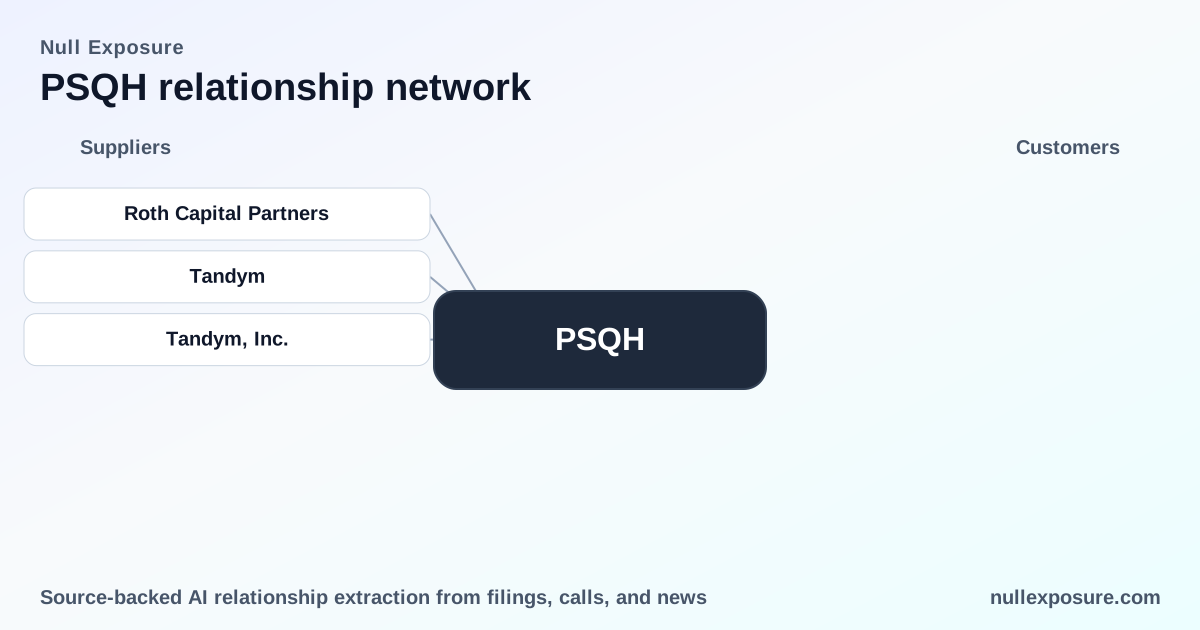
PSQH is a small-cap, high-growth posture operator (market cap roughly $32m, negative EBITDA) that is actively using external capital and third-party software to scale. The public record shows two distinct supplier/partner relationships: a capital markets placement agent and an acquired fintech software vendor. Together they reveal a company relying on external funding and purchased technology to accelerate product capability and topline growth.
Company-level constraints extracted from supplier intelligence add important context as neutral signals of operational risk and supplier roles:
- The firm-level notes emphasize a North America–centric supply footprint, which signals regional concentration for fulfillment and vendor management.
- A constraint flagged vendors as potentially sole-source or one of a limited number of suppliers, a direct indicator of supplier concentration and operational criticality.
- Relationship roles captured in the intelligence categorize suppliers broadly as manufacturers and service providers, implying PSQH’s operations depend on both physical/logistics partners and outsourced technology or payment services.
Taken together, these points describe a contracting posture that tilts toward strategic outsourcing: PSQH acquires and integrates third-party software while leaning on placement agents and other service providers for fundraising and operations. That posture accelerates capability but increases vendor concentration and single-source risk relative to in-house builds.
Public supplier relationships you need on the radar
Roth Capital Partners — placement agent for a registered direct offering
Roth Capital Partners acted as exclusive placement agent for a registered direct offering that PSQH announced in December 2025, a relationship that signals continued reliance on external capital markets to fund growth and acquisitions. (BusinessWire press release, Dec 18, 2025 — https://markets.financialcontent.com/wral/article/bizwire-2025-12-18-publicsquare-announces-75-million-registered-direct-offering)
Tandym, Inc. — acquisition of key software assets (press release)
PSQH entered into an agreement to acquire key software assets from Tandym, Inc., adding virtual and private-label credit card capabilities to its fintech stack and expanding product monetization options for merchant partners and consumers. (BusinessWire press release, Nov 10, 2025 — https://markets.financialcontent.com/stocks/article/bizwire-2025-11-10-publicsquare-to-acquire-assets-of-tandym-adding-virtual-and-private-label-credit-cards-to-its-growing-fintech-ecosystem)
Tandym — market reaction and transaction framing
The market reaction captured in coverage noted PSQH shares jumped over 10% in pre-market trading on news of acquiring Tandym’s software assets, underscoring investor recognition that embedded-payments and branded-card capabilities are material to the company’s growth story. (StockTwits market report, contemporaneous coverage — https://stocktwits.com/news-articles/markets/equity/psqh-soars-10-pre-market-as-it-signs-deal-to-buy-software-assets-from-tandym/cLPc03kRE2b)
Why these supplier ties matter for valuation and risk assessment
- Capital dependency is explicit. The Roth placement relationship confirms PSQH will use third-party capital raises to fund scale and acquisitions; that raises dilution and execution risk for equity investors if future raises are frequent. The placement-agent relationship is a standard capital markets lever, but it also means funding cadence will materially influence the growth trajectory.
- Technology acquisition accelerates monetization but increases integration risk. The Tandym asset purchase is a revenue-positive strategic move—embedded payments and branded credit cards directly enlarge monetization pathways—yet success depends on integration, regulatory compliance, and partner acceptance.
- Supplier concentration and criticality are real operational risks. Company-level constraints note vendors can be sole-source and that PSQH’s supply footprint is North American-focused; these signals indicate single points of failure in both fulfillment and vendor-provided services.
- Small-cap operating maturity. Financials (negative EBITDA, modest revenue base) show PSQH is still in an early, investment-intensive phase. That profile amplifies sensitivity to supplier disruptions and capital-market conditions.
Mid-deal diligence and ongoing monitoring should emphasize contractual terms, service-level commitments, and fallback options for any vendor deemed critical. Learn how supplier relationships feed into operational risk scoring: https://nullexposure.com/
Practical takeaways for investors and operators
- Demand transparency on vendor concentration and contingency plans. For every critical supplier (including the Tandym asset integration), request clarity on exclusivity, termination rights, and transition plans.
- Clarify the economics of the Tandym assets. Investors should ask management for defined revenue forecasts and integration milestones tied to the acquired software, and for a cost/benefit timeline showing when the acquisition contributes net positive EBITDA.
- Monitor funding cadence and dilution sensitivity. The Roth-facilitated offering is a clear signal that management will access public markets; model multiple financing scenarios and their impact on equity value.
- Stress-test operational continuity. Given the North American supplier concentration and sole-source signals, operational due diligence should cover alternative suppliers, 3PL redundancy, and regulatory compliance pathways for payment products.
Final recommendation: what to do next
For portfolio managers and operators assessing PSQH, the immediate priorities are (1) obtain contractual details on the Tandym asset transfer and implementation timetable, (2) get the placement-agent engagement letter and use-of-proceeds for recent offerings, and (3) validate vendor contingency planning for any critical service providers. Each step materially alters downside exposure and upside realization.
For deeper supplier and counterparty visibility that supports these next steps, explore supplier intelligence and monitoring tools at https://nullexposure.com/. Investing in granular supplier information will materially improve your ability to size risk and value PSQH’s strategic moves.