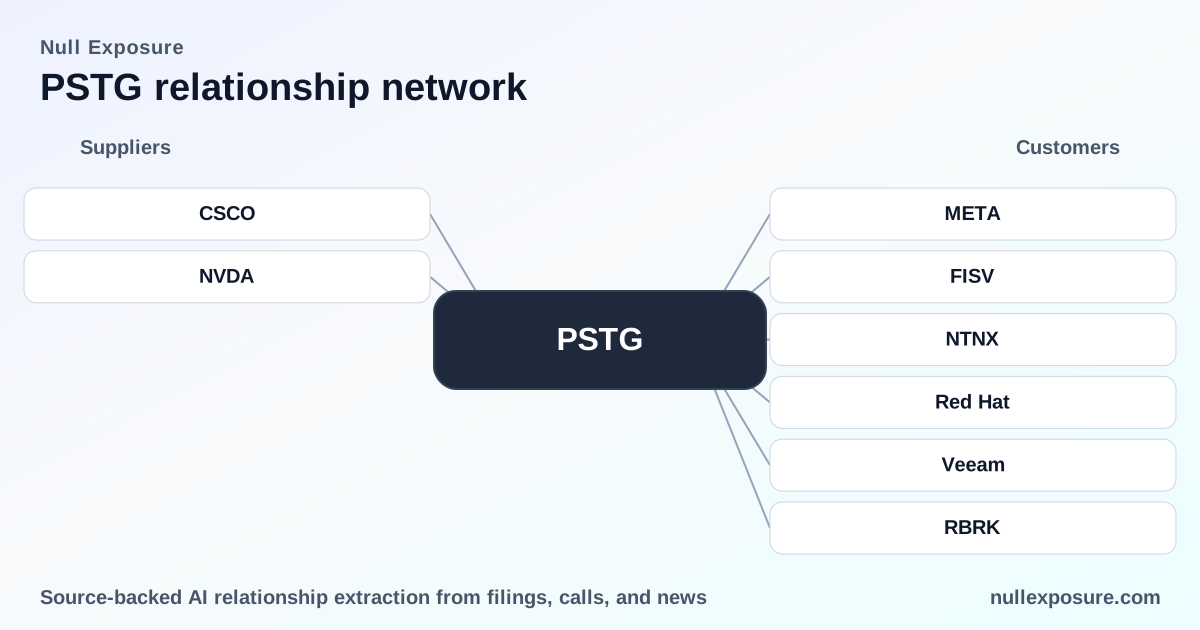
Pure Storage (PSTG): supplier relationships that enable its AI & storage value chain
Pure Storage builds and sells all-flash data storage arrays and data management software, monetizing through product sales, recurring software subscriptions, and professional services. The company packages its software with partner accelerators and networking to deliver AI-ready systems that command premium pricing and subscription revenue. Investors should evaluate supplier relationships for insights on product differentiation, supply-chain concentration, and geopolitical sourcing risk. For an at-a-glance supplier intelligence view, visit https://nullexposure.com/.
How Pure’s go-to-market maps to supplier risk and value
Pure’s business model blends recurring software economics with hardware cycles. The company reported Revenue TTM of $3.66B and Gross Profit TTM of $2.58B, demonstrating healthy software-driven margins but ongoing dependence on hardware components and partner hardware stacks. Pure’s ability to sustain subscription growth relies on tight integrations with third‑party accelerators and networking vendors, and on reliable contract manufacturing to produce hardware to spec. This creates a dual exposure: commercial dependency on ecosystem partners for product features and operational dependency on external manufacturers and cross-border suppliers for components.
For tailored supplier diligence and supplier risk scoring, see https://nullexposure.com/.
What the public record shows about specific supplier relationships
Pure’s recent product announcements and press reporting explicitly tie its software to third‑party hardware from Cisco and NVIDIA. The following captures every relationship referenced in the available reporting.
Cisco Systems — networking partner on AI-ready appliances
Pure’s AI-focused product references high-speed networking provided by Cisco Systems alongside Pure’s data management software, indicating Cisco supplies critical networking fabric for the combined solution. According to news coverage on March 10, 2026, the product bundles Cisco networking as part of an integrated offering. (Finviz and The Globe and Mail, March 10, 2026).
NVIDIA — accelerator provider for the AI stack
Pure’s product also incorporates an NVIDIA AI accelerator, positioning NVIDIA GPUs as the compute engine for workloads that run on Pure’s storage and data management software. Coverage from March 10, 2026 identifies NVIDIA as the accelerator supplier in the joint solution. (Finviz and The Globe and Mail, March 10, 2026).
What these supplier ties mean for investors: concentration, criticality, and contracting posture
Pure’s product design places third‑party hardware vendors at the heart of its AI offering, which is an intentional commercial strategy: partner accelerators and networking increase solution value and accelerate enterprise adoption. That dynamic yields three clear investor implications:
- Concentration of technology partners is high for AI solutions. The integration with NVIDIA GPUs and Cisco networking creates a concentrated supply and go‑to‑market posture where a small set of suppliers materially influence product capability and time-to-market.
- Criticality of partners is elevated. For AI workloads, the accelerator and high-speed networking are not optional add-ons; they are core to the product value proposition. Supplier performance, pricing, and availability directly affect Pure’s product competitiveness and revenue realization.
- Contracting posture relies on specification-driven contract manufacturing. Pure discloses that it uses contract manufacturers to assemble and test products to Pure’s specifications, signaling an outsourced manufacturing model rather than in-house production — a company-level operating choice that drives flexibility but requires active supplier governance.
These drivers amplify both upside (faster innovation and customer adoption) and downside (supplier shortages, pricing pressure, or partner strategy shifts).
Sourcing and geopolitical constraints to factor into diligence
Pure discloses sourcing of some product components from suppliers outside the United States, including from China, which creates logistical and regulatory exposure for investors. This company-level signal should be read with the following implications:
- Logistics and regulatory risk are non-trivial. Cross-border component sourcing increases exposure to shipping disruptions, tariffs, export controls, and compliance burdens in APAC jurisdictions.
- Operational resilience depends on contract manufacturing and alternative sourcing. The company’s reliance on contract manufacturers emphasizes the need for visible multi-sourcing strategies and contingency planning to avoid single-point failures.
These constraints are company-level signals and should be applied across supplier diligence rather than attributed to any single partner unless an explicit excerpt names that partner.
Financial context that frames supplier importance
Pure’s financials underscore the stakes of supplier performance: operating margin TTM of 8.23%, profit margin of 5.14%, and a market capitalization near $20.75B. The firm posts strong returns on equity and a high valuation multiple (trailing P/E 114x, forward P/E ~29.9x), reflecting growth expectations tied to software uptake and AI deployments. Supplier interruptions that slow product shipments or increase component costs would pressure margins and growth, while successful supplier integrations that accelerate adoption would reinforce the premium valuation.
Midway diligence step: if you are comparing supply‑chain exposures across vendors or need a supplier risk scorecard for PSTG, consult https://nullexposure.com/ to see structured intelligence and relationship mapping.
Practical investor checklist for PSTG supplier exposure
- Confirm contractual terms with major partners for supply continuity, pricing protections, and product roadmaps that affect Pure’s bundled offerings.
- Verify manufacturing footprints and redundancy for contract manufacturers, particularly for components sourced in APAC or China.
- Track partner go‑to‑market alignment with NVIDIA and Cisco: co‑selling arrangements, certification timelines, and dependency on partner hardware releases.
- Monitor export controls and regulatory developments that could affect cross-border component flows or the ability to ship AI systems with certain accelerators.
Final assessment and recommended next steps
Pure’s commercial strategy leverages high-value partnerships with NVIDIA and Cisco to deliver differentiated AI-ready storage solutions, while adopting an outsourced manufacturing model that enables scale but concentrates operational risk. The combination of technical partnership concentration and APAC component sourcing demands active supplier governance and contingency planning from management — and active monitoring from investors.
For continuous supplier intelligence, integration tracking, and to compare PSTG’s supplier posture against peers, start your analysis at https://nullexposure.com/.