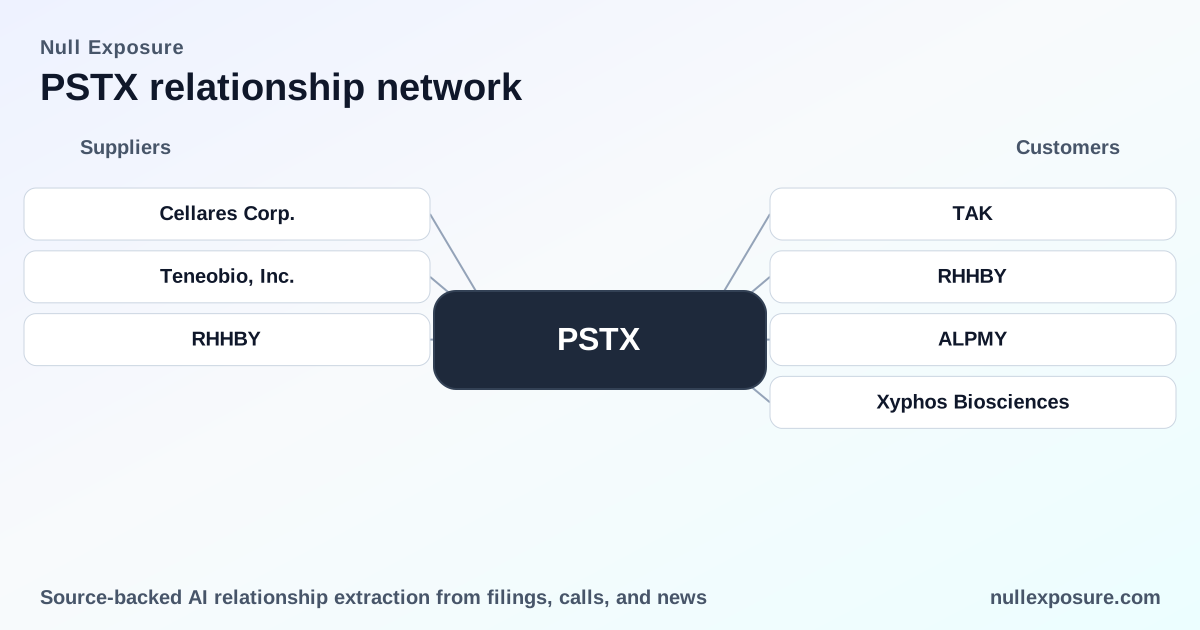
Poseida (PSTX) as a supplier counterparty: commercial partners, strategic bets, and what they mean for investors
Poseida Therapeutics operates as a developer of engineered cell and gene therapies and monetizes through a mix of clinical-stage asset development, out-licensing, and strategic partnerships that provide technology and manufacturing access. The company’s supplier and partner relationships — spanning discovery platforms, contract manufacturing solutions, and co-development arrangements with large pharma — are core enablers of its clinical programs and potential near-term value realization. For investors assessing counterparty risk and strategic optionality, these relationships reveal a posture that is collaborative, concentrated, and increasingly production-focused. Learn more about supplier intelligence and partner concentration at https://nullexposure.com/.
Why partners matter to Poseida’s operating model
Partners provide Poseida with capabilities it does not own on day one: discovery platforms, specialized automated manufacturing, and scale-up expertise. That combination accelerates development timelines, reduces capital intensity, and effectively outsources points of operational risk. At the same time, a small roster of high-value partners increases concentration risk: if a single partner’s technology or timetable slips, Poseida’s programs tied to that capability feel the impact directly.
A neutral dataset of constraints provided no explicit contract excerpts; as a company-level signal, the absence of visible contracting constraints in public materials implies limited public disclosure of vendor-level contractual terms, which increases the importance of qualitative partner assessment for investors. For deeper supplier-risk profiling, visit https://nullexposure.com/.
All supplier and partner mentions from the public results
Cellares Corp. — Bioworld report on Early Access Partnership (FY2021)
Cellares added Poseida to its Early Access Partnership Program (EAPP) for the Cell Shuttle, giving Poseida access to a highly automated “factory in a box” solution intended to accelerate cell therapy manufacturing. According to Bioworld (article, March 2026), this relationship positions Poseida to leverage Cellares’ automated manufacturing platform as part of its development strategy. https://www.bioworld.com/articles/509546-cellares-launches-new-cell-shuttle-partnership
Cellares Corp. — DrugDiscoveryTrends coverage of the same partnership (FY2021)
An industry outlet described the same collaboration as part of Cellares’ program to accelerate cell therapy manufacturing, emphasizing operational speed and throughput benefits for Poseida’s cell therapy programs. DrugDiscoveryTrends’ coverage (March 2026) highlights the practical manufacturing uplift Poseida gains from participating in the EAPP. https://www.drugdiscoverytrends.com/cellares-and-poseida-partnership-aims-to-accelerate-cell-therapy-manufacturing/
Teneobio, Inc. — GlobeNewswire release on UniDab licensing (FY2018)
Under a 2018 agreement, Teneobio generated UniDab candidates using its UniRat platform and granted Poseida exclusive global licensing rights to specific UniDab molecules for CAR‑T therapy development, giving Poseida access to novel antibody modalities for cell therapy targeting. The GlobeNewswire press release (August 2018) documents how this discovery-stage partnership feeds Poseida’s therapeutic pipeline. https://www.globenewswire.com/news-release/2018/08/07/1548014/0/en/Teneobio-and-Poseida-Expand-Their-Partnership-to-Develop-UniDabs-for-Advanced-CAR-T-Therapies.html
Roche — press release on co-development of an allogeneic dual CAR‑T (FY2023)
Poseida and Roche are developing P‑CD19CD20‑ALLO1, an allogeneic dual CAR‑T targeting CD19 and CD20 for B‑cell malignancies, reflecting a strategic collaboration with a major pharmaceutical company on an advanced allogeneic program. A Poseida PR Newswire release (FY2023) identifies Roche as a development partner on this program, underlining the commercial and regulatory heft Roche brings to a complex allogeneic initiative. https://www.prnewswire.com/news-releases/poseida-therapeutics-announces-fda-clearance-of-investigational-new-drug-application-for-p-cd19cd20-allo1-an-allogeneic-dual-car-t-cell-therapy-for-b-cell-malignancies-301868955.html
What these relationships collectively reveal about Poseida’s supplier posture
- Contracting posture: Poseida operates through strategic, technology-focused partnerships rather than vertically integrating every capability. The Cellares EAPP and Teneobio licensing show a preference for access-to-platform arrangements and IP licensing over in-house replication.
- Concentration: The public record lists a small number of materially significant partners—Cellares, Teneobio, and Roche—implying high counterparty concentration around a few specialized suppliers and co-development partners.
- Criticality: Manufacturing and discovery partners are mission‑critical. Cellares’ automated manufacturing capability is essential for timing and cost-control of cell therapy programs, while Teneobio’s discovery platform and Roche’s commercialization heft are pivotal to candidate selection and market pathway.
- Maturity and timeline diversity: Partner engagements span from 2018 (Teneobio discovery licensing) through 2021 (Cellares manufacturing access) to 2023 (Roche co-development), indicating an evolution from early discovery through to scaled manufacturing and co-development for commercialization.
Investment implications and operational risk factors
Poseida’s partner map delivers clear upside: accelerated development, reduced capital outlay, and access to complementary IP and scale. Those benefits come with a concentrated counterparty profile and limited public contract visibility.
Key takeaways for investors:
- Upside driver: Strategic partners materially de‑risk technical execution by supplying specialized capabilities (manufacturing automation, antibody discovery, large‑scale development resources).
- Risk driver: High partner concentration creates single‑point pressures — a manufacturing delay at Cellares or a renegotiation with Roche would have outsized effects on timelines and valuation.
- Disclosure gap: The absence of detailed contract constraints in public materials is a company-level signal that investors must compensate with qualitative diligence (partner track record, service-level expectations, fallback options).
For detailed supplier exposure and counterparty scoring, see the supplier intelligence hub at https://nullexposure.com/.
Bottom line and action steps for investors
Poseida’s supplier relationships are strategically coherent: discovery partnerships feed candidate pipelines, manufacturing alliances compress timelines, and a major-pharma co-development partner lends commercialization credibility. Investors should treat these relationships as both value multipliers and concentration risk points — valuable when partners perform, but material sources of downside if they don't.
To monitor supplier health and partner contract risk, use an evidence-first supplier monitoring approach and review partner operational milestones and regulatory filings. For a tailored supplier risk briefing and ongoing monitoring, visit https://nullexposure.com/.